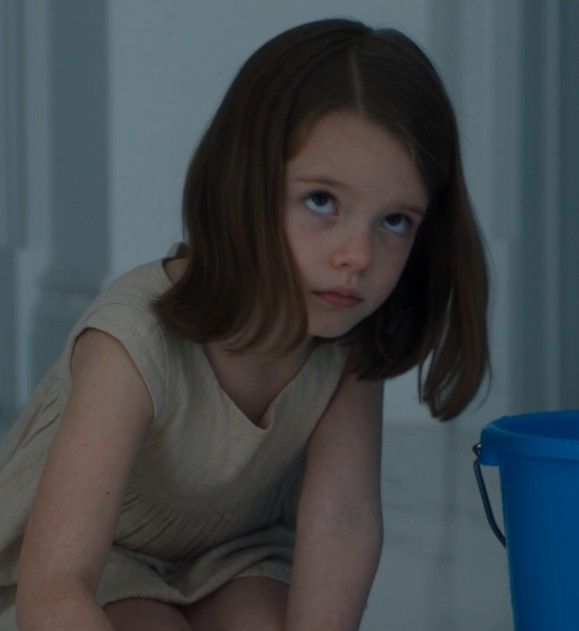
The woman laughed, a brittle, furious sound. “It’s a perfectly good room! It has a bed! She’s a child, she doesn’t need a suite—”
“Her room is the one with the yellow curtains she picked herself,” he said, each word precise. “The one with the bookshelf I built. The one with the window that looks at the oak tree because she likes to watch the birds.”
He turned to Lucy. “Is that where your things are, sweetheart?”
Lucy shook her head once. A single, miserable jerk.
Maria, crying now without sound, added, “Her clothes are in a bag, sir. Her books too. In the laundry.”
Something in his chest caved and then hardened into something like steel.
He stood to his full height, water darkening the knees of his trousers, the gold sign dripping behind him. He looked at the woman who had been smiling in his house, drinking from his glass, telling his daughter to erase her own name.
“You told me you’d love her like your own,” he said. It wasn’t an accusation. It was a quiet, terrible remembering.
“I did love her!” she snapped, and for the first time her voice cracked with real anger, not performance. “I tried! But you bring a child home and expect me to just— to just rearrange my entire life? You were gone! You left me here with her! She cries at night, she wets the bed, she stares at you like you’re a saint and looks at me like I’m nothing!”
Lucy made herself smaller with every word.
He stepped between them without thinking, blocking Lucy from that stare.
“She’s seven,” he said. “She lost her mother. She lost everyone until I found her. And you made her feel like she was a stain on your marble.”
“It’s MY marble too!” the woman shouted, and the glass in her hand sloshed. “You put my name on things! You said this was our house!”
“It was,” he said. “Until you taught a child to scrub her own welcome off the floor.”
He took his phone out again and this time he did call his lawyer. He put it on speaker so there would be no whispers.
“James,” he said, eyes never leaving the woman. “It’s me. I need you to void the cohabitation agreement we drafted last month. Immediately. And I need you to bring the finalized adoption papers to the house today. Now. And bring a witness.”
The woman’s face drained of color.
“You cannot be serious,” she whispered. “Over a sign? Over a misunderstanding?”
“It’s not a sign,” he said. “It’s a child.”
James’s voice came through, professional and alert. “Sir, are you safe? Do you need me to call—”
“I need you to come,” he said. “And after that, I need you to file a trespass notice if she is still here by sunset.”
The woman stared at him as if he had struck her. Then, with the strange, ugly clarity that comes when people realize charm has failed, her face twisted.
“You’ll regret this,” she hissed, but her voice was thin now, shaking. “You think you can just play father? You don’t know how to be a father. You work. You travel. You left her with me because you couldn’t handle her either.”
He didn’t argue. He just bent down again and lifted Lucy up. She was lighter than he remembered, and she went rigid for half a second before her arms, hesitantly, came around his neck. Her dress was damp. Her cheek was cold against his shoulder. She smelled faintly of soap.
“I know I left,” he whispered into her hair, for her ears only. “I’m so sorry I left. I thought I was doing the right thing going away to make it legal forever. I should have made sure you were safe while I was gone. That will never happen again.”
Lucy didn’t cry. She held on tighter, her small fingers digging into his shirt, and he felt the tremor run through her whole body — the release of a knot that had been pulled too tight for too long.
Maria stepped forward, tears streaming now, and touched Lucy’s back lightly, as if to say I’m here too.
The woman watched this. Watched the house choose.
She set her crystal glass down on the console table with a sharp click. Her hand was shaking so badly the liquid jumped.
“Fine,” she said, trying to gather the last shreds of dignity, lifting her chin. “If you want to throw away a real relationship for a charity case, fine. You’ll be calling me in a week when you realize you can’t do this alone.”
No one answered her.
The silence was heavier than any argument.
She grabbed her clutch from the console, her heels loud on the marble she’d made Lucy scrub, and walked toward the door. At the threshold she paused, as if expecting him to stop her.
He didn’t.
He just turned his body slightly, shielding Lucy’s face from the doorway, and said, “Leave the key on the table.”
The click of the key on wood was very loud. Then the front door opened, letting in a gust of cold, ordinary air, and closed.
For a long moment nobody moved. The foyer was bright, wet, and suddenly very quiet except for the drip from the bucket.
Then Maria let out a sob she’d been holding and rushed to them. “Ay, mi niña, mi Lucy,” she murmured, stroking Lucy’s damp hair, her own hands shaking. “I told her not to, I told her — she said if I told you, she would —”
“I know,” he said to Maria, not letting anger touch his voice when he spoke to her. “I know you were scared too. Thank you for staying.”
Lucy lifted her head from his shoulder. Her eyes were red, but she was looking at the gold sign leaning against the wall, the water still beading on its letters.
“Is it ruined?” she asked, her voice hoarse.
He carried her to it, still holding her, and knelt so she could touch it. She reached out a small, wrinkled hand and traced the W.
“No,” he said. “We just have to dry it. Gold doesn’t wash off that easy.”
She touched the letters one by one, mouthing her name. Lucy. And something in her face softened for the first time since he’d walked in.
“I helped Maria pick it,” she whispered. “We went to the shop. I said I wanted the sparkly ones.”
“I know,” he said, and his throat closed. “She sent me a picture. I’ve looked at that picture every night I was gone.”
Maria, wiping her eyes with her apron, said suddenly, “Sir — the letters she wrote. I saved them. She told me to throw them but I didn’t.”
He looked up. “Letters?”
Lucy stiffened in his arms.
Maria hurried away, her shoes squeaking on the wet marble, and returned a moment later with a plastic grocery bag, bulging. Inside were folded sheets of printer paper, lined paper torn from a school notebook, even a napkin. All covered in a child’s large, careful handwriting.
