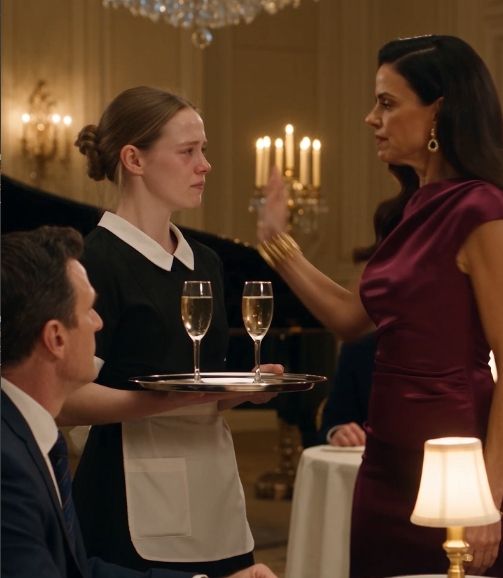
The question hung in the air like smoke after an explosion, and no one in that restaurant dared to breathe it away.
The husband — whose name was Sebastian Castellano — stood frozen behind the table, his hand still half-extended from snatching the photo. His knuckles were bloodless. His jaw worked soundlessly, like a man trying to speak in a dream where his mouth had been sealed shut.
The waitress — her name was Elena, though no one in this room had ever known it — stood three feet away with her palm still pressed to the cheek his wife had destroyed. Tears cut clean lines through the faint dusting of kitchen flour on her skin. But she wasn’t looking at his wife anymore. She was looking at him. At the brother she had been told was dead to her.
The restaurant hadn’t moved. Not a single guest had returned to their meal. A woman near the window had her hand pressed over her mouth. Two waiters stood frozen near the kitchen doors, white towels draped over their arms like surrender flags.
Sebastian’s wife — Vivienne — had retreated two full steps. Her designer clutch dangled from her fingers, forgotten. The fury that had animated her moments ago had drained so completely that her face looked like a mask someone had left behind on a chair. What remained underneath was something she clearly did not recognize in herself. Fear. Not of Elena. Of the truth that was now pouring into the room like floodwater through a cracked dam.
“Papa told me you were dead,” Sebastian said.
His voice came out wrong. Too thin. Too young. Like a boy standing in the doorway of a burning house.
Elena shook her head slowly. “Your father told you a lot of things.”
The words landed like stones dropped into still water, and the ripples moved through every person in the room. Sebastian’s mouth opened, but nothing came out. He looked down at the photo again. The baby in the cream blanket. The tiny Castellano family crest — the golden hawk mid-flight — stitched into the corner with thread that had yellowed over fifteen years.
He knew that crest. He knew that blanket. He had held that blanket in his own nine-year-old hands the night of the fire, standing in the hallway while smoke curled under the nursery door and his mother screamed at him to run.
“She died in the fire,” he whispered. “Mama said Isabella died in the fire. She said she went back for the baby and they both —”
“Your mother said a lot of things that night,” the elderly pianist interrupted from across the room. His voice carried the quiet authority of a man who had held a secret so long it had become part of his bones. He rose slowly from the piano bench, one hand pressed flat against the instrument for balance. “Things that were not true.”
Sebastian turned toward him. The pianist — whose name was Arthur Voss — had played at Castellano family gatherings for over thirty years. He had played at Isabella’s funeral. He had played the funeral march while Sebastian’s mother wept into a black veil, and everyone had believed it was grief.
But Arthur Voss was not weeping now. He was walking toward Elena with his eyes full of something that looked like recognition rewritten as guilt.
“I should have spoken,” Arthur said, his voice rough and barely above a whisper. “Fifteen years. I should have spoken fifteen years ago.”
“Spoken about what?” Sebastian’s voice cracked. He took a step toward the old pianist, and the movement broke something open in the room. People shifted. Glasses clinked. A chair scraped against marble.
Arthur stopped walking. He looked at Elena, and his eyes filled.
“Your mother came to me the night before the fire,” he said. “Isabella. She was terrified. She said your mother — Vivian Castellano — had threatened to take the baby if Isabella didn’t agree to leave the family quietly. She said Vivian had forged documents. Had already begun planning a new narrative. That the child would be given to someone outside the family and declared dead alongside Isabella in whatever ‘accident’ was coming.”
The silence in the restaurant was so total that the candle flames seemed to lean in to listen.
Elena closed her eyes. She had heard parts of this story before — fragments told by her foster mother, Maria, in their small kitchen in Queens, with the smell of beans simmering on the stove and the sound of rain on the fire escape. But hearing it spoken aloud in this room, in front of these people, made the bones of it real in a way that stripped the breath from her lungs.
“Isabella asked me to help her escape with the child,” Arthur continued. His hand trembled against the piano. “I told her I would. I made arrangements. But by the time I arrived at the estate the next evening, the fire had already started.”
He paused. Swallowed.
“I found Isabella in the garden. She had crawled out through the nursery window with the baby in her arms. She was burned. Badly. She begged me to take the child and disappear. She said Vivian’s people would come for both of them before morning.”
Sebastian’s wife, Vivienne — the glamorous rich wife who had started all of this with one violent hand — made a small, broken sound. Not a word. Something less than a word. Something that came from the place where certainty collapses.
“And you did it,” she said to Arthur. “You took the baby.”
Arthur nodded. Once. A single, heavy movement.
“I took Elena. I drove through the night. I brought her to a woman I trusted — Maria, in New York. I gave her the photo. I gave her everything Isabella had managed to write down — the child’s real name, her birth date, the truth about who her mother was. And then I went back to the Castellano estate and played the funeral march at a memorial for a child who was not dead.”
He looked at Sebastian.
“And a mother who was not dead either.”
Sebastian staggered. He caught himself on the back of his chair, his hand closing over the white tablecloth. The fabric bunched in his fist.
“Isabella is alive?”
Arthur shook his head slowly. The candlelight caught the moisture on his cheeks.
“She died in that garden, Sebastian. She died twenty minutes after I drove away. The burns were too severe. But she died knowing her daughter would live. She died holding on to the only thing that mattered — that Elena would grow up somewhere Vivian Castellano could never find her.”
The room fractured. Not physically. Emotionally. Every person in it felt the invisible architecture of a lie they hadn’t known existed collapse in on itself. The guests stared at each other. The waiters looked at the floor. Someone near the bar pressed their hand to their heart and held it there.
Sebastian turned to look at his wife.
Vivienne stood perfectly still. Her face had undergone a transformation so complete that she looked like a different woman. The glamour was gone. The weaponized beauty was gone. What stood in its place was a person who had just watched fifteen years of inherited lies detonate in a room full of witnesses, and who understood with horrible clarity that she had become part of the mechanism that tried to bury a child.
“I didn’t know,” she whispered. “Sebastian. I swear to you. I did not know.”
But Elena shook her head.
“Your mother-in-law knew,” she said, and her voice was steady now — steady in the way that only comes from having rehearsed a truth so many times in private that it no longer shakes when spoken aloud. “She knew when she told your husband his sister was dead. She knew when she had the nursery burned. She knew when she erased my mother’s name from every record in the estate. And she knew last week when she called you, Vivienne, and told you that a ‘gold-digging server’ had been asking questions about the family.”
Vivienne’s mouth fell open.
“That call,” she said. “That was — your mother told me — she said someone was —”
“She told you exactly what she needed you to believe,” Elena said. “Because she couldn’t risk Sebastian learning the truth. Not now. Not when the estate documents are being restructured and the final trust is being signed. She needed you angry. She needed you to humiliate me publicly so that no one — least of all Sebastian — would take me seriously if I ever tried to tell the truth.”
Vivienne’s hand went to her mouth. The color drained from her face in a visible wave, starting at her lips and spreading outward until she looked like a watercolor left in the rain.
“Oh God,” she breathed. “Oh God. What did I do?”
She looked at Elena’s cheek. At the red mark still glowing there. At the woman she had struck because an old woman on the phone had told her to be afraid.
The ресторан erupted — not in noise, but in the particular restlessness of people who had witnessed something they would never be able to un-see. Chairs moved. People stood. The maître d’ hurried forward and then stopped, unsure whether any protocol existed for this.
Sebastian picked up his phone.
His hands were shaking so badly that it took him two attempts to unlock the screen. He scrolled to a contact saved under a single initial — V — and pressed call.
It rang four times.
“Sebastian?” The voice on the other end was warm and measured. A voice that had read bedtime stories. A voice that had hummed lullabies. A voice that had also orchestrated the destruction of one woman and the erasure of her daughter.
