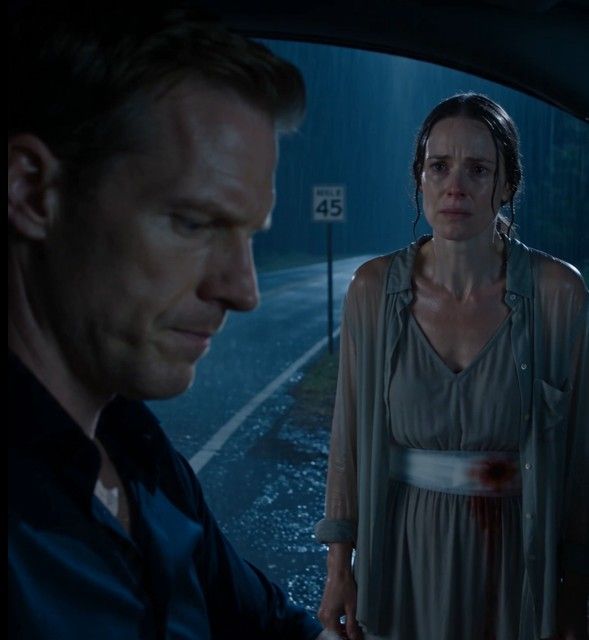
The twenty-dollar bill hit my cheek before it hit the gravel. It was damp from my tears and fever sweat, and then it fell into a puddle at my feet and the green paper darkened as dirty rainwater swallowed it. Not the rain hammering my thin jacket. Not the pain tearing through my abdomen ten days after surgery. My husband Derek Vale had just thrown his wife away on the shoulder of Interstate 87.
“Call an Uber,” he shouted through the passenger window of his white Chevy Tahoe, his face lit by that cold blue dashboard glow. “Or buy medicine. I don’t care. Just don’t come back to the house until that smell is gone.” I was on my knees at mile marker 45, rain hammering my jacket, hair plastered to my face, shaking so hard I could barely keep my hands pressed against my stomach. “Derek,” I whispered. “Please.” He heard me. I know he heard me. He looked down at me the way he looks at a waiter who brought the wrong wine. “Get some dignity, Willow.” Then he hit the gas.
For a second I thought he would stop. I thought he would see me in the side mirror—his wife, bleeding, abandoned in the dark—and turn around. He didn’t. The taillights shrank until the interstate swallowed them whole, and I was alone.
Ten days earlier, the surgeon had been clear. Rest. Antibiotics. Watch for infection. Come back immediately if there’s fever, drainage, or odor. Derek didn’t listen to any of it. At the pharmacy, when the pharmacist said the doctor had marked this specific antibiotic for a reason, Derek just smiled that polite smile he uses for strangers. “She’ll be fine.” In the car he told me doctors upsell medication now.
By day five, my incision was burning. By day seven, the bandage was stained yellow. By day nine, the smell started. By day ten, he was spraying citrus air freshener directly at me in his new Tahoe while he talked about his promotion, about his image, about how people were watching him now. “Do you even shower anymore?” he snapped as he sprayed again and again. “I tried to clean it,” I said, my fingers bloodless from clutching my stomach. “It keeps seeping through. I need a doctor, Derek.” “You need self-awareness,” he said. “If you show up smelling like a rotting fish market, what does that say about me?” That your wife is sick. “No,” he said. “It says I married down.”
That was the first cut. Getting yanked onto the shoulder and told to get out was the second. “Get out,” he ordered after yanking the SUV so hard my incision tore open. “We’re in the middle of nowhere. I can’t walk.” “Then crawl.” I stared at the man I’d married and finally saw him clearly. “I’m your wife,” I said. He laughed. “My wife doesn’t smell like death.”
The rain got heavier. Colder. The streetlights on that stretch had been out for months, and the only light was the headlights of cars flying past too fast to see the woman they were leaving to die in a ditch. I pressed my hand over the fresh warmth spreading under my bandage and realized my phone had no signal. And Derek had no idea who he had just left in that rain.
Five hours later, a news alert would flash across his screen. And he would get on his knees and beg for the woman he threw away for twenty dollars to answer her phone. But why would the entire state suddenly be searching for the woman he called worthless?
I crawled. I don’t know how far. The gravel tore through my jeans, and the rain turned to sleet, and the pain in my abdomen was so sharp I had to stop every few feet and press my forehead against the cold ground. I kept thinking about the twenty-dollar bill. I kept thinking about his face. I kept thinking about the way he said “married down” like it was a fact, like I was a mistake he had made and was now correcting.
I made it to a drainage culvert and pulled myself inside. It was dark and wet and smelled like rot, but it was out of the wind. I curled into a ball and pulled my jacket around me and tried to remember what it felt like to be warm. I thought about my mother. She had died when I was nineteen. She had never liked Derek. She had told me, on the night before my wedding, that he looked at me like I was a possession, not a person. I hadn’t listened. I had been too in love. Too naive. Too desperate to believe that someone like him could love someone like me.
I must have passed out. When I woke, the sleet had stopped, and the sky was gray, and there was a woman standing at the mouth of the culvert. She was older, maybe sixty, with gray hair and a kind face and a flashlight in her hand. She was wearing a county road crew jacket. “Sweetheart,” she said. “Can you hear me?” I tried to speak, but my throat was raw. She knelt down and touched my forehead. Her hand was cool. “You’re burning up. What happened to you?”
I told her. Not everything. Just enough. She called for help on her radio. Then she sat with me and held my hand and told me her name was Ruth and that she had been driving that stretch of road for thirty years and had never seen anything like this. “Who did this to you?” she asked. I told her. She didn’t say anything. She just tightened her grip on my hand.
The ambulance came. The paramedics were gentle. They put me on a stretcher and covered me with blankets and started an IV. One of them asked me my name. “Willow,” I said. “Willow Vale.” He wrote it down. Then he looked at the other paramedic. Something passed between them. Something I didn’t understand.
At the hospital, they took me into surgery. The infection had spread. They had to open the incision again and clean it out. I was in the hospital for eight days. Ruth visited every day. She brought me flowers and books and told me about her grandchildren. She never asked about Derek. She didn’t have to.
On the third day, a man in a suit came to my room. He was tall, with silver hair and kind eyes. He introduced himself as Richard Caldwell. I didn’t know the name. I didn’t know why he was there. Then he told me.
“You’re Willow Carter,” he said. “Your mother was Eleanor Carter. Your father was James Carter. You were born in Boston. You were adopted when you were three. Your birth parents died in a car accident. You were the sole heir to the Carter fortune.”
I stared at him. “That’s not possible. I grew up in foster care. I never knew my parents.”
“You were hidden,” he said. “Your grandmother, Margaret Carter, was a paranoid woman. She believed the family was being watched. She arranged for you to be placed in foster care under a false name. She left instructions that you were not to be found until you were thirty. You turned thirty last month.”
I couldn’t breathe. I couldn’t speak. Richard reached into his briefcase and pulled out a folder. He opened it and showed me photographs. A woman who looked like me. A man who had my eyes. A house in Beacon Hill. A bank account with more money than I could comprehend.
“Why now?” I asked.
“Because your grandmother died last week,” Richard said. “And she left everything to you. The estate. The trust. The company. All of it.”
I started to cry. Not because I was happy. Because I was overwhelmed. Because I had spent my whole life believing I was nothing, and now I was being told I was everything. Because Derek had thrown me away like garbage, and now the whole world was looking for me.
The news alert flashed across Derek’s screen at 6:47 PM. He was sitting in his living room, drinking a beer, watching the game. The alert said: “Heiress Willow Carter found alive on Interstate 87. Estranged husband sought for questioning.” He dropped the beer. He grabbed his phone. He called my number. It went to voicemail. He called again. And again. And again.
He called his lawyer. He called his mother. He called everyone he knew. No one answered. No one wanted to be associated with the man who had thrown his wife out of his car on a cold highway and left her to die. The news spread. The story went viral. The man who had called me worthless was now the most hated man in America.
The police found him three days later. He was hiding at his brother’s cabin in the Poconos. He tried to run. He didn’t get far. He was arrested and charged with attempted murder, aggravated assault, and reckless endangerment. The evidence was overwhelming. The twenty-dollar bill. The texts he had sent me. The testimony of the paramedics. The testimony of Ruth. The testimony of the doctors who had treated my infection. The story of how he had sprayed air freshener at me while I was dying.
The trial was four months later. I testified. I stood in the courtroom and told the jury what he had done. I told them about the surgery. About the infection. About the smell. About the rain. About the twenty-dollar bill. About the way he looked at me before he drove away. Derek sat at the defense table and stared at the floor. He didn’t look at me. Not once.
He was convicted on all counts. He was sentenced to fifteen years. When the verdict was read, his mother screamed. His brother cried. Derek just sat there, his face blank, his hands cuffed in front of him. He didn’t look sorry. He didn’t look anything. He just looked empty.
I didn’t feel triumphant. I didn’t feel satisfied. I felt tired. I felt free. I felt like I could finally breathe.
The final twist came a year later.
I was sitting in the library of my grandmother’s house in Beacon Hill. The house was mine now. The estate was mine. The company was mine. I had hired a team of lawyers and accountants and advisors. I had learned to run the business. I had learned to manage the money. I had learned to be the person my grandmother had believed I could be.
