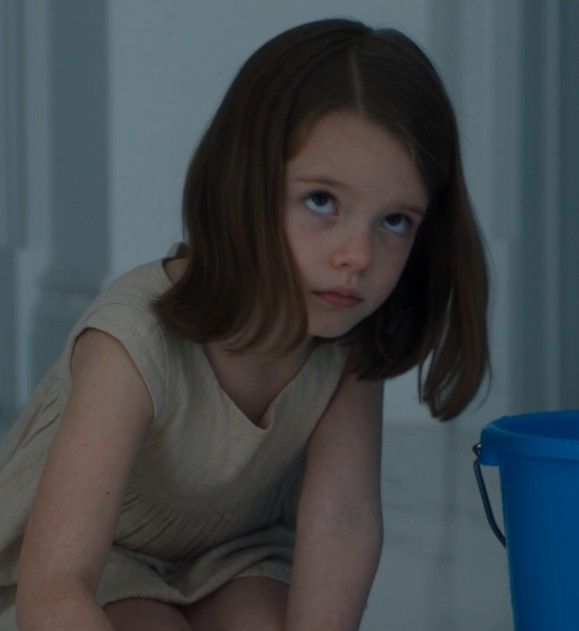
Dear Dad. Today I waited for you. Dear Dad. Today I cleaned. Dear Dad. Do you still want me?
He took one with a hand that was not steady. Lucy hid her face in his shoulder.
“She made me write them every night,” Lucy mumbled into his shirt. “She said if I was good and wrote that I was sorry for being messy, you would come home faster. But then she took them. She said you didn’t want to read them.”
He closed his eyes. The paper shook.
“I would have read every one,” he said, and his voice broke completely. “Lucy, I would have read them a hundred times. I was calling every night. She said you were asleep.”
“I wasn’t asleep,” Lucy whispered. “I was waiting by the phone. In the laundry.”
Maria made a small, wounded noise and turned away to cry properly.
He held Lucy tighter, and the bag of letters crinkled between them. He didn’t try to hide his tears now. He let them fall onto her hair.
“Look at me, sweetheart,” he said, and when she did, he held her face gently in one hand. “Those ten days I was gone — I was not leaving you. I was in a courtroom. I was signing my name over and over so that a judge would let me be your dad forever. Not a foster dad. Not a temporary dad. Your dad. The papers were in that briefcase when I walked in.”
Lucy’s eyes went wide. She glanced at the briefcase still lying on its side by the door where he’d dropped it.
“Forever?” she repeated, as if the word was new.
“Forever,” he said. “No one gets to tell you to erase your name again. This is your house. Your floor. Your name on the wall. Do you understand?”
She nodded, and then she did cry — not the quiet, practiced tears she’d learned to hide, but loud, gasping sobs that shook her whole small body, sobs that had been waiting ten days to be safe enough to come out.
He held her through them, rocking slightly on the wet marble, Maria kneeling beside them with a hand on Lucy’s back, the sun pouring through the tall windows and turning the soapy water to light.
When the sobs eased into hiccups, he stood with her still in his arms. He carried her past the bucket, past the streaked marble, and set the WELCOME HOME, LUCY sign properly upright on the console where it had always been meant to be. Lucy watched him adjust it until it was straight, her head on his shoulder, her breathing still uneven.
“Stay with Maria for two minutes?” he asked her. “I need to make the floor warm for you again.”
She nodded, and Maria took her, wrapping her in a dry kitchen towel that smelled like fabric softener.
He didn’t call a cleaning service. He got on his own knees, took Lucy’s abandoned sponge, and wrung it out into the blue bucket. He wiped the marble himself, in slow, even strokes, washing away the foam until the stone gleamed again, until the only thing left shining was the reflection of the sign and the windows.
Lucy watched him, her eyes following his hands.
When he was done, he tipped the dirty water into the sink, rinsed the bucket, and washed his hands. Then he came back and sat on the floor with them, his back against the wall, his trousers still damp, Lucy crawling immediately into his lap.
The doorbell rang.
James, his lawyer, was there with a thin leather folder and a kind, serious face. Behind him was a woman from the agency, the one who had guided him through every home visit.
They didn’t make a big ceremony in the foyer. James knelt on the marble — not caring about his suit — and opened the folder.
“Mr. Carter,” he said formally, but his eyes were warm on Lucy, “if you’ll sign here, and here — and if Lucy, you want to, you can make your mark here —”
Lucy looked at him, uncertain.
“It says you get to stay,” he explained simply. “It says he’s your dad now, by law, and you’re his daughter, by law, and no one can change that.”
Lucy’s hand hovered over the paper. She looked up at him.
“Do you want to?” he asked her, giving her the choice no one had given her before. “Only if you want to.”
She didn’t answer with words. She took the pen he offered — too big for her hand — and in wobbly letters under his signature, she wrote LUCY CARTER. Then she pressed her palm, small and still a little pruned from the soap, onto the ink pad James offered, and left a perfect, slightly smudged handprint at the bottom.
Maria clapped her hands over her mouth and laughed through tears. James blinked hard.
He — her father now, legally, finally — pressed his own hand over her print and then pulled her into his chest, folder and all.
“You’re home,” he whispered into her hair. “You’re home, baby girl.”
Later, after the lawyer and the agency woman had gone, after Maria had been promised a raise and a proper apology and had hugged Lucy as if she were her own grandchild, after the wet foyer had been dried and the sun had moved lower and more golden, he carried Lucy upstairs for the first time in ten days.
He pushed open the door to her real room.
It was exactly as she’d left it — yellow curtains, oak tree outside, bookshelf he’d built, the little bed with the quilt she’d chosen. But the closet was empty. The dresser drawers were empty. Someone had stripped it to make it look like she’d never been there.
Lucy stared, her hand tight in his.
He didn’t fill the silence with promises. He walked to the laundry room with her, took the plastic bag with her clothes and books, and together they carried it back. Together they put each book back on the shelf. Together they hung each dress. Maria brought up warm milk and stayed in the doorway, smiling.
When the room looked like Lucy again, he sat on the edge of the bed and patted the quilt.
“Try it out for me,” he said. “Make sure I fluffed it right.”
Lucy climbed in, fully dressed, and he pulled the quilt up to her chin. She was exhausted — the kind of exhausted that comes after crying and being held and being safe.
He sat with her while her eyes fluttered. The oak tree rustled outside. The house was quiet — a real quiet, not the obedient quiet she’d learned.
“Will you be here when I wake up?” she asked, her voice already sleepy, her hand finding his.
He laced his fingers through hers, small and warm now.
“I’m not going anywhere,” he said. “This is where I live. Where we live.”
She smiled in her sleep before she was even fully asleep.
He stayed until her breathing evened out, until her hand went slack in his. Then he went downstairs, took the grocery bag of letters to the kitchen table, and began to read every single one, one by one, in the warm light of the foyer where her name now stood upright and gleaming and gold.
He would answer each one tonight.
The house was no longer too bright for cruelty. It was just bright.
And it was finally, completely home.
He sat at the small table by the window with the bag of letters spread around him like fallen leaves, the ink smudged in places where small fingers had pressed too hard, and somewhere upstairs a little girl breathed deeply in a yellow-curtained room that was hers again, and the front door was locked, and the gold letters caught the last of the sun and threw it across the clean marble like a promise that would never need to be scrubbed away.
