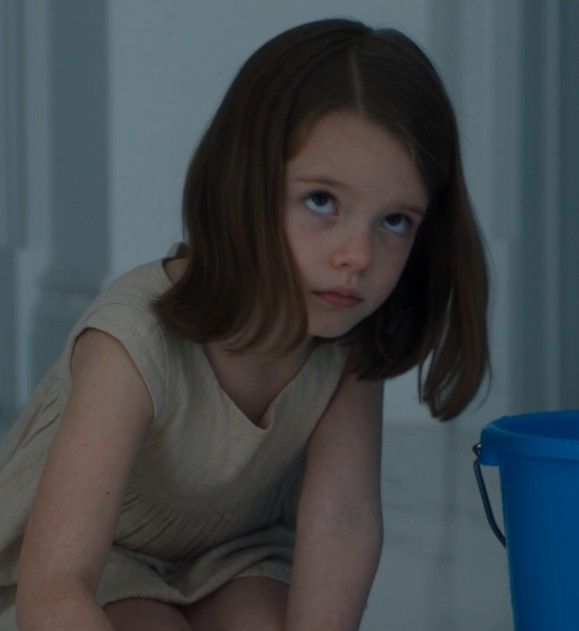
“Who told you to scrub your own name off my floor?”
Who ordered a little girl to erase the one thing that proved she belonged there?
And what else had this woman been hiding in that house while he was gone? 👇
The sponge kept dripping.
A slow, thick plop of soapy water hitting the marble, and Lucy’s small hand jerked like she’d been caught stealing. She didn’t answer him. She stared at the foam as if the right answer was written there, her shoulders drawn up to her ears, her knees already red from the cold stone.
He didn’t move closer yet. He stayed kneeled, his expensive coat brushing the wet floor, his breath shallow enough that she could hear it. He could see her now properly — the too-thin strap of her beige dress, the faint chafe on her knuckles from the sponge, the way her hair had been pulled back too tight, as if someone had done it quickly and without care.
Behind them, the glass clinked.
The woman in emerald recovered fast. She took a slow sip, eyes glittering, and let out a breathy laugh that was meant to sound amused.
“Darling, don’t be dramatic,” she said, her voice honeyed and sharp at once. “I told her she could help. She wanted to be useful. You know how children are — they feel left out if you don’t give them a little job.”
He didn’t look at her. He kept his eyes on Lucy.
“Lucy,” he said again, softer this time, his voice cracking on the second syllable. “Sweetheart. Look at me.”
She did, but only with her eyes. Her chin stayed tucked. Her lower lip trembled once and then she bit it.
“She said you wouldn’t want it dirty,” Lucy whispered. The words were so small he had to lean in. “She said the sign was in the way. That you liked things clean when you came home.”
The woman’s smile tightened.
“She’s exaggerating,” she cut in quickly. “I said we should keep the entry perfect for you. It was crooked. It fell.”
He finally stood. Slowly. The movement made the water ripple around the gold letters. WELCOME HOME, LUCY. The sign was heavy wood, hand-painted, the kind he’d commissioned three weeks ago from a little shop downtown because the woman at the counter had told him the gold would catch the light. He’d imagined Lucy running to it. He’d imagined her hands on the letters.
Now it was face-down in a bucket’s dirty water, and a seven-year-old had been told to wash it away.
He reached down and lifted it. Water streamed off the edges, soaking his cuff. He turned it over.
The back was scuffed. The little wooden stand that had held it upright was snapped clean off, as if it had been stepped on.
“Who broke this?” he asked. Still calm. Terribly calm.
The woman waved a manicured hand. “Oh, for God’s sake. It was an accident. Maria knocked it when she was vacuuming. I was going to have it fixed—”
“Maria doesn’t work on Mondays,” he said.
Silence fell so fast he could hear the clock in the hall.
Lucy flinched at the silence. Her hands were still in the foam. He saw then that her fingertips were pruning, white and wrinkled from how long she’d been at it.
He set the sign gently against the wall, gold letters catching the sun again, and then he crouched and took the sponge from her. His fingers brushed hers. They were ice cold.
“Hey,” he whispered to her. “You don’t have to do this anymore. Not ever again, okay?”
She nodded, but she didn’t believe him yet. Her eyes flicked to the woman, then back to him, checking which adult was actually in charge.
That flicker told him everything. This was not the first time.
He pulled his phone out again. His thumb hovered over the contact he’d almost called before — his lawyer — but instead he pressed another name. The house line.
“Maria,” he said when it picked up after two rings. “It’s me. Are you downstairs?”
A pause. A woman’s worried voice, hushed. “Sir? Yes. I was told to stay in the laundry today.”
“Come to the foyer. Now. And bring the key to Lucy’s room.”
The woman in emerald went very still. The crystal coupe in her hand finally stopped pretending to be steady.
“You don’t need to make a scene,” she said, her voice dropping, losing the sweetness. “You’re scaring her. You’ve been gone for ten days, you walk in, you start interrogating the child —”
“Ten days,” he repeated. He looked at her fully for the first time since he’d knelt. His eyes were not loud. They were worse. They were clear. “For ten days I was in court. In meetings. At an agency. Signing paper after paper so that Lucy would have my name legally. So that no one could ever tell her she doesn’t belong here. You knew that.”
She swallowed. Her throat moved.
“I was doing you a favor handling the house,” she said.
“You were handling her?”
Lucy made a tiny sound and curled her fingers into her dress. The woman saw it and seized on it.
“Ask her if I’ve been cruel to her,” she said quickly, stepping forward, her emerald dress rustling. “Go on. Lucy, tell him. Have I ever hurt you? Have I ever been mean to you?”
It was a trap laid in plain language. A child’s loyalty tested in front of the person she fears.
Lucy’s mouth opened. No sound came out. Her eyes filled, but the tears didn’t fall — they just made the tired sadness shine.
He saw the choice form in her small face: tell the truth and risk what happens when he leaves again, or lie and make the moment stop.
He didn’t let her have to make it.
“Don’t answer that,” he told her gently, and then to the woman, “Don’t you ever put her on trial in her own home again.”
Footsteps hurried from the back hall. Maria appeared — a woman in her late fifties, apron still on, hands wringing together, eyes already red. When she saw Lucy on the wet floor and the overturned sign, she made a choked noise and pressed her hand to her mouth.
“Señor—” she started, then stopped, looking at the woman in emerald with open fear.
“It’s okay,” he told Maria. “Tell me. Where has Lucy been sleeping?”
Maria’s glance shot to Lucy, then to the floor. Her hands twisted harder.
“In the… in the small room by the laundry, sir. Since last Tuesday. Mrs. said her room was being… painted. But the paint never came.”
