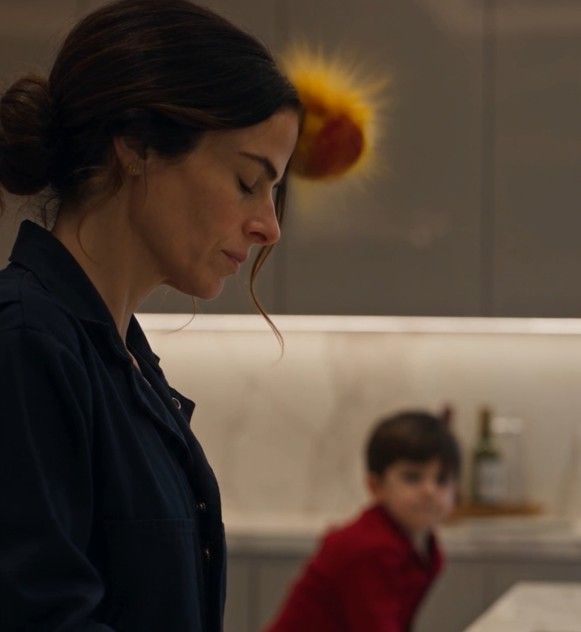
“Why?”
The word hung in the air like a challenge, and for a long moment, no one moved. Marco’s hand was still raised from where he had thrown the apple. Nico’s eyes were wide, his mouth slightly open. Alessandro clutched the cereal box taped to his chest like a shield. And the fourth boy, the quiet one who had been watching from the corner, finally lifted his head.
His name was Luca. He was the smallest of the four, the one who hadn’t spoken since Serena arrived, the one who had been sitting on the floor with his back against the cabinets, his knees drawn up to his chest, his eyes hollow and old in a way that made something twist inside her chest.
Serena didn’t look away from Alessandro. She kept her voice calm, steady, the same voice she used when Lucia woke up screaming from nightmares about her father.
“Why do you want me to be mad?”
Alessandro’s lip trembled. He didn’t answer.
“You threw an apple at my head,” Serena continued, turning back to the stove, stirring the pancetta into the pot. “You poured orange juice on the floor. You dumped cereal on the counter. You’ve been trying to get me to leave since I walked through the door. So I’m asking you, Alessandro. Why?”
The boy’s armor cracked. Just a little. His eyes darted toward the corner where Luca sat.
“Because you’re going to leave anyway,” he whispered.
The words hit Serena harder than the apple ever could have.
She set down the spoon. She turned off the burner. She wiped her hands on the dish towel and walked over to the table, pulling out a chair and sitting down. She didn’t look at Victor. She didn’t look at the mess. She looked at the four boys who had been terrorizing nannies for two years.
“I’m not going anywhere,” she said.
Marco snorted. “That’s what the last one said.”
“The last one ran down the driveway without her coat.”
“She cried,” Nico added. “She cried a lot.”
“I’m not going to cry.”
“They all cry,” Alessandro said. “Even the ones who don’t think they will.”
Serena leaned forward. She looked at each of them in turn. Marco, the leader. Nico, the instigator. Alessandro, the talker. And Luca, the silent one.
“What happened to your mother?”
The room went cold.
Victor’s glass stopped halfway to his lips. The boys froze. Luca’s eyes filled with tears, but he didn’t make a sound.
“She died,” Marco said finally. His voice was flat. Empty. “Car accident. Two years ago.”
“I’m sorry,” Serena said.
“Everyone’s sorry.” Marco’s jaw tightened. “Sorry doesn’t bring her back.”
“No,” Serena agreed. “It doesn’t.”
She stood up and walked back to the stove. She turned the burner back on. She added the cream, the cheese, the pasta. She worked in silence, and the boys watched her, and Victor watched all of them.
“Your father hired me because he wants you to eat dinner at the table,” she said over her shoulder. “But that’s not why I’m here.”
“Then why are you here?” Nico asked.
She turned around. She looked at them. She thought about Lucia. She thought about the custody hearing. She thought about the thirty-six dollars in her checking account and the overdue power bill and the way her ex-husband smiled when he told her she would never be enough.
“Because I know what it’s like to lose someone,” she said. “And I know what it’s like to be scared. And I know what it’s like to push people away because it’s easier than letting them in.”
Alessandro’s lip trembled again. “You don’t know anything about us.”
“You’re right. I don’t. But I know that you’re not bad kids. I know that you’re not monsters. And I know that the last nanny ran away because she couldn’t handle the grief. Not the apple. Not the cereal. Not the orange juice. The grief.”
Luca made a small sound. A whimper. The first sound he had made all night.
Serena walked over to him. She didn’t crouch down. She didn’t try to touch him. She just sat on the floor beside him, her back against the cabinets, her knees drawn up to her chest, mirroring his posture.
“I’m not going to leave,” she said quietly. “Not because I’m brave. Not because I’m strong. Because I need this job. Because I need to prove to a judge that I can provide a stable home for my daughter. Because I need to keep her safe.”
Luca looked at her. His eyes were wet. His voice was barely a whisper.
“What’s your daughter’s name?”
“Lucia.”
“How old is she?”
“Seven.”
“Does she have a father?”
“She does. But he’s not a good man. He hurts people. He hurts her. And I’m trying to make sure he can’t hurt her anymore.”
Luca was quiet for a long moment. Then he reached out and took her hand. His fingers were small and cold. She held them gently.
“You can’t save us,” he said.
“I know.”
“We’re too broken.”
“I know.”
“Then why are you still here?”
Serena looked at him. She looked at the other boys. She looked at Victor, who was still standing in the corner, his glass of wine untouched, his face unreadable.
“Because broken things can be mended,” she said. “It takes time. It takes patience. It takes someone who won’t run away when things get hard.”
