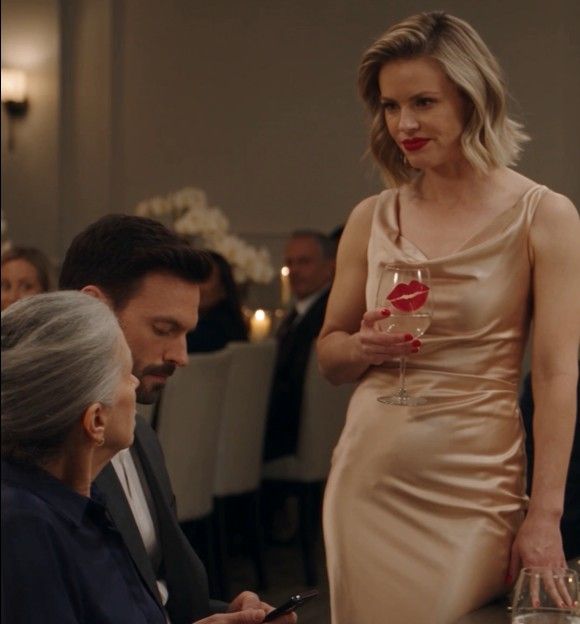
“I’ve reopened older things tonight,” Daniel said.
Steven had not sat down. He was standing at the head of the table with his hands at his sides, looking at the torn petition, and when he spoke his voice was steady in the way that only an exhausted voice can be.
“The condo’s in my name and hers. I’ll sign it over to you tomorrow. Whatever’s left after the lawyers. All of it.”
“Steven.”
“I’m not asking for it back.” He swallowed. “I’m not asking for anything. I’d like a job. Not at the company. Somewhere with a time clock, where somebody tells me at five o’clock that I’ve done enough.” He looked at the table. “Somewhere you’d be allowed to sit.”
I looked at my son — fifty-one years old, standing in the ruins of a party he had let happen to his mother — and I did not forgive him, because forgiveness delivered in a room full of witnesses is just applause with a nicer name. Instead I said, “Come for breakfast on Sunday. Eight o’clock. I make oatmeal. It’s not good.”
Something in his shoulders came down an inch. “Eight o’clock,” he said.
Daniel cleared the room in eleven minutes. The deputies took statements from the manager and from the two guests who had photographed everything, and Javier the valet, who had come in to stand silently near the door with his fists balled, gave his statement with a steadiness that made the deputy look up twice. The musicians packed their instruments in a silence that was more respectful than any music they had played all night.
Afterward I sat alone at the head of the table, in the chair Steven had been sitting in when he said nothing, and I opened the envelope.
The paper inside was hospital issue, thin and slightly translucent, and the handwriting wandered like a person walking down a corridor in the dark.
Margarita — I don’t know if this finds you. A woman came to my house last spring and she was very kind to me and she asked me questions about the money I had lent a waitress in 1979 and afterward she took my address book and I have not been able to reach anyone I love. I want you to know the bread I gave you was never a loan. I told you it was a loan because you were proud and you would not have taken it otherwise. I have followed what you built. I never wrote because I did not want to be the woman who appears once a fortune exists. You were the best thing that happened in my kitchen and I am glad, I am so glad, it was you.
I read it twice. Then I folded it along its original creases and put it back in the envelope, because some things you finish reading in your own house with the curtains open.
The restaurant manager approached with his hands clasped, sick with embarrassment, and asked whether I wanted the evening charged to anyone.
“No,” I said. “I want the kitchen staff paid triple, and I want the young man who was told to refill the sparkling water — the one she made stand there for six minutes — I want his name.”
“Javier’s brother,” the manager said. “Tomás.”
“Tell Tomás he can go home, and that he is not to come in until Thursday, and that his pay will be the same either way.”
He wrote it down like a man receiving absolution.
Steven was waiting by the door in the rain with his collar turned up and his hands in his pockets, and when he saw me he did not come forward. He stopped six feet away and waited to find out whether he was allowed.
We stood there while the quartet’s empty stand was carried past us.
“She’s going to be charged with all of it,” he said. “The house. The money. What she did to your — what she was going to do to you.”
“Yes.”
“I gave them everything. Every transfer. Every email. I sat down this afternoon with Daniel and I gave them all of it.” He paused. “I should have given it to you years ago.”
“Yes,” I said. “You should have.”
He nodded. He took that the way a man takes a bill he already knew was coming.
“Sunday,” I said.
“Eight o’clock,” he said. “I’ll bring the oatmeal if you tell me where it lives.”
“It lives in the cupboard where it has lived for eleven years, and you have never once opened it.”
He almost smiled, and it broke instead, and he looked away into the rain, and that was all right too.
In the weeks that followed, the structure came apart in the order it had been built. The condo was signed over in March and sold in May, and the buyer was a schoolteacher who did not know she was buying a story. Amber’s indictment went forward with the conservatorship affidavit attached as evidence of premeditation, and because she had delivered her own confession to a room of fifty people with three phones recording, no plea was offered. Her name appeared in the county paper on a Tuesday. Her attorney withdrew on a Wednesday. By April she had been sentenced to four years in a women’s facility thirty miles from a city where nobody knew her, and she had not spoken to Steven once, and he did not answer when she tried, and that was the last door closing quietly behind him.
Marcus called him the following Thursday. I answered the phone because Steven was in my kitchen trying to learn the difference between a simmer and a boil.
