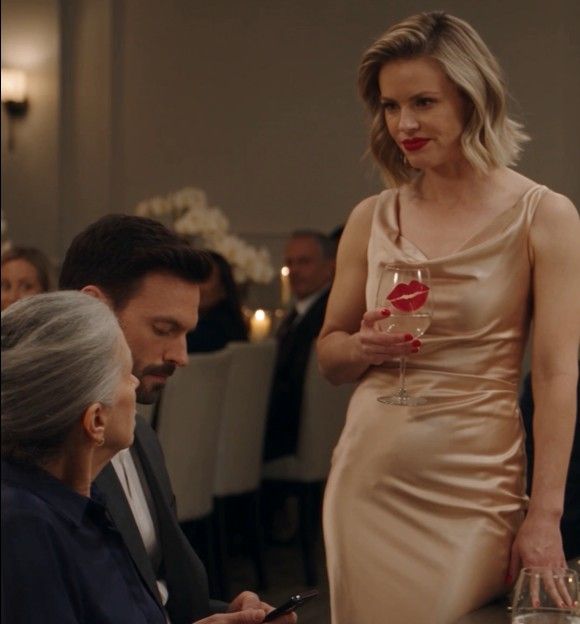
“Tell him I’m sorry I didn’t stand up,” Marcus said.
“Tell him to come to Sunday dinner and say it to my face,” I said. “There’s always an extra chair.”
Marcus came. He brought bread, and he stood in my doorway and told me that he had replayed the first five minutes of that dinner a hundred times, and that he had been the one who had looked at his plate. I poured him a coffee and told him that a man who apologizes out loud has already stood up, and that the chair by the window was his if he wanted it every Sunday.
Nadine Hurst got her mother’s house back in June. The court unsealed the estate, and Daniel found the deed hidden in a storage unit Amber had rented under a name that was only two letters off from her own. Nadine invited me to see it before she sold it, and I stood in Vivian Langford’s kitchen with the tile I remembered and the window over the sink and I said the thing I had come forty years too late to say: that the money she gave me was the reason I was ever able to be generous with anyone else, and that I had spent my whole life trying to be worthy of a bread roll.
Nadine sold the house and started a small fund in her mother’s name for home aides — real ones, licensed, paid enough to stay. She came to Sunday dinner in September and then again in October and then stopped asking whether she was welcome, which is how I knew it had worked.
Steven took the job at a distribution center on the east side. Warehouse floor, time clock, steel-toe boots he had to buy himself with a card that declined once before the balance cleared. He moved into a one-bedroom above a hardware store and he called me every Wednesday at seven, which is what we agreed, and he never once asked for money, and I never once offered, and the not-offering was its own kind of peace.
It was Daniel who told me, in September, that Plan B had never needed a second part — that the transfers had been arranged so that cutting them off would only end what I had been giving, never take anything either of them had earned — and that he had argued me out of the harsher version in February and I had let him.
“You were never going to disinherit him,” he said.
“I was going to stop financing him,” I said. “There’s a difference, and he’s learning it.”
The envelope from Vivian lived on my desk for two months before I understood why I kept returning to one line. Not the forgiveness, not the bread. The part where she wrote that she had not wanted to be the woman who appears once a fortune exists.
For forty years I had believed I was protecting people by staying small. I told myself the modest house and the secondhand coat were humility. But standing in Vivian’s kitchen I saw it clearly: I had hidden the company not to stay humble, but to keep everyone from needing anything from me, and in doing so I had taught my son exactly the lesson he had learned too well — that love is what somebody withholds until you perform.
That was the real inheritance, and it was the one thing worth correcting.
On the first Sunday in November the trees along my street had gone the color of old paper, and Steven arrived at eight with a grocery bag and a receipt he showed me before he put it away, because he wanted me to see that he had paid for the milk.
“Where’s Nadine?” he asked.
“She’s bringing the chair.”
He looked at me.
“You’ll see.”
Nadine arrived with a wooden chair under one arm, the way you carry something you have been meaning to return for a long time. It was a kitchen chair with a cracked vinyl seat, the kind that comes from a restaurant that has been replaced twice over. She set it at the end of my table, at the end where nobody ever sat because the light from the window hit it and it was, by my own quiet rule, not for guests.
“I called the old Veranda,” she said. “The one on Ninth that closed in 1984. The family still had things in storage. They were going to throw it out.” She ran her hand along the back of it. “My mother said you used to seat yourself there every morning before service. That it was your chair.”
I sat down in it. It creaked exactly the way I remembered, low and familiar, and the November light came across the table and lay over my hands.
Steven stood very still with the oatmeal box in his fist.
“Eight o’clock breakfast,” he said finally, “is going to be weird for a while.”
“Yes,” I said. “It will.”
“Good,” he said, and pulled out the chair across from mine and sat down with his boots still on and his hair still wet from the rain, and Nadine put the bread in the middle of the table and took the seat by the window, and Marcus, who had let himself in through the side door because that was already a thing we did, said good morning to nobody in particular and reached for the butter.
Nobody told anyone where to sit.
I tore the loaf in half and gave my son the larger piece, the way Vivian used to, the way you do when you have decided that the table is not a place where anything is earned, and he took it with both hands and did not look up, and the light stayed on the table for a long time, and none of us asked for it to move.
