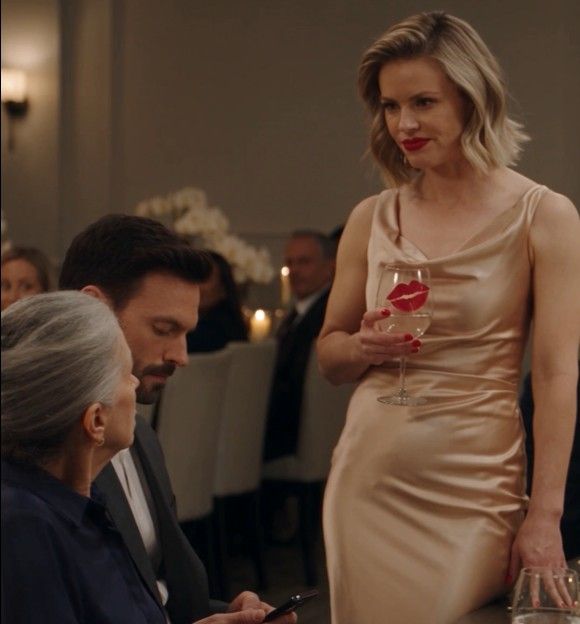
And the color drained from her face.
Not slowly. All at once, the way a window goes dark when somebody on the other side switches off the light. Amber’s wine glass stopped halfway to her mouth, red lipstick frozen against the rim, and for the first time all evening she had nothing to say.
The woman in the doorway was about fifty, wearing a gray wool coat with rain on the shoulders. Behind her stood a younger man in a cheap suit holding a leather folder, and a broad-shouldered man in a windbreaker who was not looking at the flowers or the string quartet. He was looking at Amber.
“Can I help you?” the restaurant manager stepped forward, smooth as oil. “This is a private event.”
“I’m not here for the event,” the woman said. Her voice didn’t rise. It didn’t have to. “I’m here for her.”
She was looking directly at Amber.
Amber set the glass down with a click that was too careful, too controlled, the sound of a woman rebuilding herself in the space of a single breath. “Steven,” she said, pleasant and bright, “have them removed.”
Steven didn’t move.
“Amber Schaeffer,” the woman said.
The room made a sound. Not a gasp exactly, more like fifty people inhaling at the same time and forgetting to let it out.
“Whoever you are—” Amber started.
“Amber Schaeffer, or Amber Reyes, or Amber Duran. You’ve used all three.” The woman reached into her coat and produced an envelope, worn soft at the corners, the kind that has been carried in a pocket for a long time. “My name is Nadine Hurst. My mother was Vivian Langford.”
Amber’s hand went to the table’s edge. Her knuckles went white against the white linen.
“June, 2019,” Nadine said. “You were hired as a home aide. Eleven weeks later my mother had a stroke, and eleven days after that, a codicil appeared leaving her house to a woman named A. Reyes who signed as a witness.” She let the envelope hang at her side. “You signed my mother’s name, Miss Schaeffer. She was left-handed. Her signature slants the other way.”
“That’s a lie.” Amber’s voice came out high and clean and hard. “That’s a fabricated — Steven, do something.”
The young man in the cheap suit stepped forward and extended the folder. “Superior Court, Riverside County. You’ve been served with notice of indictment, fraud upon a vulnerable adult, and forgery. There’s a warrant that’s been outstanding for thirty-nine months.”
Nobody laughed. Nobody shifted. Fifty people sat with their dessert spoons in the air.
Amber looked around the table with the quick, bright desperation of a performer whose audience has stopped applauding, and her eyes landed on Steven. “Say something,” she whispered.
Steven was staring at the woman in the gray coat as if he had never seen her before, as if the room had quietly rearranged itself while he was looking at his phone.
Then his phone rang in his hand, and he looked down at the screen, and I knew exactly what it said.
Because I had told Daniel Alarcón to call him.
I was in the parking lot. My hand was on the key. I had watched through the window long enough to see the woman walk in, long enough to see my daughter-in-law’s face break open like thin ice, and I was about to leave them all to it — fifty guests, a live quartet, a bill that would not clear — when my own phone rang on the passenger seat.
“Mrs. Herrera,” Daniel said. “Don’t start the car.”
“Then say what you need to say.”
“Nadine Hurst is in that room. She’s been looking for you for two years. Vivian Langford’s daughter. She found my office this morning, and I told her where the dinner was, and I told her to walk in.” A pause. “Go back inside.”
“You set this up.”
“I filed what you asked me to file. The rest is a coincidence with excellent timing.”
I sat there for a moment with the engine off and the cold coming through the door seam, and I thought about the fact that Vivian Langford had been dead for four years and I had never known, because the last letter Vivian wrote me went to a forwarding address I never received, because a woman using three different names had emptied the house before anyone thought to look.
I got out of the car.
The valet, Javier — the boy whose tip jar Amber had told me was “beneath me to touch” — held the door and said nothing, and his silence was kinder than anything that had happened inside.
Going back in felt like walking into a room where a window had been shattered. The cold air had gotten everywhere. The string quartet had stopped mid-phrase with their bows half-lifted, and the manager was standing very still near the ice sculpture, and nobody was eating.
They saw me before I reached the table. Heads turned, the same way they had turned an hour ago, but this time the looking was different. This time they were afraid to be the first to look away.
I walked the length of that room. Fifty guests, every one of them between me and the head of the table, and not one of them stayed where they were. They moved their chairs back. They stood. A woman reached out and touched my arm as I passed and I did not stop to find out who she was.
Amber watched me come the way a person watches a dog they have kicked and expected to stay down.
“Margaret,” she said, and she laughed, a small bright sound with nothing behind it. “Margaret, isn’t this embarrassing for you. Your little friend wandered in off the street.”
“Sit down, Amber.”
“I will not sit down in my own anniversary dinner while strangers accuse me of — ”
“Sit down.”
I said it quietly. I have discovered that after sixty-nine years the quiet is far more useful than the loud. Amber sat.
Nadine Hurst looked at me, and her eyes filled, and she said, “You’re Margaret. You’re Margarita Herrera. My mother wrote your name on the back of a photograph until the ink wore through.”
“Yes,” I said. “I am.”
And there it was — the thing I had carried since 1979, the debt that never appeared on any balance sheet, offered back to me in a gray coat in a room full of people who had just watched me be told to eat in a bathroom.
Daniel arrived four minutes later, and with him came two deputies who had been waiting in the alley, because I had asked them to wait until the card was declined.
It declined in front of everyone. The manager came back holding the black card like a dirty diaper, murmuring something about a processor error, and Amber snatched it from him and swiped it again herself at the terminal by the wall while forty-eight people watched her do it. Error. Again. Error.
“The card is closed,” Daniel said, from the doorway, pleasantly. “So are the accounts it funded. So are the transfers that supported this address, that vehicle, that insurance policy, and the mortgage on the condo you’ve lived in for eleven years without paying a dollar of it.”
Amber turned around with the card in her fist. Her lipstick was smudged now, a red smear at the corner of her mouth, and for the first time she wasn’t performing for anyone.
“You can’t do this.”
“I did it at nine o’clock,” I said. “You were being introduced to the string quartet at nine o’clock.”
Then she made the mistake.
She looked at me with a kind of triumphant, cornered fury and she said, loud enough for the deputies to hear, for the phones already recording to catch, for every person in the room to hear: “Fine. Fine. You think this is finished? I have an affidavit. I have a physician’s signature. You’re a seventy-year-old woman who forgets her own addresses, and by the end of next month you will be declared incompetent and everything you have will be in conservatorship. And I will be the one they call.”
