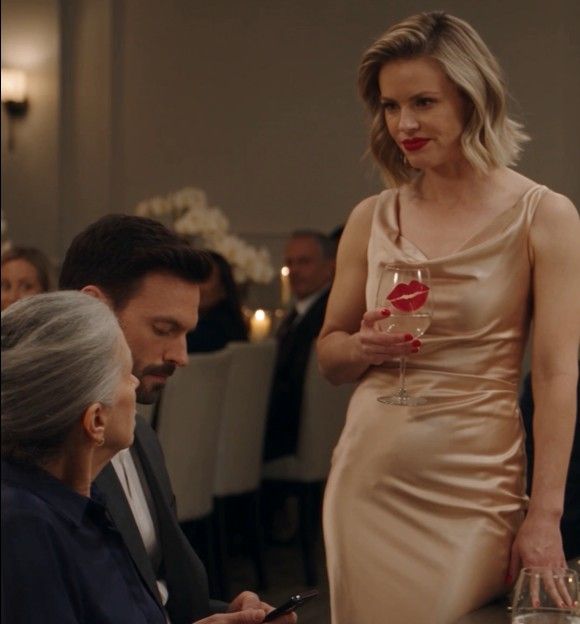
“I’ve been thinking about it for two weeks,” he said. “And tonight I sat at this table and watched her tell you to go to the bathroom, and I looked at my phone. I looked at my phone, Mom.”
The name landed in the middle of the room and stayed there.
“You could have said one thing,” I told him. My voice held. I was proud of that. “One word. I would have stopped all of this.”
“I know,” he said. “That’s the part I can’t — ” He broke off and pressed his thumb hard against the table, the way a person does when they are trying to keep something in their chest from coming out sideways. “That’s the part I know.”
Amber was on her feet. “You’re seriously — you’re going to stand there and — ” She seized the papers and tried to rip them. They were heavy stock and they only tore halfway, and the sound of it made Nadine flinch. “None of you have any proof. She’s old, she’s confused, she’s been alone so long she’s invented — ”
“Ma’am,” said the deputy, and he said it gently, which was worse than if he hadn’t.
“You cannot arrest me. I am married to this family. I am — this is my home, I am part of this — ” She was backing along the table now, her chair scraping back, her hand leaving a red smear on the linen where she’d touched her mouth. “Steven. Steven, tell them who I am.”
Steven looked at her. It was the longest look he had given anyone all night, and there was no hatred in it, which somehow made it unbearable. There was only a man seeing clearly, for the first time, the exact shape of the thing he had protected.
“You’re the woman who told my mother to eat in the bathroom,” he said. “In a room she paid for. At a table I set.”
“I did it for us!” Amber’s voice broke into something high and thin and genuine, and for one second she was not a villain, she was a terrified woman in a red dress with nowhere left to stand. “Everything I did, I did for us! You think I wanted to be here with your awful mother and her little checks and her little notes about what everything cost? You think I enjoyed being owned by a woman who eats dinner alone in a house with four rooms and no one in them?”
The deputies took her arms. She did not fight them. She went rigid instead, chin up, the way she had stood at the door all night, still performing for the room that had already turned its back.
As they walked her past me she leaned in and said, very low, so only I could hear: “You’ll die alone in that house and nobody will come.”
I let her get two steps ahead.
“He’s coming home with me,” I said. “On Sundays. Whether you’re in a house or a cell, you won’t be there to tell him not to.”
She didn’t turn around. The door swung shut behind her, and the sound it made was the sound of a lock engaging on a room that had been open for fifteen years.
The string quartet did not resume. The manager stood frozen with a card in his hand. And fifty guests discovered, all at once, that they had nowhere to put their eyes.
Nobody left. That was the strangest part. You would think they would have run — out into the rain, into their cars, into the version of the evening they could tell people about later. Instead they stayed in their chairs with their desserts going cold and they said nothing, because saying nothing was exactly what they had all done an hour ago and they were only now beginning to understand what it had cost somebody.
A woman near the window — the one who had laughed, the loudest laugh in the room — stood up, opened her mouth, closed it, picked up her purse and walked out without meeting anyone’s gaze.
Marcus, Steven’s oldest friend, remained. He got up from his chair, walked around the table, and poured a glass of water with a steady hand and put it in front of Steven, and then he did something I did not expect. He turned to me and said, “Mrs. Herrera, I’m sorry I laughed.”
“You didn’t laugh,” I said.
“I didn’t stop her either,” he said. “That’s a different kind of laugh.” He set the pitcher down. “I’ll be outside if you want the room cleared.”
“Give us ten minutes.”
Nadine Hurst had not moved from where she stood near the ice sculpture. When I turned, she was crying quietly with both hands around that worn envelope, and she held it out to me.
“I’ve had this for four years,” she said. “I didn’t know how to find you. Everyone she stole from was already gone.” She pressed it into my hands. “My mother wrote it in the hospital, the last week. She kept asking for Margarita. The nurses thought she was confused.”
I did not open it. Not yet. I held it against my chest the way you hold something that has been in the air a long time and has finally landed.
“I have a company,” Nadine said, and a small broken laugh escaped her. “I’m sorry. That’s a terrible thing to say in a room like this. But I want you to know I don’t need anything from you. I just wanted you to have this.”
“I know what you need,” I said. “You need the house back.”
She pressed her lips together and nodded once, sharply, and could not speak.
Daniel was already beside me. “The estate proceedings can reopen. I’ll take it on contingency, and I’ll take it tomorrow.”
“It’s four years old,” Nadine said.
