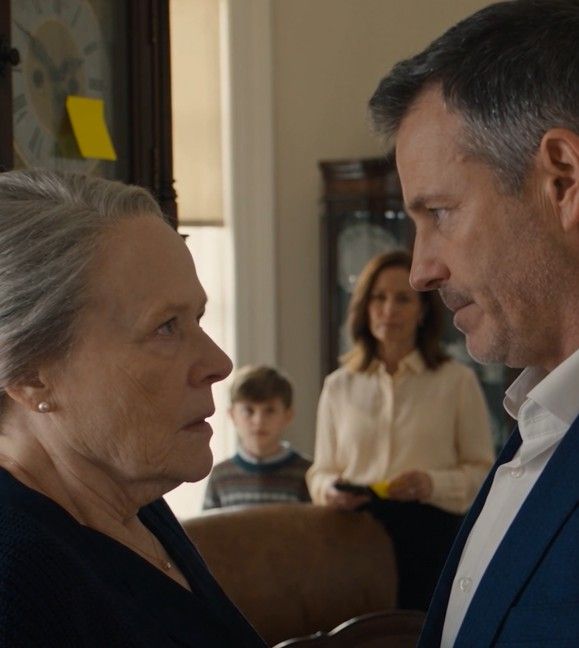
Not on one knee. Both knees. On the thin, industrial carpet of that law office, in front of the lawyer, in front of his sister, in front of his son.
He put his hands on my knees, and he looked up at me, and his face was wrecked.
“Mom.”
Just the word. Nothing else. But everything was in it — thirty-seven years of love and blindness and entitlement and the slow, terrible erosion of a bond that had once been unbreakable.
“I need you to know that I heard him. I heard Dad.”
I looked down at my son. My boy. The baby I’d nursed through fevers, the teenager I’d driven to practice at five in the morning, the man I’d watched walk down an aisle and then walk away from me, one degree at a time, as the promise of money grew louder than the sound of my voice.
“I know you heard him,” I said. “I just need you to remember it tomorrow.”
He pressed his forehead against my knee, and he stayed there.
Catherine — my daughter — wiped her face with the back of her hand and looked at me through swollen eyes.
“Mom, I need to ask you something, and I need you to tell me the truth.”
“Okay.”
“All those years. When Dad was alive. When we were — when we were being…” She stopped. Started again. “When we were being awful to you. Did you hate us?”
The question hit me harder than anything else that day. Harder than the will. Harder than the letter. Because it was the one question I had asked myself a thousand times in the dark, and I had never found a clean answer.
“No,” I said. “I never hated you. I hated what the money was doing to you. I hated watching your father’s face when you’d call and only talk about the house, the accounts, the plans. I hated that I had to learn which child was calling based on what they wanted instead of how they sounded.” I paused. “But I never hated you. A mother doesn’t get to hate her children. She just gets to grieve the ones she raised.”
Catherine pressed her fist against her mouth and nodded, fast, tight nods, as though she were agreeing to a contract she had just realized she’d already signed.
The lawyer cleared her throat softly.
“There is one more item,” she said. “Mr. Calloway left a sealed addendum to the will. It was to be opened only if, during the reading, either child expressed — and I’m quoting here — ‘any sign that they remembered who their mother actually is.'”
She slid a cream-colored envelope across the table.
My hand was steady when I took it. I opened it and unfolded a single sheet of paper.
It was a deed. Transferred to my name exclusively eighteen months ago. The lake house. The one Daniel had already “looked into the paperwork” for. Richard had purchased it outright and placed it in my name before the ink on his new will was dry.
Tucked behind the deed was a handwritten note.
“Eleanor — this is the one place they’ll never be able to take from you. Not because they’ll try, but because you built it. Every board, every screen door, every garden row. It was always yours. I just made the paperwork match the truth. — R.”
I held the note against my chest.
The room was very quiet.
Daniel raised his head from my knee and saw the deed. He read it. His face didn’t crumble — it did something worse. It settled. He saw it, understood it, and for the first time, did not reach for it.
“That’s yours,” he said.
I looked at him.
“I know.”
He stood up slowly. Walked back to his chair. Sat down. Put both hands flat on the table, palms down, as though grounding himself against the urge to argue.
Catherine picked up her phone from the armrest, looked at it, turned it face-down on the table.
