The police were standing on her porch.
Her daughter-in-law, Vanessa, was crying to the officers about a “break-in” — at *her* house. She told them a stranger had changed the locks and shut down a business she “owned.”
But the neighbor across the street had seen everything. She knew whose name was really on the deed.
And she had just handed the officers a piece of paper that was about to end Vanessa’s perfect little performance.
For three years, her son Julian and his wife Vanessa lived upstairs in her historic Massachusetts home while they “saved for their future.”
She paid for nothing they couldn’t handle. She asked for nothing except respect.
She told herself that generosity was not the same as surrender.
She almost believed it.
Then Christmas Eve arrived.
The living room glowed with tree lights. A small American flag ornament her late husband bought in Bar Harbor hung near the window, turning gently whenever the old radiator sighed.
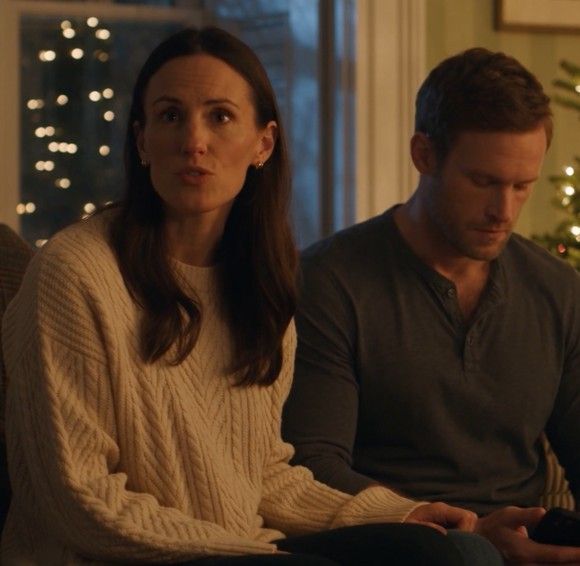
Vanessa moved through the room like she was hosting in a house that belonged to her — handing out gifts, correcting dinner plates, smiling in that polished way people smile when they think kindness has no spine.
Julian sat near the couch, half present, half buried in his phone.
She was carrying fresh coffee from the kitchen when she heard Vanessa’s voice behind the half-open guest room door. Speaking to her mother. Cheerful and proud. Like she was revealing a renovation show finale.
The old wooden deck at her Maine beach house had already been removed. The new stonework looked modern. The house had been listed online for short-term stays while she was “busy here.”
Then came the sentence that changed everything.
They were planning to move into her beach house full-time in January. Julian, according to Vanessa, would “handle” her.
She stood in the hallway with the coffee tray in both hands and felt something inside her become very still.
That beach house was not a shared project. She bought it years earlier with her own inheritance, after working through grief and learning how to sleep alone in a quiet house.
Salt air in the curtains. White shutters. Weathered steps. The kind of silence that healed her.
Vanessa had treated it like an opportunity.
She did not raise her voice. She did not argue through Christmas dinner.
She simply opened her planner, made one small note, and let the room sit in the silence they had created.
The next morning, she removed Julian’s access from every account. She confirmed the online listing Vanessa had created — her house, photographed in coastal light, described with charming phrases Vanessa had no right to sell.
She called Arthur, a local locksmith in Maine who had known her late husband. She asked him to replace the lock system and send the new keys only to her.
By lunchtime, Vanessa’s imagined new life had quietly closed.
She told Julian that three years of living without rent had been a gift, not a permanent arrangement.
“Mom, we’re family,” he whispered.
She looked at him with the kind of sadness only a mother understands.
“Then start acting like it.”
When Vanessa finally came home from the grocery store, Julian tucked the lease into his jacket instead of facing her.
January came cold and sharp. Vanessa still floated through the kitchen as if her plan was unfolding perfectly.
She did not know the new keys had arrived. She did not know the utilities had been adjusted. She did not know every account tied to her name was secure.
Then the messages began.
One evening, while she was eating soup by the fire, Vanessa rushed downstairs with Julian behind her, both pale with surprise. Guests she had arranged could not enter the Maine house. The access no longer worked. Refunds were due. Her careful plan had met a locked door and a paper trail.
Then, near the end of January, her phone lit up again and again. Ninety-nine missed calls. A long row of voice messages from Vanessa. Miles away on the Maine coast, her final attempt to claim what was not hers had brought local officers, a watchful neighbor, and a moment she could not charm her way through.
She looked at the screen, took one slow breath, and pressed play on the first message.
The audio was shrill, barely controlled, the kind of voice Vanessa only used when no one she wanted to impress was listening.
“Your neighbor — that crazy woman across the street — she handed them some kind of paper. The officers are looking at it right now. I told them you broke into my house, I told them everything, and now they’re — they’re reading something and they won’t even look at me anymore. Call me back. You need to call me back right now and fix this.”
Static. Then the end-of-message tone, thin and clinical.
Her thumb hovered over the second message. She did not press it yet. Instead she set the phone face down on the kitchen table, beside the bowl of soup that had gone lukewarm, and listened to the old house settle around her. The radiator clicked. Wind pressed against the window frames. Somewhere down the block a dog barked twice and stopped.
She picked the phone up again.
The second message was Julian. His voice was lower, rougher, stripped of the easy confidence he performed for Vanessa.
“Mom. I don’t know what’s happening down there. Vanessa called me crying. She says the police are involved. She says you — she says you sent someone. Mom, I need you to just tell me what’s going on. Please.”
The pause that followed was not silence. She could hear him breathing. She could hear the particular quality of a thirty-one-year-old man standing in a kitchen that was not his, trying to decide whether to be a husband or a son.
“Please call me back.”
She did not call him back.
Message after message, the evening unspooled. Vanessa’s voice climbed higher, sharper, more desperate. She was no longer performing for the officers — she was performing for voicemail, for an audience of one woman who was not picking up. Each recording captured another layer of the mask slipping. There was the version where she described herself as a victim of harassment. There was the version where she threatened legal action. There was the version — the eleventh message, the one she listened to twice — where the performance cracked completely and Vanessa’s voice dropped into something raw and small and terrified.
“I can’t go to jail. I have a career. I have a reputation. You can’t do this to me. You can’t — Julian, Julian, tell her — ”
The message cut off. Thirty seconds later the twelfth one arrived. Julian again.
“Mom, the officer here says the house is in your name. He says Vanessa doesn’t have any documentation. He says she told them she was the owner. Mom, that’s — she could be in real trouble.”
