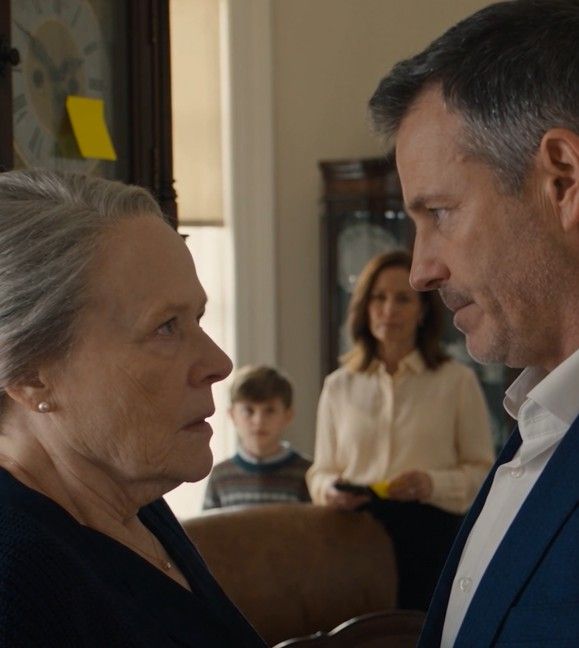
My son’s jaw tightened. A vein surfaced at his temple.
“That’s not—”
“He called his lawyer the next morning. And we wrote the will together. Every word. Every clause.” I reached into my pocket and drew out the document — not the will, but the other paper, the one I’d carried for fifteen years. “But this came before all of it. This came from your father, too. And this is what none of you know about.”
I unfolded it on the table. The paper was worn at the creases, softened by years of being held, folded, pressed against my chest in quiet rooms when nobody was watching.
The lawyer leaned forward and read it silently. Then she sat back, and for the first time that afternoon, something shifted behind her professional composure. She looked at me with an expression I couldn’t quite name — not pity, not admiration, but something close to recognition.
“Would you like me to read this aloud?” she asked.
“Yes.”
She took the paper gently, as though it were fragile in a way that had nothing to do with its age.
“This is a letter from Richard Edward Calloway, dated eleven years ago. Addressed to his children, Daniel Calloway and Catherine Calloway Reed. It reads as follows.”
She paused, adjusted her glasses, and began.
“Daniel. Catherine. If you’re reading this, it means I’m gone, and it means your mother has decided you’re ready to hear what I couldn’t say to your faces.”
My daughter made a small sound — something between a gasp and a sob.
“I have spent the last years of my life watching you two become people I don’t recognize. Not because you’re bad. But because somewhere along the way, you started believing that love is measured in dollars, and that a father’s worth is only what he leaves behind.”
The lawyer’s voice was steady, but her hand trembled slightly at the corner of the page.
“I built this company from nothing. Your mother was beside me when nothing was all we had. She typed my business plans at the kitchen table with a baby on her hip and coffee she reheated three times because she kept getting interrupted. She didn’t ask for shares. She didn’t ask for credit. She held us together while I built something, and you have never once thanked her for it.”
My son’s hand was flat on the table now, pressing down, as though he needed something solid beneath him.
“When I got sick, your mother was the one who sat with me through every appointment. Not either of you. You sent flowers. You sent texts. You asked about the estate. Your mother asked the doctor to repeat the prognosis three times because she couldn’t hear him through her own heartbeat.”
I wasn’t crying. I had promised myself I wouldn’t. But something was rising in my throat — not grief, not anger, but the vast, aching weight of being seen. Of having someone write down the truth of who I was and what I carried, and having it read aloud in a room full of people who had never once thought to ask.
“So here is what I need you to know. Your mother has not been ‘taken care of.’ She has been carrying you. All of you. For decades. And I will not allow my death to be the moment you finally throw her away.”
The lawyer lowered the letter.
The silence that followed was a different kind. Not the shocked silence of the will reading. Something deeper. Something that had roots.
My daughter was the first to break. She pressed both hands over her face and wept — not delicately, not politely, but with the raw, heaving sobs of a woman who had just realized she had been wrong in a way that could not be undone.
My grandson stood up, walked to his mother, and put his hand on her shoulder. He didn’t say anything. He just stood there, and for the first time all day, he looked like someone’s child instead of someone’s heir.
My son hadn’t moved.
He was staring at the letter on the table as though it were a mirror, and he didn’t like what he saw.
“Dad wrote that?” His voice was barely audible.
“Your father wrote every word. He dictated some of it from his hospital bed, the last time we were alone together. He made me promise to keep it until the right moment.” I folded the letter carefully and placed it back in my pocket. “He said you’d need to hear it when the money stopped making you deaf.”
My son closed his eyes.
And then something happened that I had not expected — not in my most hopeful, most guarded imagining.
He stood up, walked around the table, and knelt beside my chair.
