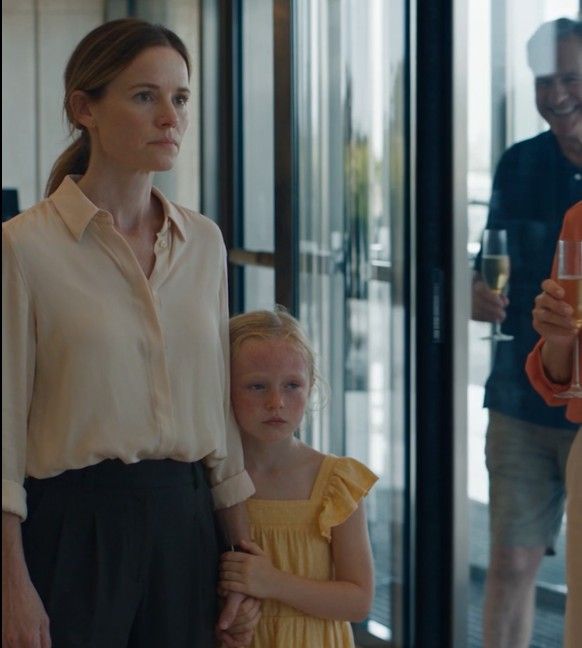
Greg set his champagne glass down on the nearest table. His hand was trembling. He took a long step toward the door, then stopped, realizing there was nowhere to go.
The second officer approached my father.
“Mr. Holloway, Mrs. Holloway, I need you both to come with us to the station. You are not under arrest at this time, but you are persons of interest in a child endangerment investigation. If you refuse to come voluntarily, we will need to—”
“We’ll come,” my father said quickly. Too quickly. The desperation underneath it was naked. “We’ll cooperate. This is a misunderstanding. You can see she’s fine. She’s right there. She’s okay.”
He pointed at Lily.
Lily didn’t look at him. She was sitting on the edge of a lobby chair with a paramedic kneeling beside her, the cooling blanket around her shoulders like a cape. She was holding a paper cup of water in both hands, drinking slowly, carefully, the way you drink when you’ve been without water for a very long time and your body has learned to be afraid of needing it.
She didn’t look at her grandmother. She didn’t look at her grandfather. She looked at me.
I walked over and knelt in front of her. I put my hands on either side of her face. Her skin was still warm but not burning anymore. Her eyes were clear.
“Mom,” she said.
“I’m here.”
“I knew you’d come.”
My throat closed. I pressed my forehead to hers and breathed. Just breathed. In and out. Her breath synced with mine. Small and warm and alive.
Behind me, I heard my mother’s voice rise to that shrill, indignant pitch she used whenever someone dared to suggest she was anything less than perfect.
“This is ridiculous. She’s fine. Children are resilient. We did nothing wrong. Margaret, tell them—”
“Mom.”
My sister’s voice. Quiet. Raw. Not the voice I was used to from Emily — not the cheerful, people-pleasing, go-along-to-get-along voice. Something had broken loose in her. Something she had been holding shut for years.
“Mom, stop talking.”
My mother spun toward her. “Excuse me?”
Emily’s eyes were wet. Her jaw was tight. She was looking at our mother like she was seeing her clearly for the first time, maybe the first time in her entire life, and the picture was too much to hold.
“You locked a child in a closet,” Emily said. “Your granddaughter. In a hot room. With no water. For seven hours.”
“She was not—”
“You told her to stop screaming.” Emily’s voice cracked. “You told her she was being dramatic. While she was screaming for help in a locked room.”
“She was being difficult—”
“She’s eight.” Emily’s voice broke open. “She’s eight years old, Mom. What is wrong with you?”
The lobby was utterly silent. The bellhop had stopped moving. The family of four by the elevator hadn’t moved. Even the ambient music seemed to have faded to nothing.
My mother opened her mouth. Closed it. Opened it again.
For the first time in my life, I watched my mother fail to find the right words. I watched the mask slip completely, and underneath it there was nothing. No regret. No horror. No sudden understanding of what she had done. Just a cold, cornered look in her eyes — the look of someone who had been caught, not someone who was sorry.
She turned to my father. “Say something.”
My father said nothing. He was staring at the floor. His hands were in his pockets, and his shoulders were curved inward, and he looked like a man trying to make himself smaller, trying to disappear into the marble.
The officer took them both out through the side exit. My mother walked stiffly, her chin up, her back straight, refusing to look at anyone. My father shuffled. Emily stood in the middle of the lobby with her arms wrapped around herself, tears streaming down her face, watching our parents being escorted to a patrol car.
Dan put his hand on her shoulder. She shrugged it off so hard he stumbled.
“Don’t touch me,” she whispered. “You knew. You were there. You saw the door. You saw the thermostat. You said nothing.”
Dan’s mouth moved but no sound came out.
“You sat on that boat,” Emily continued, her voice barely above a breath, “drinking champagne, eating shrimp cocktails, watching the sunset. And that little girl was alone in a hot room screaming for someone to let her out. And you did nothing. Because Mom said it was fine. Because it was easier to say nothing.”
She turned and walked toward me and Lily. She knelt down on the other side of my daughter and just stayed there, shaking, not saying anything, one hand resting gently on Lily’s knee.
Lily looked at her aunt. Then she looked at me. A question in her eyes.
“It’s okay,” I told her. “You don’t have to talk to anyone you don’t want to talk to.”
The paramedics cleared Lily for release. Her temperature had come down. She was dehydrated but stable. They gave me a printed sheet of instructions — watch for signs of heat exhaustion over the next twenty-four hours, encourage fluids, bring her back if she develops a fever or nausea.
I carried her to our room. Not Room 714. I had already moved us. A new room on a different floor, the one the hotel had comped without my asking. The manager had handled it himself. He’d given me his personal number. He’d looked at me with an expression I recognized — the look of a parent who had just watched something unforgivable and wanted to do whatever he could to put even a small piece of it right.
Lily fell asleep on the clean sheets with the curtains wide open. I sat beside her and watched her chest rise and fall. The room was cool. The water bottle on the nightstand was full. The door was locked from the inside, and the latch was one she could reach herself if she ever needed to.
She slept for four hours.
When she woke up, the sky outside was purple and gold. The city lights were beginning to flicker on. She blinked at me like she was surprised I was still there, and that look nearly destroyed me.
“I’m right here,” I said. “I’m not going anywhere.”
“Mom?”
“Yeah, baby?”
“Why did Grandma do that?”
I opened my mouth. Closed it. I could have said a hundred things. I could have explained the family dynamics, the favoritism, the way my mother had always treated my daughter as an inconvenience. I could have talked about how my mother had never forgiven me for leaving my ex-husband, for having Lily on my own, for refusing to perform the version of my life that made my parents comfortable.
But Lily was eight. She didn’t need an analysis. She needed the truth, simple and honest.
“Because she made a very wrong choice,” I said. “And it wasn’t your fault. Not even a little bit. Do you hear me?”
She nodded slowly.
