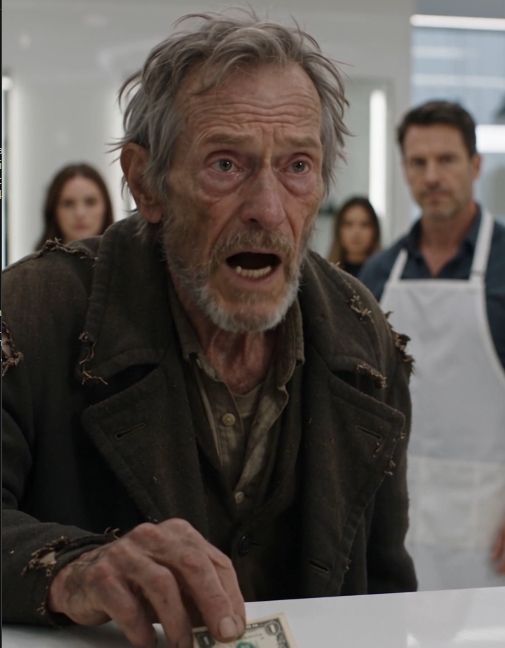
The old man’s eyes held something the barber had never seen in another human being — the quiet, exhausted dignity of someone who had been carrying a secret for decades and was finally too tired to carry it alone.
The barber’s name was Marco. He’d worked at Bellini’s Salon for eleven years, sweeping hair from the floor, mixing colors, learning every technique from the senior stylists. He loved this place. It was the only stable thing he’d ever had. And now, holding this envelope, he understood that the ground beneath his feet was not what he thought it was.
He looked down at the paper again.
The gold emblem on the envelope matched the faded gold script above the salon’s front door — Bellini’s. But beneath the name, in smaller, elegant handwriting, the letter read:
*To whom it may concern, this document confirms that I, Enzo Bellini, am the sole founder, owner, and creator of Bellini’s Salon, established in 1963. This letter was never meant to be opened in a place that had forgotten me. But if it is being opened, it means someone finally let me back through the door.*
Marco’s hands were shaking so badly that the paper trembled like a leaf in wind. He looked at the old man — Enzo — and felt something collapse inside his chest.
“You’re Enzo Bellini?” Marco whispered.
The old man nodded, once. Just once.
The receptionist, a woman named Dana, stepped forward with her arms crossed. She’d been watching the exchange with narrowing eyes, her perfectly manicured nails tapping against her forearm. She’d worked at the salon for three years, hired by the current management group that had purchased the lease from a corporation in 2019. To her, this place was a paycheck and a social stage.
“Okay, what is this?” she said, her voice sharp. “Some kind of performance art? Marco, you can’t just let random people into the—”
“He’s not random,” Marco said.
His voice was quiet but it landed like a slap. Dana blinked.
Marco turned the envelope around so she could see the gold emblem. Then he held up the letter.
“This is Enzo Bellini,” he said. “The man who built this place from nothing. The man whose name is above that door.”
Dana stared at the letter. Then she stared at the old man in his torn coat and broken shoes. Then she laughed — a short, uncertain sound that died when she saw Marco’s face.
“That’s impossible,” she said. “Bellini’s was bought by Ridgeway Holdings. The original owner — he died years ago. That’s what the records say.”
“The records say what they were told to say,” Enzo said.
His voice was barely above a whisper, but every person in the salon heard it. The three stylists near the back wall had stopped pretending to organize products. A client in the washing chair tilted her head, still draped in a black cape, foam dripping from her hair onto the floor.
Enzo reached into his coat again and pulled out a second item — a folded, yellowed newspaper clipping. The edges were soft from years of being touched. He handed it to Marco without a word.
Marco unfolded it carefully. The headline read: *LOCAL BARBER BUILTS SALON EMPIRE FROM SINGLE CHAIR. Enzo Bellini, 42, reflects on twenty years of Bellini’s Salon.*
The photograph showed a younger man — still thin, still humble, but standing straight, wearing a clean white apron, smiling beside a woman with dark hair and kind eyes.
“That’s my wife, Lucia,” Enzo said. “She helped me open the doors. She swept the floors when we couldn’t afford an assistant. She died four years after this photo was taken. Cancer. I never remarried.”
He paused. His jaw tightened.
“After she died, I wasn’t the same. I made mistakes. I trusted the wrong people. A financial advisor I’d hired to manage the salon’s investments started siphoning money. By the time I discovered it, he’d forged documents transferring ownership to a shell company. Ridgeway Holdings. He sold my salon out from under me while I was burying my wife.”
The salon was so quiet now that the hum of the fluorescent lights felt deafening.
“I fought it,” Enzo continued. “For years. But I ran out of money for lawyers. The courts sided with the paperwork — forged paperwork — and I lost everything. My name. My business. My wife’s legacy. They even changed the records to say I had died. Because dead men don’t file lawsuits.”
Dana’s face had gone white. She hadn’t moved from where she stood.
Enzo looked at her then, really looked at her, and there was no anger in his gaze. Just a deep, aching sadness.
“You pushed my dollar away,” he said softly. “And I understand why. I looked like nothing. I looked like no one. But that dollar was the last money I had, and I offered it because this place — this chair, these mirrors, these walls — are the only home I have ever known.”
Dana opened her mouth. Closed it. Her hand drifted up to her throat.
Marco folded the clipping and placed it gently back into Enzo’s hands. Then he did something no one expected. He turned to face the salon, removed his white apron, folded it neatly, and set it on the counter.
“I’m not cutting hair in a place that turns away its founder,” he said.
“Marco—” Dana started.
“No.” He shook his head. “I’ve been here eleven years. I kept my head down. I did my work. I never asked questions about who owned the building or where the profits went. But I know this: this man built something beautiful, and it was stolen from him. And I just stood here and watched you humiliate him for wanting to come home.”
He looked at the other stylists — three young women named Priya, Jules, and Bea, all of whom had been listening with wide eyes and tightening mouths.
Priya spoke first. “Is it true?” she asked Enzo. “All of it?”
Enzo nodded. “I can prove every word. The original incorporation documents. Tax records. Photographs. Letters from the city granting my permit in 1963. It’s all in storage. I kept copies of everything, even when I had nothing left. Because Lucia told me to. She said, ‘Enzo, the truth doesn’t expire.'”
Jules set down her scissors. Bea stepped forward and stood beside Marco.
Dana looked around the room and realized, with the slow horror of someone watching the ground vanish beneath their feet, that she was alone.
“Fine,” she said, her voice brittle. “Call whoever you want. I didn’t buy this salon. I just work here.”
“But you treated him like an animal,” Marco said. “You saw a man in need and you pushed him away. That’s not about ownership. That’s about who you are.”
Dana’s eyes glistened, but she didn’t respond. She turned and walked to the back room. The door clicked shut behind her.
Enzo stood in the center of the salon, the newspaper clipping pressed against his chest. He looked at the mirrors lining the walls — the same mirrors that had hung there for decades, reflecting every haircut, every conversation, every small human moment that had taken place in this room.
“This chair,” he said, touching the leather of the nearest styling station. “I bought this chair in 1964. A man in Brooklyn was selling it from his closed shop. I took the bus there with twelve dollars in my pocket. Lucia sat beside me.”
Marco guided him gently toward the chair and pulled it out.
“Sit down,” he said.
Enzo hesitated.
“Please,” Marco said. “Let me do what I should have done the moment you walked in.”
Enzo lowered himself into the chair. The leather creaked — the same sound it had made thirty years ago, and fifty years ago, and every year in between. He looked at his reflection: the gray beard, the deep lines, the eyes that had seen loss after loss after loss.
“I look like a ghost,” he murmured.
