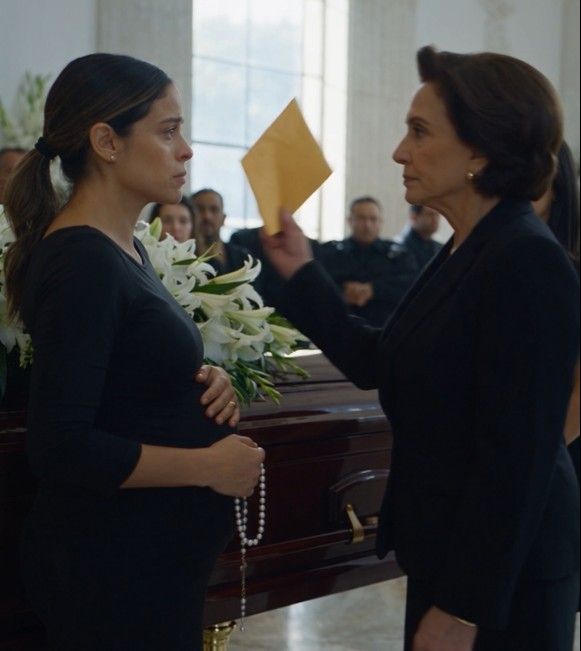
The envelope hit the coffin with a sharp slap. “Doña Teresa, please—this is Julián’s funeral,” I whispered, but she didn’t even flinch. She pulled out the papers and held them high for every mourner in the Church of San Agustín to see. “A DNA test,” she declared. “That child is not my son’s.”
The whispers hit me before the words fully did. I stood there with one hand on my eight-month belly and the other gripping the rosary Julián had given me on our wedding day, my legs shaking, feeling my baby shift inside me as if he could already sense that something was wrong. “That’s not true,” I said, but my voice barely made it past my throat.
Doña Teresa laughed—not loud, not angry, worse—amused. “My son may be gone,” she said, “but he was not a fool. We knew exactly what you were.” A nobody. An opportunist. The public school teacher from Iztapalapa who had dared to marry into the Mendoza name.
Then Fernanda stepped forward, and before I could move, before I could pull away, she grabbed my left hand and slid my wedding ring off my finger right there in front of everyone. Businessmen. Politicians. Relatives. Employees who had worked for Julián for years. All of them watching. None of them speaking.
Fernanda held the ring up like a trophy. “Look at her,” she said. “A widow, broke, and carrying a child that doesn’t even belong to this family.” I wanted to fight back. I wanted to scream. But the only thing I could think about was what Julián had said the morning he left for Valle de Bravo. “No matter what happens, trust Arturo.” “I already protected everything.”
Arturo was his lawyer, but Arturo wasn’t here. Doña Teresa leaned close to the coffin and placed the false papers on the lid, right on top of the white lilies. “You will leave the house today,” she said. “The accounts are frozen. The cars, the properties, the company—everything goes back to the real family.”
Everything. The home where I had painted the nursery myself. The crib Julián had assembled with his own hands at two in the morning. The name he had whispered to my belly every single night. Gone. Just like that.
Doña Teresa raised her hand, and two security guards stepped forward from the back of the church. “Get her out of here,” she said, “before she embarrasses this family any further.” And that’s when the church doors flew open, the sound breaking through the silence like thunder.
Every head turned. A man in a gray suit walked down the center aisle, and behind him, two assistants carried black briefcases and a portable screen. It was Arturo—Julián’s lawyer. He didn’t stop. He didn’t hesitate. He looked straight at Doña Teresa and said five words that silenced the entire church. “By strict instruction of Mr. Mendoza, no burial will take place until this video has been played.”
Doña Teresa smiled—confident, arrogant—clearly expecting a tribute to her son, a eulogy, a love letter to the family name. But when the screen flickered on and Julián’s face appeared, every trace of color left her face. I couldn’t breathe, because the first words out of his mouth made me realize he had known. He had known all along what they would try to do to me after he was gone. And he had left me something they never expected.
Julián looked directly into the camera, his eyes tired but steady, his voice calm in a way that only made the silence around us heavier. “If you are watching this,” he said, “then I am gone, and my mother has already tried to destroy the woman I love.” Doña Teresa’s hand flew to her chest. Fernanda took a step back. The mourners leaned forward, hungry for every word.
“I married Camila because I chose her,” Julián continued, and his voice cracked just slightly when he said my name. “No one forced me. No one arranged it. No one approved it. I loved her from the moment she spilled coffee on my suit at that awful conference in Puebla, and I have loved her every day since.”
Tears were streaming down my face now, and I didn’t bother to wipe them away. The baby kicked, hard, as if he too was listening. “The child she carries is mine,” Julián said. “I have the DNA test to prove it—the real one, not the forgery my mother paid a lab technician to create three weeks ago.”
A collective gasp moved through the church like wind through wheat. Doña Teresa’s face went from pale to gray. She opened her mouth to speak, but Arturo held up a hand, and she fell silent.
“The forgery was commissioned on March 14th,” Julián continued, “by Teresa Mendoza, who paid Dr. Esteban Ruiz fifty thousand pesos to falsify the results. Dr. Ruiz has already provided a sworn statement to my attorney. He has also provided the bank records showing the transfer from my mother’s personal account.”
Fernanda grabbed her mother’s arm, her face twisted with panic. “Mama, what is he talking about?” she hissed, but Doña Teresa shook her off, her eyes fixed on the screen as if she could will it to stop playing.
“I know about the house,” Julián said. “I know about the accounts. I know about the cars. I know about every single thing my mother and sister have planned to take from my wife and child.” He paused, and his jaw tightened. “And I have made sure that none of it will work.”
Arturo stepped forward and opened the first briefcase. He pulled out a thick stack of documents, bound in blue leather, and held them up so everyone could see the embossed seal on the cover. “The last will and testament of Julián Mendoza,” he announced, “executed six weeks before his death, witnessed by three attorneys and notarized by the state of Mexico.”
Doña Teresa’s voice finally broke free. “That’s impossible. He would have told me. He told me everything.”
Arturo didn’t look at her. He simply opened the will and began to read. “To my mother, Teresa Mendoza, I leave the house in Coyoacán, which she has always loved, and a monthly allowance sufficient to maintain it. I leave her nothing else.”
Doña Teresa’s mouth fell open. The house in Coyoacán was beautiful, yes, but it was a fraction of the Mendoza estate. The family mansion, the properties in Valle de Bravo and Acapulco, the company shares, the investments—all of it was elsewhere.
“To my sister, Fernanda Mendoza,” Arturo continued, “I leave the apartment in Polanco and the art collection she has always admired. I leave her nothing else.”
Fernanda’s face went red. “That’s not fair. I worked for the company for years. I deserve—”
Arturo cut her off with a single raised finger. “To my wife, Camila Reyes Mendoza, I leave the family mansion, the properties in Valle de Bravo and Acapulco, fifty-one percent of Mendoza Industries, all liquid assets, and full custody and control of our unborn child’s inheritance until he or she reaches the age of twenty-five.”
The church erupted. Voices rose from every pew, overlapping, arguing, questioning. But Arturo kept reading, and his voice was calm and relentless. “To my unborn child, I leave the remainder of my estate, to be held in trust, with Camila Reyes Mendoza as sole trustee.”
Doña Teresa was shaking now. She grabbed the edge of the coffin as if she needed support. “This is a lie,” she said. “This is a forgery. My son would never—”
“There’s more,” Arturo said, and the room went quiet again. He pulled a smaller envelope from the briefcase. “This was sealed and signed by Mr. Mendoza, to be opened only if his mother contested the will.”
He opened the envelope. Inside was a single sheet of paper, and Arturo read it aloud. “To my mother,” he read, and his voice was almost gentle. “I know you will try to take from Camila what I have given her. I know you will claim the child is not mine. I know you will try to freeze the accounts and take the properties. I have prepared for all of this.”
Doña Teresa’s eyes were wild. “Stop,” she said. “Stop this.”
“I have prepared for all of this,” Arturo repeated. “Because I know you, Mama. I have always known you. You never wanted me to be happy. You wanted me to be a Mendoza, not a man. You wanted me to marry someone who would make you look good, not someone who would make me feel alive.”
He paused, and I could hear Julián’s voice in my head, the way he used to talk to me in the dark, his hand on my belly, his lips against my hair. “Camila made me feel alive,” the letter continued. “She made me laugh. She made me think. She made me want to be better than I was. And you hated her for it.”
Doña Teresa took a step back. Her heel caught on the edge of the coffin, and she stumbled. Fernanda grabbed her, but Doña Teresa shook her off, her face twisted with something between rage and grief. “You don’t understand,” she whispered. “I was trying to protect him. I was trying to protect the family.”
“You were trying to control him,” Arturo said, and the words landed like stones. “And when you couldn’t control him, you tried to destroy the only thing he loved.”
The screen flickered again, and Julián’s face reappeared. He was holding something now—a small silver rattle, the one he had bought the day we found out I was pregnant. “Camila,” he said, and his voice was so soft I had to lean forward to hear it. “If you’re watching this, I’m sorry I couldn’t be there. I’m sorry I couldn’t hold your hand. I’m sorry I couldn’t see our baby’s first smile or hear his first word.”
I was sobbing now, the rosary digging into my palm, the baby rolling and kicking as if he was dancing to his father’s voice. “But I want you to know that I never stopped loving you,” Julián said. “Not for one second. Not for one breath. And I want you to know that you are not alone. Arturo will take care of you. The trust will take care of you. And our child will know, every single day, that his father loved him before he was even born.”
The video ended. The screen went dark. The church was silent.
Then Arturo reached into the second briefcase and pulled out a small, velvet box. He walked toward me, past Doña Teresa, past Fernanda, past the security guards who had been told to throw me out. He stopped in front of me and opened the box.
Inside was my wedding ring. The one Fernanda had taken. The one I had thought I would never see again. “Mr. Mendoza recovered it from his sister’s safe three weeks before his death,” Arturo said. “He wanted to be sure you had it back.”
I took the ring with trembling fingers. I slipped it back onto my finger. It fit perfectly, as it always had.
Doña Teresa made a sound—a low, guttural sound—and fell to her knees. Fernanda tried to pull her up, but she wouldn’t move. She just knelt there, on the cold stone floor of the church, staring at the coffin of her son.
“You destroyed everything,” she whispered, and I wasn’t sure if she was talking to me or to herself or to God. “You destroyed everything.”
“No,” I said, and my voice was steady now, steady in a way it hadn’t been all morning. “You did. The moment you decided I was the enemy instead of the family.”
Arturo turned to the mourners. “The burial will proceed as planned,” he said. “Mrs. Mendoza and her child will follow the procession. Anyone who objects is welcome to leave now.” No one moved. No one spoke. Doña Teresa stayed on her knees, and Fernanda stayed beside her, and the rest of the church watched as I walked to the coffin and placed my hand on the white lilies.
“I love you,” I whispered to Julián. “I always will.”
The burial was quiet. The sun was setting over the cemetery, painting the sky in shades of orange and pink. I stood beside the grave with Arturo on one side and the priest on the other, my hand on my belly, my wedding ring glittering in the fading light. Doña Teresa and Fernanda had left before the procession began. No one had tried to stop them.
The next few weeks were a blur. Arturo helped me move into the mansion—the one Julián had left me—and I walked through every room, touching every wall, remembering every moment we had spent there. The nursery was exactly as I had left it. The crib was still in the corner, the mobile still hanging above it, the name Julián had whispered still painted on the wall: Mateo.
The legal battles were long and ugly. Doña Teresa contested the will. She hired lawyers, filed motions, gave interviews to the press, claiming I had manipulated her son, that the will was a forgery, that the child was not his. But Arturo had prepared well. The real DNA test proved Mateo was Julián’s son. The bank records proved Doña Teresa had paid for the forgery. The witnesses proved she had planned the whole thing.
The judge ruled in my favor. Doña Teresa was ordered to return the house in Coyoacán, which she had already tried to sell. Fernanda was ordered to return the art collection, which she had already shipped to a gallery in New York. They were both fined for contempt. They were both warned that any further interference would result in criminal charges.
Mateo was born on a Tuesday morning, six weeks after the funeral. He had his father’s eyes. He had his father’s hands. He had his father’s stubborn chin and his father’s quiet way of watching the world. I held him in the hospital room and cried, and Arturo stood by the window, and the sun streamed in, and I felt Julián in the room with us, as real as the baby in my arms.
The final twist came a year later. Mateo was learning to walk. He was clumsy and determined, just like his father. I was sitting on the floor of the nursery, holding out my hands, and he was wobbling toward me, and Arturo was taking pictures, and the doorbell rang.
