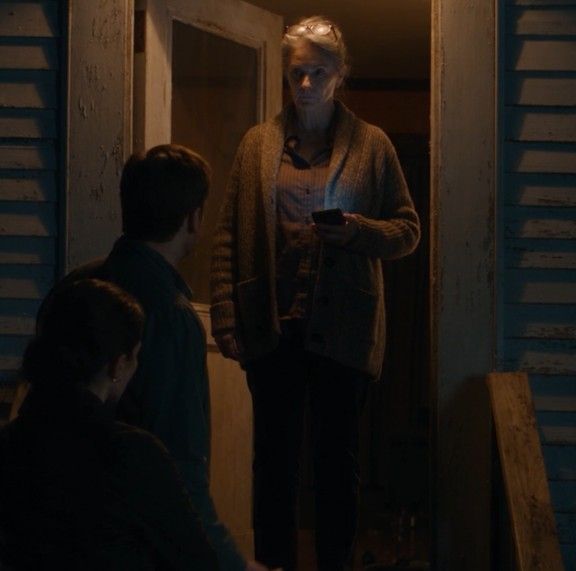
*Margaret — We’re sorry. Karen shouldn’t have spoken to you the way she did. We should have asked. We should have known better. The cabin is beautiful. You and Robert built something special. We won’t trouble you again. — Paul*
She read it twice.
Then she folded it and put it in the drawer where Robert kept his old maps and receipts, the drawer she never opened, the drawer that held things she wasn’t ready to sort through but couldn’t bear to throw away.
She opened every window in the cabin. Cold mountain air rushed in, filling the rooms with the smell of pine and earth and distance. She stood in the center of the living room, on the rug, between the fireplace and the walnut table, and breathed.
This was hers.
Not because of a deed or a law or a threat. Because she had earned it. Because Robert had driven the nails and she had chosen the curtains and together they had built a place where the world could not reach them unless they allowed it.
She allowed it now, on her own terms.
Three weeks later, Mark came to the cabin alone.
He knocked this time. She opened the door and he stood on the porch with his hands in his jacket pockets and snow in his hair.
“Can I come in?”
She stepped aside.
He walked into the living room and stopped where she had stopped that night — in the middle of the room, looking at the table, the chairs, the fireplace. He ran his hand along the back of the sofa the way he used to when he was a boy, trailing his fingers along furniture like he was reading braille.
“Emily and I are separated,” he said.
Margaret said nothing.
“She’s staying with her parents. I’m at the house.” He paused. “I’ve started seeing someone. A therapist. First time in my life.”
She nodded.
“Mom, I need to say something, and I need you to let me finish before you respond.”
She sat down. He remained standing.
“I failed you. Not just with the cabin. For years. I let Emily — I let myself — treat you like you were something to be managed. Like your life was a resource to be allocated. And I did it because it was easier than admitting that my wife was using me to get to you.”
His voice cracked on the last word. He kept going.
“I’m not asking you to forgive me today. I’m asking you to let me show you, over time, that I understand what I did. And that I’m different now.”
Margaret looked at her son. At the snow melting in his hair. At the red rims of his eyes. At the man who had once handed her a dandelion and told her it was a rose, because he wanted her to have something beautiful, even if it was a lie. He had always wanted her to have something beautiful. He had simply forgotten what beautiful meant.
“Sit down,” she said.
He sat.
She got up, went to the kitchen, and made him a cup of tea. Earl Grey, the way he liked it, with too much honey. She brought it back and set it in front of him. Their fingers touched on the mug, and neither of them pulled away.
“I forgive you,” she said. “But forgiveness is not the same as forgetting.”
“I know.”
“Things will be different.”
“I know that too.”
She sat across from him, the way Robert used to sit across from her, and they drank tea in silence while the fire crackled and the mountain held them in its ancient, indifferent arms.
