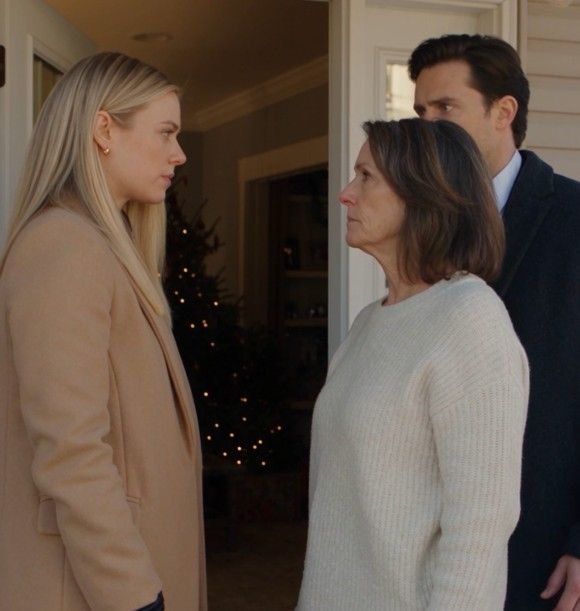
The phone was still warm in my hand when Marcus came into the kitchen.
He stood in the doorway without his tie, shirt sleeves rolled past his wrists, one palm flat against the frame as though the house had begun to lean and he was the only thing holding it up.
“What did she say?”
“Who?”
“Your attorney. What did she say?”
I set the phone face down on the table. “She said stop talking and start sending paperwork.”
That landed. He looked at the floor, at the gingerbread cooling on the rack, at the cinnamon steam coming off the stove, anywhere but at me.
“I didn’t know about the sale either, Mom.”
“I know you didn’t.” I poured coffee I had no intention of drinking. “You didn’t know about the six hundred twenty thousand. You didn’t know about the three hundred thousand. You didn’t know about eighty thousand in cards. You are, without exaggeration, the least informed man at this table.”
He almost smiled. It died before it arrived.
“I keep thinking there’s a number where it stops.”
“There is. It’s the amount you’re willing to lose.”
The refrigerator hummed. Somewhere down the hall, a door closed softly, and I knew she was listening, standing barefoot on the other side of the wall with her ear near the wood.
“Go to bed, Marcus.”
He didn’t go.
Instead he pulled out a chair, sat the way his father used to sit, dropping into it all at once with his shoulders already defeated, and said, “Then show me. Show me what she’s going to send.”
So I went to the dining room and lifted down the box of my husband’s records from the top of the china cabinet, the one I hadn’t opened since the spring I packed it away, and I brought it to the table between us.
Tax returns. Receipts. A folder labeled in my handwriting with a year from a decade ago.
And inside it, folded twice, gone soft at the creases, coffee-ringed along one edge, a single page.
It was typed. My husband had typed it himself on the old machine he refused to throw away, hunting and pecking with two fingers while I rolled my eyes at him from the couch.
I handed it to Marcus.
He read it out loud, and his voice got smaller as he went.
“‘Promissory note. Borrower, Marcus. Lender, his mother. Principal, thirty-five thousand dollars, given for the purpose of a down payment on real property known as… Birchwood Lane.'”
He stopped. Swallowed.
“‘Borrower acknowledges this sum is a loan and not a gift. Borrower agrees that the lender shall receive written notice of any sale, transfer, or refinance of said property, and that the outstanding balance shall be paid to the lender from the proceeds of any such sale prior to distribution to the parties.'”
His thumb was pressing a white crescent into the paper.
There was a second page. I turned it over. Two signatures at the bottom, side by side, both in blue ink. Marcus. Delaney. And beneath them, a third line in my husband’s cramped block letters: WITNESSED, and a date, and then the small dark stamp of the county clerk.
“It was recorded,” Marcus whispered.
“It was recorded,” I said. “Your father made you both sign it in this kitchen. He drove to the courthouse the next morning. He came home with a stamp on his coffee cup and told me I’d thank him one day, and I told him he was being ridiculous and suspicious of a son who would never do that to me.”
The words came out flat and even, and I hated how flat they were.
Marcus set the page down and pushed it back toward me like it was hot.
“She told me it was a gift.”
“Then she lied to you too.”
He opened his mouth. Closed it. Opened it again. “Maybe you forgave it and forgot. People do that. You could have—”
“I didn’t forget anything, Marcus.”
From the hallway, the soft click of a door, and then Delaney was there in the kitchen doorway in silk pajamas, blonde hair still perfect, arms folded, reading the paper on the table the way you’d read a restaurant menu you had no intention of ordering from.
“Well,” she said. “That’s ancient.”
“It’s recorded with the county.”
“It’s thirty-five thousand dollars, Helen. From before the Obama administration. Nobody is coming for you.” She said my name the way she always said it, a half-tone too familiar, like we were sorority sisters who had drifted. “We’re family. Family forgives.”
“Did I forgive it?”
She blinked. “You must have.”
“I didn’t.”
Something small and hard moved behind her eyes. She looked at Marcus, waiting for him to back her, and he was staring at the two blue signatures at the bottom of the page as if he had never seen his own handwriting before.
“We’re going to bed,” Delaney said. “We’re exhausted. Everything will look different in the morning.”
She put her hand on his shoulder and steered him out of the chair.
At the archway he turned back. Just his head, just his eyes, and the light from the Christmas tree throwing little red and green sparks across his face.
“I didn’t know it was recorded,” he said.
Then she pulled him into the dark of the hallway, and the bedroom door shut with a sound like a book closing.
I stayed at the table until the coffee went cold and the house got that deep, settling quiet it only has after midnight, and I ran my finger over my husband’s careful little letters, and I thought: you knew. You always knew, and you let me call you paranoid for twenty years.
The morning came in gray and thin through the kitchen windows, the kind of December light that doesn’t warm anything, and I was at the stove when I heard the front door open and Delaney’s voice carry across the porch in that bright, carrying tone she used when she wanted an audience.
