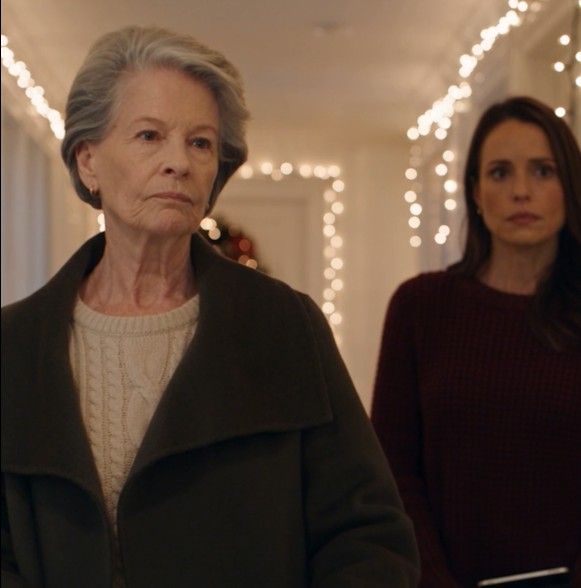
The last document was a single page, crisp and white, with a notary seal in the corner and three signatures at the bottom. David saw it before I even set it down, and his face went the color of old ash.
I placed it on the marble console beside the deed.
“This,” I said, “is the transfer of ownership.”
Jessica leaned forward, her tablet clutched against her chest like a shield. “What transfer?”
“The transfer of this house,” I said, “from me to the trust.”
David’s knees buckled. He grabbed the edge of the console to steady himself.
“Mom, don’t—”
“The trust,” I continued, “that I established six months ago. The trust that names my grandchildren as the sole beneficiaries. The trust that prevents anyone—including you, David—from borrowing against the equity, selling the property, or using it as collateral for any loan.”
Jessica’s mouth opened. Closed. Opened again. “That’s not possible. We would have known.”
“You would have known if you had read the documents you signed when you moved in,” I said. “The ones that outlined the terms of your residency. The ones that stated clearly that any attempt to access the equity of this home would result in immediate eviction.”
David’s voice was barely a whisper. “You tricked us.”
“No,” I said. “I protected myself. I protected my grandchildren. I protected the home your father and I built with our own hands. The home where you learned to walk. The home where you celebrated every birthday. The home where your father died in the bedroom down the hall.”
I reached into the folder one last time and pulled out a small, worn envelope. I held it up for the room to see.
“And this,” I said, “is the letter your father wrote before he died. The one he asked me to give you when you turned forty. I forgot. Grief does that. But I found it last week. And I read it.”
David looked like he might be sick.
“You want to know what it says?” I asked. “It says: ‘David, I love you. But you have always taken more than you gave. You have always looked for shortcuts. You have always looked for someone else to pay the price for your choices. I hope you learned from me. I hope you became a man of honor. I hope you earned your place in this family.'”
I set the letter down beside the deed.
“You didn’t,” I said quietly. “You didn’t earn it. And now you have to leave.”
The room was so silent I could hear the Christmas lights humming. Twenty guests stood frozen in my living room, plates of turkey in their hands, wine glasses halfway to their lips. They had all paid eighty dollars to Jessica. They had all believed they were attending a holiday dinner. They had all believed I was the one who was out of line.
Jessica finally found her voice. “You can’t do this. We live here. We have rights.”
“You have the right to leave peacefully,” I said. “You have thirty days. The trust has already notified the sheriff’s office. If you’re still here after that, you’ll be removed.”
David took a step toward me. “Mom, please. The kids. Their school. Their friends. Jessica’s job. We can’t just—”
“You should have thought about that before you stole from me,” I said. “You should have thought about that before you stood there while your wife demanded eighty dollars for me to enter my own home. You should have thought about that before you decided I was someone you could take from without consequence.”
I looked at Jessica. “You made one expensive assumption,” I said. “You assumed I didn’t know. You assumed I was old and tired and easy to push aside. You assumed I would never fight back.”
I picked up the deed and held it up.
“You were wrong.”
The next few months were hard.
David and Jessica moved out three weeks later. They found a small apartment across town. It was cramped and expensive. The children had to change schools. Jessica had to take a job at a department store. David stopped speaking to me.
I didn’t hear from him for a year. Not a call. Not a card. Not a text. I heard from my grandchildren, though. They called on Sundays. They told me about their new school. Their new friends. Their new life. They didn’t mention their parents. They didn’t have to.
I stayed in my house. I decorated for Christmas alone. I cooked turkey for myself and my memories. I walked through the rooms and touched the walls and remembered everything.
I wasn’t lonely. I was quiet.
And then, one evening, there was a knock at the door.
I opened it.
David stood on the porch. He was thinner. Older. His eyes were red.
“Mom,” he said. “I’m sorry.”
I didn’t say anything. I just looked at him.
“I know it’s not enough,” he said. “I know I can’t undo what I did. But I want you to know that I understand now. I understand what I lost. I understand what I threw away.”
He held out a small box. “This was Dad’s. I found it in the storage unit. I thought you should have it.”
I took the box. I opened it.
Inside was a watch. A simple, silver watch. The one my husband had worn every day for forty years.
I closed my hand around it. I looked at David.
“Come in,” I said. “I have turkey.”
He came inside. He sat at the table. He ate with me. We didn’t talk about the past. We talked about the future. We talked about the grandchildren. We talked about the house.
And when he left, I hugged him. Not because I forgave him. Because I loved him. Because he was my son. Because sometimes love means giving someone the chance to become the person they should have been.
The final twist came a year later.
Jessica called. She was crying. She said she had left David. She said she had found someone else. She said she wanted to see the children. She said she wanted to be part of their lives.
I listened. I didn’t interrupt. When she finished, I said one sentence.
“You made your choice.”
I hung up. I walked to the window. The sun was setting. The sky was pink and gold. The Christmas lights were glowing.
I was not Jessica’s doormat. I was not David’s wallet. I was not the old woman they had tried to push aside.
