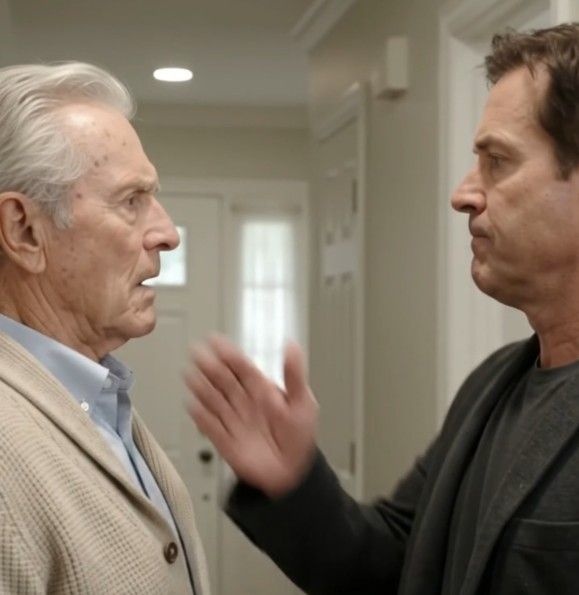
“I didn’t know,” he kept saying.
“I believe you didn’t know about the jewelry,” I answered. “But you did know you hit me. You did know you asked me to destroy evidence. Don’t let the first truth erase the second.”
He accepted that without argument. It was the first time I had heard him answer a hard sentence with silence instead of a defense.
The police and prosecutors handled the matter from there. Mia was offered legal representation, and the allegations were assessed through formal procedures rather than family accusations. Eventually she admitted responsibility for several thefts as part of a resolved criminal case, with restitution and other court-ordered consequences. The details belonged in the court record; I refused to turn them into a neighborhood spectacle.
She never gave a satisfying explanation for the staged accusation. Through her attorney she said she had feared I was about to expose the thefts and had wanted Daniel to take her side before I could speak. It was a devastating thing to hear, not because it was clever, but because she had understood exactly where my son was most vulnerable: his desire to believe that love required instant loyalty.
Her plan had not protected her. It had destroyed the trust she was trying to manipulate. The recovered footage, the records of the stolen possessions, and her own decisions made it impossible for Daniel to pretend this was a misunderstanding. Their marriage ended after a long separation. He worked with an attorney to settle the practical matters, and Mia’s future would be shaped by the consequences the court had imposed and the relationships she had chosen to damage.
I did not feel victory. When the case was resolved, I came home, put the earrings on the table, and sat beside them until the light faded. The house was mine again in the most literal sense. But a locked door and an accurate recording couldn’t give me back the easy belief that anyone I loved was incapable of hurting me.
My daughter came over with soup. She put it on the stove and began quietly washing the dishes, leaving me free to speak or remain silent. I asked her whether she had known Margaret kept the earrings in the locked drawer. She nodded. “Mom told me she didn’t wear them much after you gave them to her,” she said. “She was afraid she’d lose one. But she loved them.”
“I thought losing them meant I had failed her,” I admitted.
My daughter sat beside me. “Dad, Mom didn’t marry a security system. She married you. She’d be angry about what happened to you, not disappointed that someone stole from you.”
The words loosened something that had been knotted for months. I had blamed myself first for misplacing the watches, then for not noticing the thefts, then for not stopping Daniel’s hand. It was easier to believe I had failed than to acknowledge that someone else had made a choice I could not control.
Daniel asked to visit the following Sunday. I agreed only after telling him that he could not have access to the house without permission and that any future threat would end the visit. He arrived carrying no gifts. His eyes went straight to my cheek, though the mark had long since faded.
“I’ve been seeing someone,” he said. When I raised an eyebrow, he explained that he had begun counseling to understand his reaction that night and the way he’d allowed Mia to isolate him from his family. “I don’t expect you to trust me because I say I’m trying. I just wanted you to know I’m doing the work.”
We sat in the kitchen. I told him what the slap had felt like: the shock of a familiar face turning hostile, the humiliation of knowing my son had chosen a stranger’s accusation over a single question, the fear that I might not be believed even with a camera above us. He kept his hands flat on the table and listened.
“I thought I was defending my wife,” he said. “I was really defending the version of my life I didn’t want to lose.”
“And you were willing to lose me instead,” I replied.
He nodded. “Yes.”
I did not forgive him that day. I told him forgiveness was not a door that opened because he had finally said the right thing. It might come in time, but rebuilding trust would require him to behave differently in the moments when defending me was difficult, not merely when it was easy.
He asked whether he could help with the garden. Margaret’s roses needed pruning, and I had been putting it off. We worked outside for an hour, passing tools back and forth with careful politeness. At one point he held a thorny branch steady while I cut it, and I remembered teaching him as a boy to keep his fingers clear of the blade. We were both painfully aware of how far we had traveled from that simple kind of trust.
In early autumn, my daughter and I sorted Margaret’s jewelry box. I intended to return the recovered earrings to their velvet case and close the drawer. But beneath the tray we found an envelope addressed in Margaret’s sloping handwriting. My name was on the front, along with the words For a day when you need to remember.
The envelope had been there for years. I could tell by the faded paper and the way Margaret had sealed it with a little flower sticker she used on birthday cards. My hands shook as I opened it. Inside was a photograph of our family at a picnic: Daniel laughing with his mouth full, our daughter leaning against Margaret’s shoulder, me trying to keep the tablecloth from blowing into the grass.
On the back she had written, We were never perfect, but the good moments were real. Don’t let anyone teach you that love means giving up the truth.
There was also a short letter. Margaret had written it when she was worried about her health. She told me to keep living if she was gone, to ask for help when I needed it, and to remember that our children were people we could love without carrying every decision they made. She ended with a line that made me set the paper down and cover my eyes.
The greatest gift we gave them was a home where the truth mattered. Make sure it stays that way, even when telling it hurts.
My daughter put her hand over mine. Neither of us spoke for a long time. Margaret had not known about Mia, the missing jewelry, or the night Daniel struck me. Yet her words seemed to reach straight through those events to the part of me still struggling to believe I had done the right thing.
Daniel came by the next weekend, and I showed him the letter. He read it standing beside the kitchen window. When he reached the last sentence, his face crumpled. He sat down slowly, as if the chair were the only thing keeping him upright.
“She would have been ashamed of me,” he whispered.
“She would have expected better from you,” I said. “And she would have wanted you to become better, not spend your life hiding from what you did.”
He read the letter again and asked if he could have a copy. I made one. I kept the original with the recovered earrings, but not in the same locked drawer. I put it in a small wooden box on the living-room shelf, where I could reach for it on difficult days without feeling I was guarding treasure from my own family.
My daughter continued visiting for Sunday dinners. Daniel joined us when I invited him. We spoke about Margaret’s recipes, the state of the garden, and the absurdly persistent leak beneath the kitchen sink. We did not pretend the past had disappeared. Sometimes we talked about it directly. More often our growing steadiness was visible in smaller things: Daniel asking before borrowing a tool, my daughter leaving without worrying that I’d be alone, me opening the door because I wanted company instead of because I was afraid to refuse it.
