“She staged the entire thing underneath a camera she never knew existed.
Every tear. Every scream. Every button she tore off her own blouse. Recorded, all of it, by a little black dome in the corner of my ceiling that she only noticed when it was far too late.
My name is Thomas Harrison. I am seventy years old, and I owe that camera more than I owe most people.
It was not there for her. It was there because three months before that dinner, things began disappearing from my bedroom.
Expensive watches, gone. A gold bracelet, gone. At first I blamed myself — a misplaced box, an old man’s memory going soft around the edges. A man my age would rather believe he is losing his mind than believe his own house is being emptied around him.
Then my late wife Margaret’s diamond earrings vanished out of a locked drawer. Locked. Things do not walk out of a locked drawer by themselves, and whoever had been helping themselves to my home knew that house, knew that drawer, and knew I was too proud and too grief-blind to say anything out loud.
So I had cameras installed in the common areas, and I told no one. Not my daughter. Not even my son.
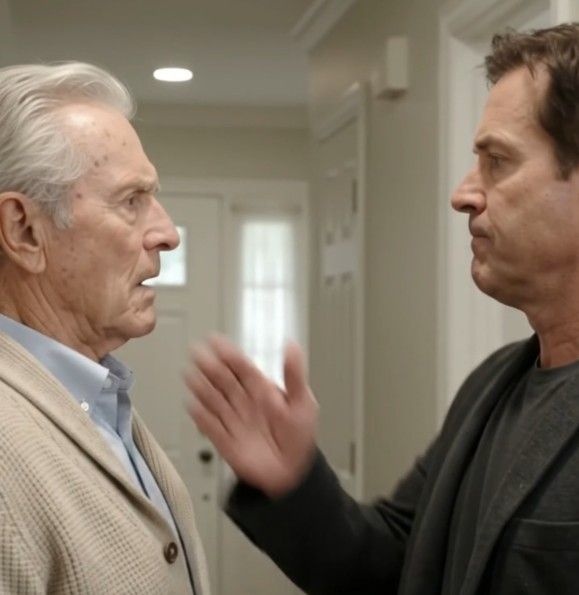
The one in the hallway had a clear view of the staircase, the window, and the exact stretch of wall my daughter-in-law Mia would later throw herself against while she screamed that I had come after her.
My son Daniel believed her story in a single breath and slapped me for it. Then he saw me point at the ceiling. Then he demanded I delete the footage — because his wife was involved, as if that settled it. And Mia, who had been sobbing without pause for ten minutes, stopped crying in the middle of a breath the instant her eyes found that little black dome.
Her first clear words of the night were not a denial. They were a plea, aimed at the one piece of evidence that could not be charmed, rushed, or shouted down.
“”Don’t watch the camera.””
Somebody had been moving through my house and my locked drawers for three months. That night, under my own camera, somebody else showed me exactly how fear behaves when it realizes it has been witnessed all along.
Mia’s hand rose toward the black dome as if she could reach across the hallway and cover its lens. Her face changed with each breath. First the panic, then an almost calculating stillness, then a smile so thin it was barely there.
“Thomas,” she said, “we can talk about this.”
Daniel stood between us, the hand he’d used to strike me hanging at his side. My cheek burned. The silence after her plea was so complete I could hear the kitchen clock through the open doorway. I had spent three months trying to understand what was happening inside my house. Now my son was asking me to help hide the answer.
“Don’t move,” I told them. “And don’t touch the camera.”
“Dad, this is insane,” Daniel said. “If you keep a recording of Mia, you’re going to destroy our family.”
I looked at him. “You hit me because she said I attacked her. Before you ask me to erase anything, don’t you want to know whether she told the truth?”
He stared at the floor. It was the first time I’d ever seen the confidence leave his face so quickly. Mia reached for his arm and said the camera wouldn’t show how frightened she’d been. Then she looked at me and warned that playing the footage would make the evening much worse.
“It’s already worse,” I said. “I want you both to sit in the living room while I make a copy.”
I did not trust myself to keep arguing in that narrow hall. I went to my study, closed the door, and called my daughter. She had known about the missing things because she’d helped me search for Margaret’s earrings. She was also the only person I had told about getting professional advice after the valuables disappeared. My voice sounded strangely steady as I described what had happened.
“Dad, are you safe?” she asked immediately. “Do you need me to call someone?”
“I don’t think they’re going to hurt me again,” I answered, then realized I could not be certain. “I want a witness, and I want to preserve the recording.”
She told me to call the police if I felt threatened and said she would come over. I asked her to wait outside until I could speak with Daniel. Then I opened the camera system on my computer and exported the relevant footage to a separate drive. I saved a second copy according to the installer’s instructions, noting the time, date, and camera location.
I watched only enough to know the recording existed. Mia was visible in the hallway. So was I, standing several feet from her with my hands open. She looked toward the dining room, seized the edge of her own blouse, and tore away two buttons. Then she threw herself against the wall and started screaming.
I stopped the video. For one instant I sat completely still, my fingertips touching the keyboard, because the truth was worse than the fear I’d carried. She hadn’t merely exaggerated an argument. She had constructed an accusation and watched my son punish me for it.
When I went back to the living room, Daniel sprang to his feet. “Did you delete it?”
“No.” I placed the drive in my shirt pocket. “I watched enough to know I never touched her.”
Mia stared at me. “You’re going to believe a camera over your own family?”
“I watched your hands tear the buttons off,” I said. “I watched you throw yourself against the wall. You can explain that if you want, but you cannot tell me I imagined it.”
