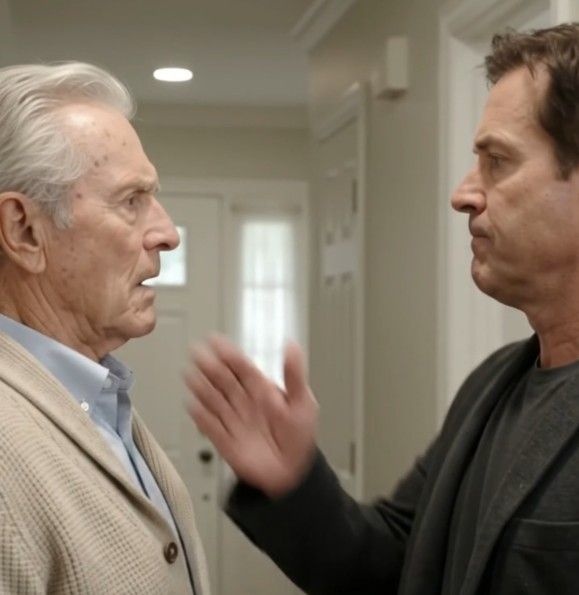
She turned to Daniel. “He installed surveillance without telling us. That’s a violation.”
“The cameras are in the common areas of my home,” I said. “I sought advice before installing them. There are none in bedrooms or bathrooms. We’ll let the proper authorities determine what can be used. I’m not arguing about it with you.”
Daniel pressed his palms to his eyes. I had seen him as a little boy after breaking a neighbor’s window, terrified that admitting the truth would end the world. I wanted to reach out. My cheek reminded me that he had grown old enough to choose violence when he was afraid.
“Why did you do it?” he asked Mia.
She said nothing. Then she began crying again, quieter this time, and told him that she had been overwhelmed, that I disliked her, that he never defended her. Each explanation circled the accusation without accounting for the buttons or the wall.
“I will not discuss this while you try to turn it into another performance,” I said. “I need you to leave my house tonight. You can collect your belongings later with arrangements made in advance.”
Daniel looked at me, stunned. “You’re asking your son to leave?”
“I’m asking the man who struck me to leave,” I answered. “You are my son. Both things are true.”
My daughter arrived before they went. She stayed on the porch while Daniel carried his coat outside, and I could see from the doorway how hard she was working not to confront him. When Mia passed her, she kept her eyes on the path. The car doors shut. Their headlights swept across the ceiling, then disappeared down the street.
Only after the house grew quiet did my knees give way. I sat on the bottom stair and covered my face. My daughter came in, sat beside me, and put an arm around my shoulders. For months I had feared I was misplacing my mind. That night I learned I could trust my memory, and the relief was so tangled with grief that I couldn’t tell them apart.
“She took your mother’s earrings,” I whispered. “I don’t know how to prove that yet. But I think she took them.”
“We don’t need to decide everything tonight,” my daughter said. “We need to keep you safe and get help with what happened.”
We called the local police non-emergency number for guidance and made a report about the physical assault and suspected thefts. An officer came to take my statement. I described the missing watches, the bracelet, the locked drawer, and the hallway confrontation. I gave him the exported footage and told him what I had observed, careful not to claim it showed anything it didn’t.
The officer explained that the property losses would need a separate investigation. A recording of a staged confrontation did not automatically prove who had entered my locked drawer. I appreciated his caution. I had spent three months fearing my own judgment, and I wanted evidence, not a story convenient to my anger.
The next morning I photographed the drawers and locks, gathered receipts and old photographs of the missing jewelry, and reviewed the dates when family members had visited. I also asked a locksmith to replace the exterior locks and document the work. I changed my passwords and contacted the camera installer to confirm that the system was secured.
Daniel called on the second day. His voice was hoarse. “Mia says you filed a police report.”
“I did. You hit me. She accused me of something the video does not support. Valuable things have disappeared. I need the truth established by someone other than us.”
“I shouldn’t have slapped you,” he said. “But was a report really necessary?”
I sat at the kitchen table where Margaret used to arrange flowers from the garden. “When you struck me, you didn’t ask whether I was safe or whether the accusation was true. You’re still asking me to make the consequences smaller for you. I’m not going to do that.”
A long silence followed. Then he said he wanted to see the recording. I told him he could review it through an appropriate, documented arrangement, but he would not take the only copy or decide whether it was erased. He agreed in a small voice.
A few days later he watched it with his own attorney present. I wasn’t in the room. My daughter drove me to a café instead, and we sat beside a window watching rain move across the street. She told me stories about Margaret that I hadn’t heard from her before: how her mother used to slip little handwritten jokes into school lunches, and how she always saved the first ripe tomato for me.
When Daniel called that evening, he didn’t speak for several seconds. “I saw it,” he whispered. “Dad, I saw everything.”
“I know,” I said.
“I hit you for something that never happened.”
I wanted to say that everything would be all right. I wanted him to be ten years old again, with a scraped knee I could clean and a mistake I could help him mend. Instead I answered, “Yes, you did.”
He started to cry. I let him. Tears were not an apology, and they were not proof of change, but they were at least a sign that he had stopped trying to argue with reality.
The investigation into the missing valuables moved more slowly. I provided a list of dates when items were last seen, and the officers checked available leads. One watch had a recorded serial number. A local dealer, approached through the proper investigative process, identified a matching piece in a transaction involving someone connected to Mia. Another lead brought investigators to a pawn shop where a bracelet resembling mine had been sold.
I did not learn those details all at once. Each arrived in a phone call or formal update, and every update seemed to take something from me even as it returned a piece of certainty. The jewelry wasn’t lost in a drawer or hidden beneath a pile of laundry. Someone had carried it away from the place Margaret and I had built.
Then officers recovered the diamond earrings. They had been kept with paperwork from a transaction that investigators could trace. I identified them using an old photograph of Margaret wearing them on our anniversary. I remembered fastening the clasp behind her ear while she laughed because my hands were trembling. Holding the recovered earrings was like touching a fragment of a life I’d thought I could keep safe simply by locking a drawer.
The strongest revelation came when Daniel brought me a folder he’d found among shared household papers after he and Mia separated. Inside were records that matched several dates on my list, including a payment for jewelry made shortly after Margaret’s earrings disappeared. Daniel said Mia had told him the money came from selling possessions she’d inherited. He had believed her without asking questions.
