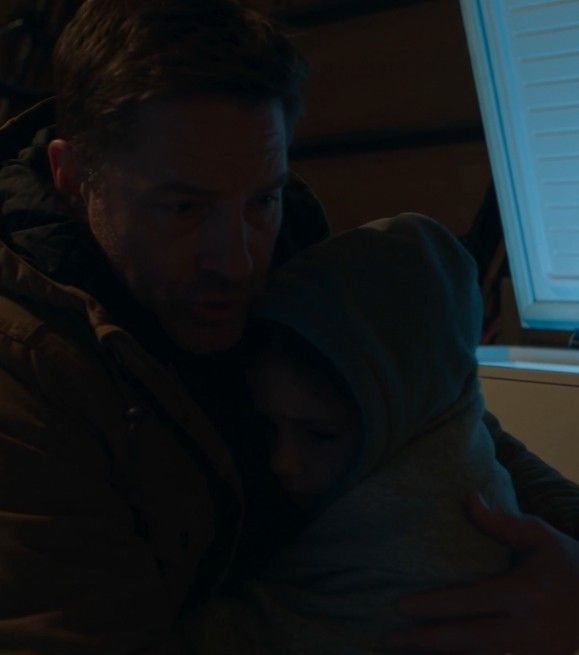
That was the most honest thing she ever said about the case.
Evelyn eventually entered a guilty plea rather than force Lily to prepare for trial. The agreement included a custodial sentence, probation after release, mandatory treatment, and a long-term protective order prohibiting direct or indirect contact with Lily.
At the sentencing hearing, Evelyn turned toward Taylor.
“You are destroying this family over a child’s exaggeration,” she said.
Taylor’s face went still.
“No,” she answered. “I almost destroyed my daughter by calling her fear an exaggeration.”
Evelyn looked shocked.
For the first time, Taylor had chosen Lily in a room where her mother could see it.
I did not forgive everything in that moment.
But I saw the beginning of change.
Lily’s recovery took much longer than the criminal case.
For months, she panicked around chest freezers in grocery stores. She refused to enter the garage at my rental house. If a door clicked shut behind her, she sometimes screamed before she understood where she was.
Her therapist taught us not to force bravery.
“We build safety first,” she said. “Courage grows after.”
So we built safety.
Lily chose a night-light shaped like a moon.
She decided her bedroom door would stay open while she slept.
We created a rule that no adult used isolation as punishment.
When she made mistakes, consequences happened in the open, with words she understood.
The ordinary transparency of it seemed revolutionary after what she had survived.
I found a small house to rent near her school. Nothing fancy. Two bedrooms, a narrow kitchen, a backyard with a tree too large for the property.
When I showed Lily the garage, she stopped at the threshold.
“No freezer?”
“No freezer.”
She looked up at me.
“Ever?”
“Ever.”
I signed the lease that afternoon.
The divorce decree had already divided our property, but custody had to be revisited after the abuse case. The final order gave me primary residential custody. Taylor received increasing unsupervised parenting time after months of successful supervision, therapy, and positive reports from Lily’s treatment team.
I struggled with that.
Part of me wanted the court to punish Taylor permanently.
Lily’s therapist challenged me.
“Are you trying to keep Lily safe,” she asked, “or make sure Taylor feels what you felt?”
The question angered me because it was accurate.
Safety had to be the measure.
Taylor was not Evelyn.
She had failed catastrophically, but she was taking responsibility and changing the conditions that allowed the failure.
So I stopped opposing progress merely because anger wanted a sentence longer than the law or Lily needed.
The first time Lily spent an entire Saturday alone with Taylor, I was sick with anxiety.
Taylor sent no constant updates because we had agreed not to make Lily feel monitored like a patient. She sent one photograph at noon: Lily sitting at a kitchen table making pancakes, flour across her cheek.
I stared at it for a long time.
Then I put my phone down.
When Lily came home that evening, she ran inside carrying a paper bag.
“Mom made cookies.”
“How was your day?”
“Good.”
That was all.
A good day did not erase a dangerous past.
It simply became one safe piece of the future.
The garage at Aspen Ridge Lane remained a difficult place. Police released the house after the investigation, and Taylor eventually decided to sell it. She asked whether I wanted any of the boxes I had originally gone there to retrieve.
