I tasted blood before I understood what my son had done.
One second I was standing in my kitchen on Christmas Eve, and the next, Jacob’s hand came across my face hard enough to split my lip open.
But when he looked at me bleeding against the china cabinet—my cheek already swelling, red glass from my late husband’s shattered ornament scattered around my feet—he didn’t look horrified.
He looked irritated.
Then he said the five words that changed everything: “See what you make me do?”
My son. The boy I raised alone after his father died. The child who once cried because he worried Rudolph would get cold flying through snow.
He had just blamed me for the bruise forming across my face.
Then he stepped over the broken glass, walked upstairs, locked his bedroom door, and went to sleep.
It was 11:14 p.m. on Christmas Eve.
For one moment, I saw exactly the woman Jacob expected me to see. Old. Widowed. Terrified of losing her only child. The kind of mother who would wake on Christmas morning, cover the bruise with makeup, and pretend the night before had never happened.
Then I looked harder.
And I saw the woman who buried her husband and still got out of bed the next morning to make breakfast for an eleven-year-old boy. The woman who worked two jobs, skipped meals, kept the electricity on, paid for college, covered his first apartment deposit, loaned him money after his divorce.
The woman who eight months ago opened her home to her forty-one-year-old son because he said he needed “a little time to get back on his feet.”
That woman had survived too much to become afraid of the man sleeping upstairs.
Even if that man was her son.
I rinsed the blood from my mouth. Held ice against my cheek.
Then I picked up the telephone.
My first call lasted five minutes. My second lasted eight. The third was shorter.
Then I walked into my late husband’s study and opened the bottom drawer.
Inside was the thick folder Jacob had been pressuring me to sign for days. He called it “routine estate paperwork.” He wanted my signature before the end of the year.
Something about the language bothered me. Whenever I asked questions, Jacob became impatient. “You’re making this difficult.” “They’re just forms.” “This will make everything easier later.”
Later. That word had begun appearing more often whenever Jacob discussed my money. My accounts. My home.
I called Thomas’s old attorney. On Christmas Eve. At nearly midnight.
His voice changed immediately. “Eleanor. Do not sign anything.”
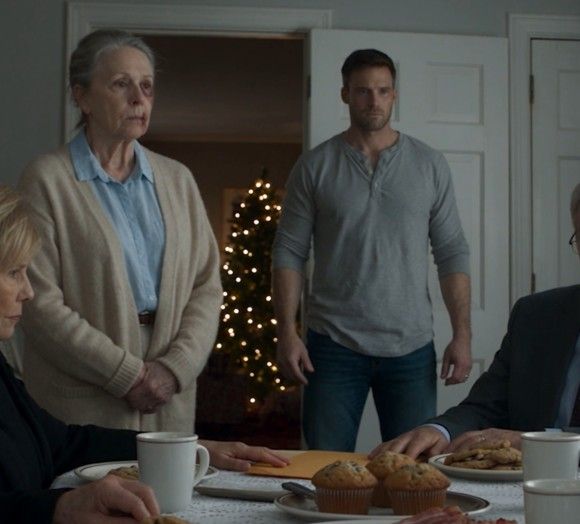
At six-thirty Christmas morning, headlights swept across the icy front yard. Then another car arrived. Then another.
By seven-fifteen, everyone I had called was inside my house.
At eight-thirty, Jacob’s footsteps came down the staircase.
He saw the breakfast spread across my best white lace tablecloth. The kind of Christmas morning that once belonged to another life.
He smiled.
“So you finally learned.”
He thought I had spent the night doing what I had always done. Forgiving. Cleaning up. Making breakfast.
Then he looked toward the head of the table.
And his smile disappeared.
Five people were already sitting inside my house.
One was the attorney who had helped my late husband and me create our estate plan almost twenty years earlier.
And sitting directly in front of Jacob was the thick folder he thought would eventually give him control over my money and my home.
Jacob looked at my bruised cheek. Then at the people around the table.
“What is this?”
I folded my hands in front of me.
“The Christmas morning you earned.”
But what Jacob discovered in those documents—and who the two strangers at the end of the table really were—changed everything he thought he knew about his inheritance.
The silence held for three full seconds. Then Jacob’s gaze landed on the two people seated at the far end of the table—a woman in a navy blazer with sharp, watchful eyes and a man with silver hair and a recording device already running on the table in front of him. He didn’t recognize them, but something in his chest tightened.
“Mom.” His voice came out different. Not angry. Not commanding. Almost a boy’s voice. “What is this?”
Margaret Hale, the attorney who had drawn up my estate plan with Thomas twenty years ago, opened the thick folder. She was seventy-three now. Her hands shook slightly from the arthritis that had settled into her fingers, but her voice did not shake.
“Jacob. Sit down.”
“I’m not sitting—”
“Sit. Down.”
Something in her tone—the same tone she had used fifteen years ago when a opposing counsel tried to bulldoze her in a deposition—made Jacob pull out a chair. He sat. His knee bounced under the table. His jaw worked side to side the way it always did when he was calculating.
Margaret laid the documents out in a neat row. Five pages. Each one highlighted in a different color.
“This,” she said, tapping the first page, “is your mother’s current estate plan. Executed and notarized in March of this year. It supersedes every previous version.”
