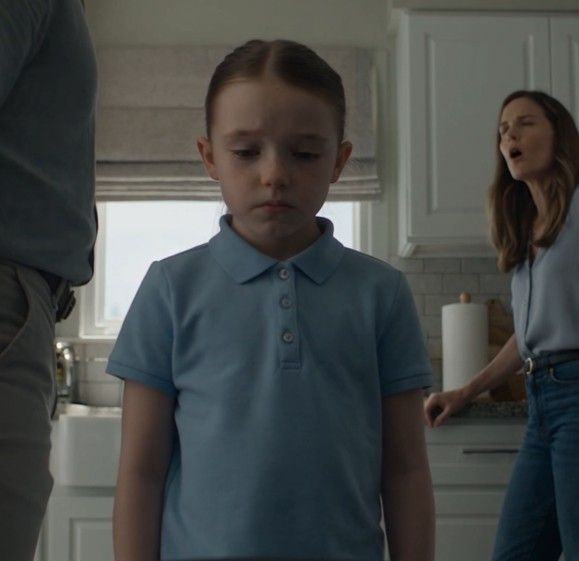
“No. I am leaving because my daughter learned to hide hunger from me in my own house.”
Mark looked toward Nora. “Tell her the truth.”
Nora stepped behind Anna.
Lisa moved in front of her. “She already did.”
His expression sharpened. “So I am not allowed to set rules? She wastes food. She manipulates you. She—”
“Stop talking about her like she is the adult who caused this.”
“You are exhausted. You are not thinking clearly.”
Lisa almost laughed. He had used that sentence many times after her night shifts. Tonight it sounded different. Smaller. Obvious.
“I have been tired,” she said. “That is not the same as being blind forever.”
Mark glanced toward Anna, then lowered his voice. “You are going to blow up our whole life.”
Lisa answered, “You already did. I am just refusing to keep living inside the damage.”
At Anna’s apartment, Nora ate tomato soup, grilled cheese, and half a banana. Nobody commented on portions. Nobody watched the clock. When she asked if she could have more soup, Anna said, “Of course,” as casually as if the question had never carried danger.
Nora cried over the second bowl.
Not loudly. Tears simply dropped from her face into the steam.
Lisa sat beside her. “What happened?”
“Nothing.”
Anna placed the pot on the table. “Sometimes nothing happening is the part that feels strange.”
Nora looked at her, then gave a tiny nod.
The next week moved slowly and quickly at the same time. Lisa met with the school counselor and provided the grocery receipts, Mark’s messages, and a timeline of her shifts. Ms. Patel shared the cafeteria record and the meal-support form. Nora spoke to a child advocate at school with Lisa nearby but not in the room, because the counselor explained that Nora needed a place where she did not have to protect anyone’s feelings.
Mark sent apologies that changed shape from hour to hour. First he had been misunderstood. Then he had been strict because Lisa was too permissive. Then he was sorry Nora was sensitive. Then he was sorry “everyone had gotten emotional.” Finally, when Lisa would not answer, he became angry again.
That cycle clarified more than any apology could.
Lisa arranged for Mark to collect his belongings when Nora was at school and Anna was present. He argued that he had rights to stay because he had helped with expenses. Lisa did not debate him in the kitchen. She had already spoken with the appropriate people about separating their household and protecting Nora’s routines. She kept the conversation to logistics. The more calmly she spoke, the less power his familiar tactics seemed to have.
Before leaving, Mark stood beside the refrigerator and said, “One day she will realize you let a child ruin this family.”
Lisa looked at the refrigerator door. Nora’s spelling test was held there by a magnet shaped like a strawberry. Beside it was a drawing of three people under a yellow sun: Nora, Lisa, and Mia sharing a picnic table.
“She did not ruin anything,” Lisa said. “She told the truth.”
Then she opened the door for him.
The school did not turn Nora into a spectacle. That mattered. Ms. Patel told her only what she needed to know: adults were handling the adult parts. The cafeteria account was adjusted so Nora could get breakfast or lunch without explaining herself. A counselor checked in twice a week. No one announced why. Mia continued splitting snacks with her until Nora finally believed she did not have to save half for later.
One afternoon, Ms. Patel set a new lunchbox on Nora’s desk. It was deep blue with tiny white stars.
Nora stared at it. “Is this because mine got thrown away?”
“Your mom brought it,” Ms. Patel said. “She asked me to give it to you here.”
Inside was a sandwich, strawberries, pretzels, yogurt, and a folded note. Nora’s chest tightened when she saw the paper. For a second she was back in the parking lot, watching adults unfold a secret.
Then she opened it.
Eat what you want. Bring home what you do not. You never have to earn food. Love, Mom.
Nora read it three times.
At the bottom, Lisa had added one more line.
P.S. If you are still hungry, get more. That is what food is for.
Nora laughed, then cried, then laughed because Ms. Patel pretended not to notice until Nora handed her the note.
A few weeks after they moved, Lisa asked Nora whether she wanted to go back to the old house for the rest of her things. Nora said no so quickly that Lisa did not ask again. Instead, Anna went with Lisa while Nora stayed at the library with Ms. Patel’s recommended reading list and a stack of graphic novels. Lisa returned with two boxes: clothes, school papers, a stuffed rabbit Nora had not slept with in years, and the small plastic measuring cup Mark had kept beside the cereal container.
Nora stared at the cup. “Why did you bring that?”
Lisa had not meant to. It had been inside a kitchen box, probably swept in without thought. She picked it up, then stopped herself from throwing it away. “What do you want me to do with it?”
Nora considered the question. Mark had used that cup to decide what counted as enough. One scoop if she was late. Half a scoop if he said she had wasted food the day before. It was such a small object that Lisa had seen it a hundred times without understanding what it meant.
“Can I?” Nora asked.
Lisa handed it to her.
Nora carried the cup to the trash and dropped it in. Then she stood there, staring down at it. Lisa waited. She did not clap, praise her bravery, or turn the moment into a lesson. She simply stood close enough to be there if Nora wanted her.
After a while Nora said, “I thought rules were supposed to make you safe.”
“Good rules do,” Lisa said.
“His didn’t.”
“No.”
“So how do I know the difference?”
Lisa sat on the kitchen floor with her back against a cabinet, and Nora sat beside her. Together they made a list. A safe rule could be explained. A safe rule did not depend on whether an adult was angry. A safe rule never took away food, water, sleep, or the right to ask for help. A safe rule did not require a child to lie for an adult. A safe rule could survive being described to a teacher.
