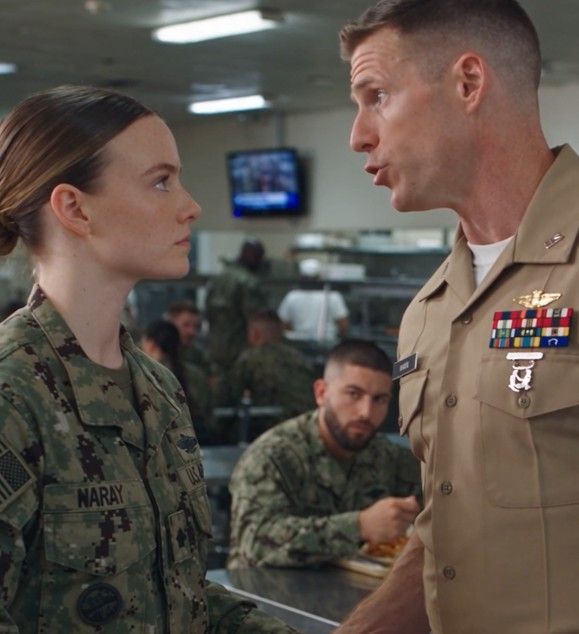
“I thought if I looked uncomfortable, he’d turn on me.”
“Would he have?”
“Probably.”
“Then you were not imagining the pressure.”
Parker looked surprised.
Emma continued. “But pressure explains a choice. It does not erase it.”
“I know.”
“Good. Then do better with the next one.”
The next one came sooner than anyone expected.
During a field exercise two weeks later, a new candidate named Marcus Bell reported numbness in two fingers after a heavy equipment carry. The assistant instructor told him to finish the event first. Bell hesitated.
Before Emma could speak, Parker did.
“We need medical to check that now.”
The assistant instructor frowned. “He can walk.”
Parker stayed where he was.
“That is not the same as being fine.”
Ruiz backed him.
The exercise paused.
Bell had a nerve compression that required treatment and rest. No permanent damage occurred.
That evening, Parker passed Emma in the hallway.
She nodded once.
He understood.
Months later, Colonel Bennett asked Emma to join a small working group reviewing candidate culture. Emma initially refused.
“I’m here to train,” she said. “Not become the symbol of a cafeteria incident.”
Bennett agreed.
“Then don’t. Join because you know the difference between pressure that reveals performance and humiliation that only feeds an instructor.”
Emma reconsidered.
The group changed no selection standards. The physical requirements remained brutal. Technical evaluations stayed unforgiving. Candidates still failed.
What changed was accountability around instructor behavior.
Corrective pressure had to serve a training purpose. Public degradation for entertainment did not. Candidates were given a clear channel to report safety concerns without having complaints routed through the same instructor involved.
Some people complained that the changes made training soft.
Emma answered the same way every time.
“If your standard depends on cruelty, it is not a standard. It is a personality.”
The changes did not make Emma’s own evaluation easier. If anything, they made her more visible. Every failure risked being interpreted through the cafeteria incident, either as proof that Bennett had protected her or as proof that Mason had been right to doubt her. Emma refused both stories.
During a night navigation exercise in heavy rain, she missed a checkpoint by nearly four hundred meters. Nobody dumped her meal. Nobody mocked her in front of the group. The evaluator simply showed her the error and told her she had forty minutes to recover.
Emma did.
The next week, she failed a timed equipment problem because she chose the wrong sequence under fatigue. She wrote the mistake into her notebook, repeated the event, and passed on the second attempt.
That mattered to Parker, who had quietly assumed that protecting someone from humiliation meant lowering the consequences of failure. Watching Emma work changed his understanding. Standards could be severe without becoming personal. A person could be told, clearly and without cruelty, that performance was not good enough. Then the work could continue.
One afternoon, Parker said as much while they packed gear.
“I think I had the whole thing backward.”
Emma tightened a strap. “Which whole thing? You have several.”
“Cole used to say pressure reveals people. I thought what happened to you was just too much pressure.”
“It was not pressure.”
“I know that now.”
She looked at him.
Parker searched for the words. “Pressure comes from the task. Sometimes from the stakes. Humiliation comes from the person who wants an audience.”
Emma nodded. “Better.”
“Do I get a grade?”
“No.”
“Harsh standard.”
They laughed.
