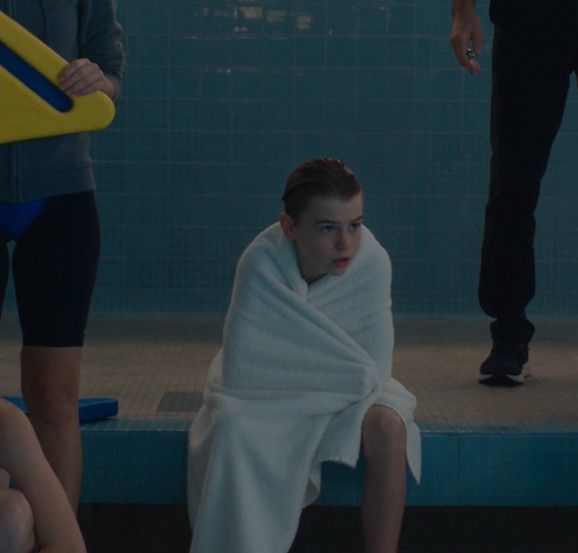
No whistle.
At the far wall, he stopped and looked back.
His father raised one hand.
Aaron swam another length.
Then another.
He left after twelve minutes.
It was enough.
The next week he returned for twenty.
When team practices resumed under Mara, Aaron watched from the observation deck before deciding whether to rejoin. He saw something that would have looked unremarkable months earlier: a boy missed a turn, and Mara stopped the lane to explain it. Nobody had to perform extra laps while teammates waited. Nobody laughed because the coach did not laugh first.
Aaron came down.
Mara met him at the door.
“You swimming?”
“Maybe.”
She nodded. “Lane four is open.”
She did not make the moment ceremonial.
Aaron appreciated that.
He joined warmups.
Dylan was there.
For a second, neither boy knew where to look.
Then Dylan moved his bag off the bench so Aaron had room to sit.
That was all.
Trust came back in pieces.
Dylan’s apology became more meaningful after he stopped asking Aaron to make him feel better about it. He admitted his role to the rest of the team. He lost the relay captain position for the next meet because Mara said leadership could not continue as though nothing had happened.
Dylan accepted the consequence.
When Mara later allowed swimmers to nominate a new captain, he did not nominate himself.
Aaron did not become captain either.
That mattered too.
The story did not need to reward him with every thing Mercer had denied.
He needed the chance to swim without the result being rigged.
At home, Aaron and his father had harder conversations than either expected.
His father admitted he had been proud of Aaron’s toughness in a way that made him slow to recognize distress. He had watched from behind thick glass and assumed the silence was evidence that practice was normal. When Aaron asked to leave the team, he had heard a problem to solve instead of a message to understand.
“What should I have said?” he asked.
Aaron thought about it.
“Why?”
His father nodded.
“That simple?”
“Probably not. But you could’ve started there.”
They both laughed.
His father began using that question more carefully.
Why do you want to skip practice?
Why do you hate that class?
Why are you quiet?
Sometimes Aaron answered, “I don’t know.”
His father learned that “I don’t know” was still information.
Mara changed the team culture in practical ways. Instructions were given close enough for swimmers to hear them. Training changes were written on a whiteboard. Corrections were directed at the skill, not the child’s character. Swimmers rotated lane responsibilities instead of using younger or less favored teammates for errands.
The changes were ordinary.
Parents were invited to observe from the deck once a month, not to coach from the sidelines but to remove the old wall of silence around training. Swimmers also learned that asking for instructions again did not count as defiance. Aaron noticed how quickly the younger children adapted when nobody mocked the question. They asked, listened, and swam. What had once been treated as a character flaw turned out to be an ordinary part of learning in a loud building. Aaron had spent months blaming himself for needing clarity; now clarity was simply part of practice. He no longer apologized for needing to hear the instruction twice.
That was why the changes worked.
No one had to be brave every day to survive practice.
By the end of the season, Aaron qualified for the relay again on time alone.
