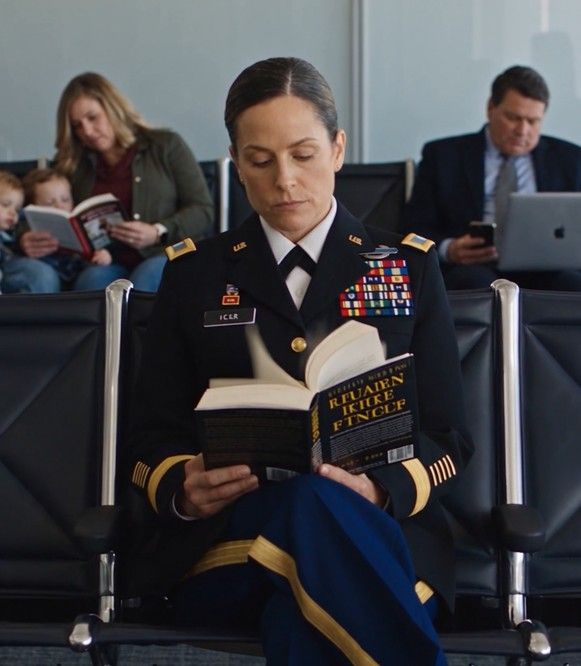
The best consequence had outgrown me. Carter no longer needed to apologize every time our paths crossed, and I no longer needed to remember him as the stranger who touched my sleeve. We had both been able to leave Gate C27 where it belonged: in the past, with a lesson strong enough to travel farther than the embarrassment.
General Shaw retired from active service several months after my command tour. At her farewell, she mentioned Gate C27 only once, privately.
“Still reading in airports?” she asked.
“When Marines let me.”
She laughed.
Then she said, “The important part was never that I was standing behind him. It was that eventually nobody needed me standing behind them.”
I thought of Mason stopping the NCO, Carter checking the manifest, and the captain redirecting questions to Ms. Chen. She was right.
That was the result I wanted from leadership: not a story where one general rescued one lieutenant colonel, but a culture where ordinary people recognized the moment respect started slipping and corrected it themselves.
By then, I could remember Carter without anger arriving first. Accountability had done its job because the behavior changed, not because the embarrassment lasted forever.
The lesson remained.
A year after Gate C27, I passed through the same airport on another trip.
No uniform this time.
Jeans, sweater, carry-on bag.
I bought coffee and found a seat near the windows.
Across the concourse, three young service members were talking loudly. One of them made a joke about an older woman wearing a military cap.
Before I could even decide whether to pay attention, another young man beside him said, “Knock it off. You do not know her.”
The joke ended.
No general stepped forward.
No rank was identified.
No one needed to become important first.
I smiled into my coffee.
Then I opened my book and enjoyed the silence I had wanted the first time.
