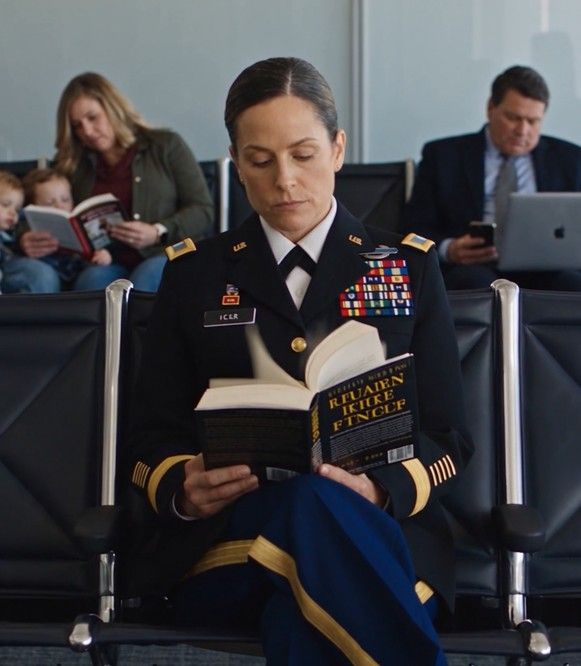
The young Marine looked at my Army uniform, laughed with his friends, and asked where I had found the “costume.” Then he flicked the sleeve with two fingers and said, “Real officers don’t look like you.” What he did not realize was that a general standing only a few feet behind him had heard every word. I had been sitting near Gate C27 for almost ten minutes when Lance Corporal Evan Carter finally worked up the nerve to say what he had clearly been thinking. The terminal smelled of burned coffee and floor cleaner. My paper cup had already gone cold beside my boot, and I still had four hours before my connecting flight. All I wanted was silence. I was wearing my Army service uniform because I had been specifically instructed to arrive at my destination in it. My garment bag occupied the seat beside me. The dark coat, ribbons, and gold oak leaves on my shoulders were not decorations chosen for attention. They represented lieutenant colonel. Carter either did not understand that or had already decided it could not possibly be true. He sat across from me with two other Marines, probably no older than twenty-two. Mason Reid wore the uneasy expression of someone who knew the joke had crossed a line but had not yet found the courage to stop participating. The third Marine stayed mostly quiet. Carter handled the performance. “Looks like costume stores are getting pretty realistic these days,” he said. His friends laughed. I kept reading. Around us, passengers were trying to survive an ordinary travel day. A tired mother had a sleeping child leaning against each shoulder. An older couple quietly shared a paperback. A businessman had somehow occupied four seats with his laptop, charger, phone, and jacket. Nobody wanted a confrontation. Carter seemed bothered by my refusal to give him one. He stood, crossed the aisle, and dropped into the chair beside me. “Hey.” I looked up. “That’s a costume, right?” I said nothing. His eyes moved across my coat, ribbons, then the oak leaves. “Seriously. Where did you get it?” Mason gave one short laugh, then looked at the floor. I returned to my book. People who provoke strangers rarely care about the answer. They care about the reaction. Carter wanted anger, embarrassment, maybe a defensive explanation. Silence should have discouraged him. Instead, it made him bolder. He leaned closer and flicked the sleeve of my uniform. “Real officers don’t look like you.” That made me look directly at him. Not because the sentence hurt. I had heard enough careless assumptions in my life to understand that someone else’s opinion did not alter reality. What caught my attention was his certainty. He knew nothing about where I had served, what I had done, why I was traveling, or why I had been ordered to appear in uniform. Yet he had already decided exactly what a real officer should look like. The terminal seemed to tighten around us. The mother across the aisle adjusted one sleeping child but kept watching. The older couple stopped passing their book. Even the businessman finally looked away from his laptop. Mason was no longer laughing. Carter still had an audience. It simply was not the audience he thought he had. I noticed movement behind him. Another passenger had been standing in line long enough to hear the costume remark, the questions, and every word about what a “real” officer looked like. The general stepped out of line. He walked toward us without hurry, set his bag carefully on the floor, and looked directly at Carter. I knew from his expression that he understood exactly why I was there. Carter still hadn’t turned around. 👇
The general stopped directly behind Carter.
“Marine.”
One word.
Carter’s face changed before he turned around.
He stood so quickly his knee struck the edge of the chair.
“Sir.”
The general looked at the hand Carter had used to flick my sleeve, then at the gold oak leaves on my shoulders.
“What rank is this officer?”
Carter swallowed.
“Sir, I—”
“That was not the question.”
Carter looked at me properly for the first time.
Not at my face. Not at the fact that I did not match whatever picture he carried in his head. At the uniform.
“Lieutenant colonel, sir.”
“Correct.”
The terminal had gone quiet in that strange public way where nobody openly stared while everyone stared.
The sleeping child across the aisle shifted against his mother’s shoulder. Mason Reid stood slowly beside the other Marine.
The general picked up his bag and set it beside the empty seat across from me.
Then he looked at Carter again.
“Did you touch the lieutenant colonel’s uniform?”
Carter’s face reddened.
“Yes, sir.”
“Why?”
No answer.
The general waited.
That silence did more than shouting would have.
Finally Carter said, “I thought it was a costume.”
“Based on what?”
Carter looked at me, then away.
“I don’t know, sir.”
“That is closer to the truth.”
The general turned to me.
“Lieutenant Colonel, are you all right?”
“Yes, sir.”
“Do you want airport security?”
“No, sir.”
Carter looked relieved.
I was not finished.
“I do want his name, unit, and chain of command.”
The relief disappeared.
“Yes, ma’am,” the general said.
The use of ma’am from a general toward me was simply courtesy in context, but Carter heard it like a verdict.
He gave me the information.
Mason did too, although I had not asked him yet.
“I was there,” he said. “I laughed at first.”
Carter shot him a look.
Mason did not look away.
The third Marine, Private First Class Lewis Grant, quietly gave his details as a witness.
The general sat across from me.
