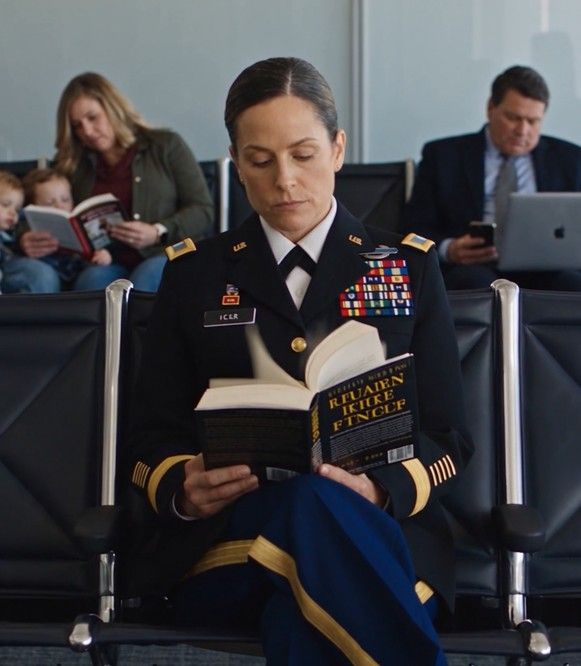
Because consequences are supposed to change what happens next.
The exercise was not the last time I crossed paths with Carter. Four months later, Staff Sergeant Ortiz invited me to observe part of a professional-development day his unit had built after several incidents involving junior Marines and disrespectful behavior. I almost declined. I had no interest in becoming the inspirational victim in someone else’s lesson.
Ortiz understood.
“You would not be there to retell the airport,” he said. “I want you to listen to what they built and tell us if we missed the point.”
That I could do.
The class was held in a plain training room. Carter stood at the front with Mason beside him. No one introduced me until the end. They began with rank recognition, but only for five minutes. Then Mason put a sentence on the screen: What do you owe someone before you know who they are?
The discussion became uncomfortable quickly. Junior Marines talked about jokes aimed at civilians, women, service members from other branches, and people whose jobs seemed less important. One Marine admitted he treated contractors differently depending on whether he thought they could affect his evaluation. Another said he had watched senior people ignore disrespect because the target was lower ranking.
Carter did not dominate the discussion. That impressed me.
When someone asked what had caused the class, he answered without using my name.
“I humiliated an officer in an airport because I thought she did not look like my idea of one. The rank made the mistake obvious. The actual failure happened before I knew the rank.”
No excuse followed.
At the end, Ortiz introduced me simply as the lieutenant colonel involved in the incident. Carter looked nervous. I spoke for less than five minutes.
“I do not need you to remember me,” I said. “I need you to remember the moment before you know someone’s title. That is where character usually shows up.”
Then I left.
A week later, Ortiz emailed a short note saying the unit had adopted a peer-intervention exercise for new arrivals. It required Marines to practice stopping low-level disrespect before it became a command problem. No mention of Gate C27. No heroic version of me.
Good.
My own command learned something from the incident too. I realized I had been so focused on professional competence that I rarely discussed how assumptions affect who gets heard in logistics spaces. We added scenarios to our leader development sessions: a junior civilian specialist ignored because of age, a quiet sergeant overlooked because someone louder seemed more confident, a woman mistaken for administrative support in a room she was leading.
I never told the participants which scenario came from my own life.
They did not need to know.
Months later, a captain on my staff stopped a briefing when a visiting official repeatedly directed technical questions to the male analyst sitting beside the woman who actually built the model.
“Sir,” the captain said, “Ms. Chen owns that analysis.”
The visitor corrected himself.
The meeting moved on.
No one applauded.
That was exactly how it should work.
When I told General Shaw about it later, she smiled.
“You know the airport story has produced an alarming amount of training.”
“I would have preferred coffee.”
“So would Carter.”
We laughed.
Then she grew serious. “You handled him like a future leader instead of a permanent problem.”
“I did not know he would become one.”
“You left room for the possibility.”
That sentence stayed with me.
Command is full of consequences. Counseling. Evaluations. Removed responsibilities. Sometimes separation. But if every failure becomes a permanent identity, correction loses its purpose. Carter had needed a consequence because he crossed a line. He had also needed a path to become someone who no longer crossed it.
That did not mean everyone earned unlimited chances. It meant accountability and growth did not have to be enemies.
Near the end of my command tour, Carter’s unit sent several Marines to support another joint exercise. Mason arrived as team lead. During the first planning meeting, a young civilian scheduler corrected an error in a movement timeline. One senior NCO dismissed her too quickly.
Mason spoke before I did.
“She built the timeline. Let her finish.”
The room quieted.
The scheduler explained the conflict. She was right.
Afterward, Mason caught me in the hallway.
“I sounded less like an idiot that time.”
“Progress.”
He grinned.
Carter was not there. I liked that too. The lesson had moved beyond the person who caused it.
Before my command tour ended, I received Carter’s final evaluation summary through his chain only because Ortiz included a note thanking our unit for the joint exercise. Carter had not become a perfect Marine. He had been late once, struggled with a technical qualification, and received ordinary criticism. He had also become the person junior Marines approached when they were unsure whether a joke or comment had crossed a line.
That detail mattered more to me than any award could have.
I wrote Ortiz back: Glad the correction became useful. Please keep the focus on the team, not the airport story.
He replied: Already is.
