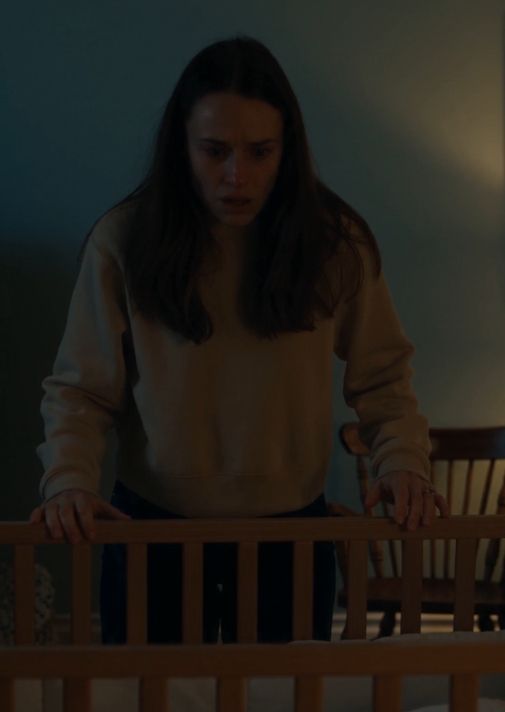
“I’m not doing this here,” she said.
“No,” he agreed. “You shouldn’t.”
The police came at 11:40 and went up the service stair without their lights on, because Jonah asked them not to, and because the man they took down that corridor was suddenly, after fifteen years, simply a man in a rolled shirt with his hands behind him and no one in that kitchen would move aside for him. Not one person. They kept working. They turned their backs to him the way he had taught them to turn theirs to everything, and the sound of the dish pit went on and on, and the only thing anyone heard as he passed was the elevator light humming.
He did not look at them. He looked at the carpet.
In the office, an evidence tech bagged the ledger, the phone, the paper Lena had not signed, and a small handwritten rule book with no title on the cover that Nadia handed over without a word. The money went into envelopes, forty-two thousand dollars counted twice in front of two witnesses, and one of the envelopes was sealed and labeled and never opened again.
Nobody spoke about it. Nobody needed to.
Marisol was at the sink in the prep area at four in the morning, scrubbing a container that was already clean. Lena found her there and stood beside her for a while without saying anything, and the water ran, and outside the loading dock the sky was going the color of a bruise healing.
“You could have sent me out that dock,” Lena said finally. “Clean. Safe. Your name never in it.”
“Yes.”
“Why didn’t you?”
Marisol turned the tap off. She stood there with her wet hands over the edge of the sink and did not look up.
“Because my niece is four,” she said, “and next year she’s going to be somebody’s employee somewhere, in some building with a locked door in it, and I wanted to be able to tell her what I did the night somebody’s baby went missing.” She wiped her hands on her jeans, badly, still shaking. “Don’t forgive me tonight. I don’t deserve it tonight. Just say it sometime when I’m not wet.”
Lena put her hand on Marisol’s arm, above the elbow, and left it there long enough to feel the tremor in it slow down.
“He’s gone,” she said. “It’s over.”
“I know.” Marisol exhaled, and it came out close enough to a sob that she pressed her lips together hard. “Nobody’s said that to me in six years.”
Nadia quit the next afternoon and then, an hour later, unquit, because Jonah asked her to stay on long enough to testify, and she said she’d stay on longer than that if someone finally taught her what the numbers meant instead of asking her to hide them. The photocopied deliveries, the ledger, the phone, and the recording Lena had made with her phone face-down on the arm of a chair were enough. Dominic Rusk was charged with embezzlement, fraud, coercion, and unlawful confinement, and the forged call log — fifteen years of a quiet man’s name pressed onto other people’s threats like a stamp — was read into the record in a room where he sat with his hands flat on the table and did not once look up.
He was sentenced in the spring. He did not appeal. There was nothing left to appeal to; every person he had ever used walked into that courtroom and said the true thing out loud, and the true thing, once it is standing up in daylight with its name on it, cannot be un-said.
Tomás got the night shift he had asked for six months ago and been denied for asking. Hal handed his badge in, and Jonah gave him back the key to the camera room with a note taped to it that said you opened the door. He went home and told his wife everything, and on opening night he sat at the table by the window with her and neither of them mentioned the last fifteen years once.
It was a week before Lena went back up.
She went alone. Ellie was with her mother’s neighbor, asleep, and the stairwell light buzzed the same hard white buzz, and the carpet was still there, and the door at the end of the hall was open all the way this time.
He was sitting at the desk with a drawer pulled out, and when he saw her he stood up so quickly that the chair rolled back into the wall.
On the desk lay a photograph, creased soft along the folds, of a boy of about nineteen holding a swaddled newborn in a hospital corridor with the exhausted, disbelieving face of somebody who has been handed something he did not earn.
“You were nineteen,” Lena said.
“I was nineteen, and then I was not here.” He turned the photograph face-down, then turned it back again, as if he could not decide which was worse, showing it or hiding it. “Our father owed money to people who don’t send letters. One night they came to the house and I was the one who opened the door, so I was the one they took, and after that I was the reason they knew where to find the rest of you. So I stopped being where they could find me. I took another name. I washed dishes. I learned what a spreadsheet was. It took me eleven years to own a building and nine months to find out you were working in the basement of it.”
“You could have walked down the stairs.”
“I could have,” he said. “Every night for ten months I could have. And every night I told myself tomorrow, because the men who took me are still somewhere, and being seen with a Carter is the one thing I have spent my whole life making sure never happens to you again, and I was so wrong about that that I nearly watched it happen anyway on a Tuesday with a bag of money in a closet.”
Lena said nothing for a while. She looked at the desk. At the bottom drawer, which was still open.
Inside, on a square of felt, lay a yellow rattle, chipped at the rim, its handle worn to a shine, and on a strip of old masking tape around the neck, in handwriting that Lena recognized with a shock so total it nearly took her knees out, was a single word.
LENA.
“That was in your mother’s box,” Jonah said. “She had one for each of us. Mine broke the week after you came home and I cried about it for three days, so she gave me yours to keep until you were old enough not to swallow it. And then I left, and I kept it. In my coat pocket, in a shoebox, in a desk drawer in the back of this building for eleven years. Every night you walk past this drawer, Lena. Every night for ten months you walk past it on your way to a closet.”
