I set down the kettle.
“No,” he added. “That is the old thought. You did not owe it.”
I let the silence last. Learning was not the absence of a bad thought. It was catching the thought before making it someone else’s problem. He stayed for soup and left before I grew tired.
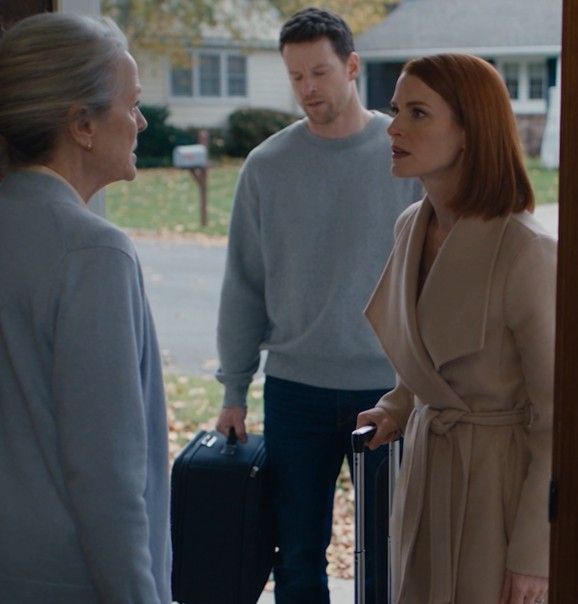
Before the weather turned, Linda helped me clear leaves from the front path. We found a small scratch on the threshold where the suitcase wheel had scraped the paint. I bent to rub it with my thumb.
“I can get a little paint,” she said.
“I will do it.”
She handed me the brush when I was ready. I sanded the mark, wiped away the dust, and painted the narrow strip. It took less than an hour. The work did not make the afternoon vanish. It gave me something I could mend without waiting for anyone else to become sorry.
Michael saw the fresh paint on his next visit. He stopped beside it and asked if he had caused the damage.
“The luggage did.”
“Can I pay for the supplies?”
“You can. That will pay for supplies, not for what happened.”
He nodded. I showed him the receipt. He sent the exact amount and did not round it into a grand gesture. I was glad. Large gestures had too often come with a request that I stop being hurt before I was ready.
He also began checking the facts when relatives called. One cousin said I had refused shelter to a penniless son. Michael answered that there had been a cash reserve and that I had not been asked before they arrived. Another said Amanda only acted because she was desperate. He said desperation did not excuse a slap.
He told me about those calls after they happened, without asking for praise. I listened and felt a little of the old loneliness loosen. At the porch I had been the only voice defending my right to decide. Now he was using his own voice where I could not hear it first.
We did not become close overnight. There were missed calls, awkward meals, and moments when I wanted to ask whether his courtesy would last. I chose to watch what he did over time instead of testing him with traps.
He learned the same patience. When I declined a Sunday visit, he did not ask whether Linda had turned me against him. He said he hoped I had a good afternoon. I spent it reading, with no guilt beside my chair.
That quiet afternoon mattered. It was proof that reconciliation could leave room for solitude. I could love my son and still enjoy a day he had not arranged, paid for, interrupted, or claimed.
Winter came. The reserve paid for practical housing and advice while the separation moved toward a settlement. The venture eventually returned a small portion through its formal process. Most of that investment was lost, but the loss was named accurately.
Michael told me the figure without asking me to soften it. “It is money I should not have risked without understanding,” he said. “I can earn and save again. I cannot pretend that fear gave me a right to your home.”
I heard regret without the old demand hidden inside it. That did not repair every memory. It gave us a place to begin building a different one.
At Christmas, I invited Linda and Michael to dinner. He asked whether Amanda was coming. I said no, and he nodded without bargaining. They were pursuing a divorce with separate homes and advisers.
We ate in the dining room, not at a crowded threshold. Linda brought a pie. Michael washed dishes and asked which towel to use. I laughed at the question, then saw he meant it.
Afterward he gave me a thin envelope. “Not money,” he said before I could tense. “Something I found in the copies of the house papers I sent you.”
Inside was a drawing made when he was a child. He had tucked it into an old folder years before, and it had traveled with papers through moves without anyone looking closely.
There were three bedrooms drawn as three squares. In the first he had written Mom. In the second, Michael. In the third, Anybody who asks nicely.
I touched the uneven letters. “I remember this.”
He had been worried that a neighbor might need a room after a fire on the next street. I told him we could help if the person wanted help and if we agreed. He drew the plan so he would not forget to ask.
“I thought those rooms meant nobody could be afraid,” he said. “Then I grew up and treated them like space you had failed to use.”
The old drawing made the house look small and crooked. Yet the child who made it had understood a boundary the adult at my door had tried to ignore. Shelter could be offered. It could not be taken in the name of love.
I put the drawing on the shelf beside a photograph of him. “You remembered,” I said.
“Too late that day.”
“In time for other days.”
He did not ask for a room. He put on his coat, thanked me for dinner, and stepped onto the porch. Linda stayed to finish her tea while I watched him reach his car safely.
Then I closed my front door. The click was soft and ordinary. Inside, three bedrooms remained mine, and the house held no emptiness I was required to fill. I went back to my tea, hearing Linda turn a page, and let the warm room hold us in peace.
