The legal process moved with a grinding, impersonal momentum. Diane handled everything she could, but there were hearings and depositions and documents to sign and a forensic accountant who needed to trace every dollar that had been moved from Sophia’s accounts to Jeffrey and Melanie’s. The accountant found more than Sophia had known about — a third bank account Jeffrey had opened in her name, a credit card she’d never seen with twelve thousand dollars in charges, a life insurance policy on her life worth five hundred thousand dollars that had been taken out eight months ago without her knowledge.
When Diane told her about the insurance policy, Sophia sat in Diane’s office and stared at the wall for a long time. The wall had a watercolor of a Japanese garden — quiet, orderly, nothing out of place. She focused on it until her breathing slowed.
“He took out a life insurance policy on me,” she said.
“Yes.”
“While he was living in my house. Eating my food. Calling me every morning to ask how I slept.”
“Yes.”
Sophia nodded. She folded her hands in her lap. “Add it to the file.”
Jeffrey called her four times during those six weeks. She didn’t answer. Melanie’s lawyer sent a letter suggesting that Sophia had been “manipulated by external parties into pursuing a vindictive and exaggerated course of action.” Diane framed it.
In late January, the case was presented to a grand jury. Jeffrey and Melanie were indicted on all counts. Bail was set. Jeffrey’s was posted by his mother-in-law, who apparently had not been told the full story and who, when she eventually heard it, called Sophia at eleven at night and wept for twenty minutes while Sophia sat in bed and listened and said nothing because there was nothing to say that would make any of it less terrible.
In February, Jeffrey’s lawyer requested a meeting. Sophia agreed. Not because she wanted to see her son but because Diane advised her that cooperating with the process would look favorable and because Sophia, despite everything, needed to hear something from Jeffrey’s mouth that she could not get from a courtroom transcript or a police report or a recording made on her dead husband’s voice recorder.
They met in Diane’s office on a Tuesday afternoon. Jeffrey sat across the table from his mother and looked like a man who had aged ten years in two months. His suit was wrinkled. His eyes were red-rimmed. He had lost weight — his cheeks were hollow, his jaw sharp in a way that reminded Sophia, painfully, of Richard at the same age.
“I’m not going to ask for forgiveness,” he said. “I know I don’t deserve it.”
“Good,” Sophia said. “Don’t.”
“I want to tell you the truth. Not because it helps. Just because you deserve to hear it.”
Sophia said nothing. She waited.
“It started before Dad died,” Jeffrey said. He was looking at his hands, not at her. His fingers were interlaced on the table, the knuckles white. “Melanie and I were drowning. The business was failing. We owed money everywhere. And I kept looking at this house — at what Dad had built — and I kept thinking, it’s going to come to us eventually. And we needed it now.”
“So you decided I was an obstacle.”
He flinched. “I decided that the money mattered more than — ” He stopped. Started again. “No. That’s not exactly right. I decided that the money was mine anyway. That it was always going to be mine. That waiting was the problem. And Melanie — ” His voice caught. “Melanie just said out loud what I was already thinking.”
“That I should die.”
“That you should — that it would be easier if you — ” He pressed his palms flat against the table. “I can’t say it.”
“You said it before. Over breakfast.”
The silence in Diane’s office was absolute. The building’s heating system hummed. A car passed on the street below. Jeffrey’s throat worked as he swallowed.
“I know,” he said. “I know I did.”
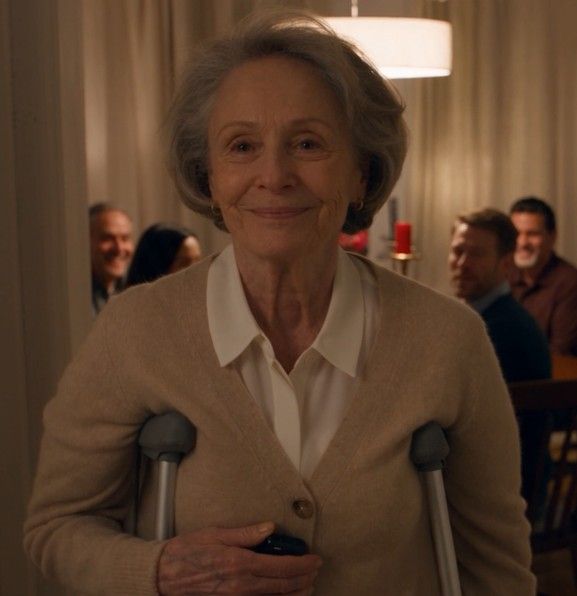
“Jeffrey, I need you to understand something.” Sophia leaned forward. She was not on crutches anymore — the cast had come off two weeks ago, and her foot was stiff but functional, a dull ache that the doctor said would fade with time. She placed both feet flat on the floor and felt the solid ground beneath them. “I need you to understand that I did not do this to destroy you. I did this to survive you. There is a difference. Your father built something real — a life, a home, a legacy. You tried to turn it into a waiting room where the only thing that mattered was how fast the patient died.”
Jeffrey looked up. His eyes were wet. “I know.”
“Do you love me?”
The question landed between them like a stone dropped into still water. Jeffrey’s face folded. He nodded.
“Then prove it,” Sophia said. “Not to me. To yourself. Prove it by telling the truth in court. Prove it by not making me testify against my own son. Prove it by being the man your father thought he was raising.”
She stood up. Diane opened the office door. Sophia walked out into the February afternoon where the air was sharp and cold and tasted like the beginning of something.
Jeffrey pled guilty in March. The judge gave him four years with the possibility of parole after two. Melanie pled not guilty and went to trial, and the recordings — her voice, calm and measured, explaining exactly how and when Sophia should die — played in a courtroom full of people who sat in stunned silence as a woman methodically narrated the planned disposal of her mother-in-law’s life. The jury deliberated for three hours. Guilty on all counts. The judge sentenced her to six years.
Sophia did not attend the sentencing. She was at home, in Richard and her original apartment in Brooklyn — the one they’d bought before the bakeries, before the money, before everything — sitting at the kitchen table with Carol and Diane and a pot of chamomile tea. She had moved back in November, after the arrest, after she’d decided that the house with the dining room and the Christmas tree and the good china was no longer a place she wanted to be. The apartment was small and bright and smelled like the old neighborhood, and she could hear the bakery on the corner opening every morning at five, the sound of trays sliding into ovens, the muffled conversation of bakers starting their day.
Carol had finished her radiation. The cancer was in remission. She came over every Thursday and they cooked together — Richard’s recipes, the ones he’d written on index cards and stored in a blue tin box that Sophia had kept in a cabinet for years without opening. They made sourdough and cinnamon rolls and a black forest cake that Richard had invented one Christmas when Jeffrey was six and had insisted on helping, standing on a step stool with flour on his nose, reaching for the cherries with sticky fingers.
“He was so happy that day,” Sophia said one Thursday in April, pulling the cake from the oven. “Your brother. He was so happy.”
Carol set down the dish towel she was holding. “Do you want to talk about it?”
“No. I want to remember it. There’s a difference.”
In May, Sophia went to visit Jeffrey in prison. She had not planned to. But Diane, who had become more than a lawyer by then — a friend, a regular Thursday presence, a woman who stayed for tea and left with an armful of baked goods — told her that Jeffrey had asked. Not demanded. Not through his lawyer. He had written a letter to Sophia’s address — not Diane’s office, not the old house, but the Brooklyn apartment, the one where he’d grown up — and the letter said only: “Mom. If you can. I would like to see you. If you can’t, I understand.”
He had written “if you can” twice.
Sophia went on a Wednesday. The prison was a gray building with windows that let in pale spring light. She sat across a table from her son in a room that smelled like industrial soap and saw the man he was becoming — quieter, thinner, stripped of the bravado and the slick confidence that had characterized him for so long. Without Melanie’s voice in his ear, without the constant pressure of debt and ambition and the desperate performance of a life he couldn’t afford, Jeffrey looked like someone who was finally, painfully, meeting himself for the first time.
“I’ve been reading Dad’s journals,” he said.
Sophia’s breath caught. “What?”
“In the house. Before the police took everything. I found them in his study, behind the bookshelf. He kept journals the whole time we were growing up. I never knew.” Jeffrey’s voice was hoarse. “He wrote about us. About you and me and Aunt Carol and — he wrote about everything. And in the last one, the one from the week before he died, he wrote — ” Jeffrey stopped. He pressed his lips together and looked at the ceiling. When he looked back down, his eyes were red but dry. “He wrote, ‘Jeffrey has his mother’s courage and his own fear. I hope he finds hers before he needs it.'”
Sophia closed her eyes. A tear slid down her cheek, warm and slow, and she let it fall.
“He knew,” Jeffrey whispered. “I think he always knew I was — that I was weak. That I would need — that I would — ”
“He didn’t think you were weak, Jeffrey. He thought you were scared. There’s a difference. And he loved you anyway.” She opened her eyes and looked at her son — really looked at him, past the prison uniform and the shaved head and the hollow cheeks, past the guilt and the shame, to the six-year-old boy with flour on his nose reaching for cherries with sticky fingers. “I love you anyway. That is not the same as forgiveness. I don’t know if I’ll ever forgive you. But I love you. And that’s not something you can steal.”
Jeffrey put his face in his hands. His shoulders shook. Sophia reached across the table and placed her hand on his — the one thing she could give him that no courtroom could take away.
They sat like that for a long time.
Summer came to Brooklyn the way it always did — slow and then sudden, the trees on her street going from bare to green in what felt like a single week, the bakery on the corner opening its windows and letting the smell of fresh bread drift down the block like a welcome home.
Sophia started baking again. Not in a commercial kitchen, not for customers, not for profit. Just for herself. She baked Richard’s sourdough on Saturday mornings. She baked cinnamon rolls for Carol on Thursdays. She baked a black forest cake for Diane’s birthday in July and watched Diane’s face when she took the first bite — the way her eyes closed, the small involuntary sound of pleasure, the way she set down her fork and said, “Mrs. Reynolds, I would commit a crime for this cake.”
“You’ve already committed one,” Sophia said. “You helped a sixty-eight-year-old woman take down her own family. That’s got to be at least a misdemeanor.”
They laughed. It was the kind of laughter that comes after something heavy has been set down — not light, exactly, but free.
