Daniel finally gave me the name that afternoon.
The agent, Claire Monroe, sounded alarmed when I called. She had met Melissa two days earlier at a coffee shop. Melissa represented herself as my daughter-in-law and said the family was preparing my move to Rosewood. Daniel had requested a comparative market analysis by email, but Melissa had gone farther.
She had asked how quickly the house could be photographed.
She had asked whether furniture could remain during showings.
She had asked what documents would be required if the owner was “not really able to manage the sale herself.”
Claire told her she would need to speak directly with me or with a legally authorized representative.
Melissa said she would provide the paperwork.
My skin went cold.
“Did she?”
“No,” Claire said. “Not yet.”
Yet.
That word became the edge of a cliff.
Nothing had been listed. Nothing had been sold. But Melissa was moving toward both as though my refusal were a temporary inconvenience.
Elise advised me to document everything and make a formal report about the forged admission paperwork. I did.
I hated walking into the station with a folder carrying my own name.
I hated describing my daughter-in-law’s behavior to a stranger.
I hated the possibility that Daniel would say I had overreacted.
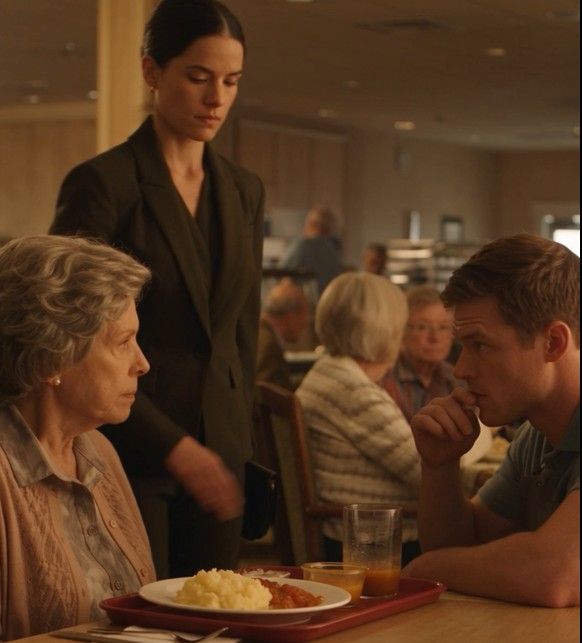
Then I remembered mashed potatoes sliding under a chair while Melissa told me my house was being sold whether I liked it or not.
I finished the report.
The investigation uncovered more than I expected and less than I feared.
There was no completed sale contract. No secret deed transfer. No vanished bank account.
There was, however, a digital trail.
Melissa had created an online folder labeled “Transition” containing photographs of my house, room measurements from Rosewood, a moving-company estimate, the admissions application, and a draft email to Claire Monroe saying the family expected “full authorization” shortly.
The folder had been shared with Daniel.
He had opened it twice.
That fact broke the last version of the story in which my son had simply been careless.
When I confronted him through Elise, he admitted he had seen the folder but claimed he did not examine everything inside. He knew Melissa was planning a move. He knew she was gathering estimates. He knew she believed I would eventually give in.
“What did you think would make me give in?” I asked when we finally met in Elise’s conference room.
Daniel stared at the table.
“Time.”
“No.”
He swallowed.
“Pressure.”
There it was.
He had not forged my signature.
He had helped create the pressure that made forgery seem useful.
Melissa refused to attend the meeting.
Instead, she sent a long email accusing me of being manipulative, saying Daniel was exhausted by the responsibility of worrying about me, and insisting the Rosewood application had been completed only to “keep options open.”
Elise printed the email.
One sentence stood out.
If Carol refuses to sign, we need to be prepared to act quickly when the next incident happens.
My name is Carol Parker.
I read the sentence again.
The next incident.
A fall. A forgotten burner. A mistake.
Melissa had been waiting for ordinary human imperfection to become leverage.
I stopped feeling guilty for protecting myself.
The weeks after that were full of uncomfortable proof that independence is not a feeling. It is infrastructure.
I reviewed every automatic payment. I checked the county property record twice even after Elise showed it to me. I placed a fraud alert on my credit file, not because we had found a financial theft, but because Melissa had already demonstrated how much identifying information she possessed. I asked my doctor to add a note that no family member could request records or discuss care without my permission.
The doctor’s receptionist sounded surprised. “Even your son?”
