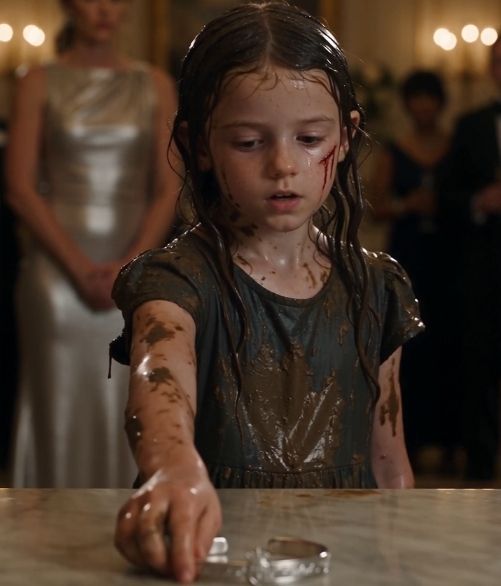
She was staring at Evelyn with a raw, wounded clarity that didn’t belong to a nine-year-old.
“I saw the papers in the office,” she said. “Mrs. Keller left them on the desk. Whitmore Foundation, every month. Ten thousand dollars. For ‘special care, confidential.’ Your name was on the checks. Evelyn Whitmore.”
Evelyn swayed.
Henry reached out, not to catch her, but to steady himself against the table. The marble was cold under his palm.
He pulled his phone from his breast pocket with the other hand. His fingers fumbled, slick with sweat. He pressed a name and put it on speaker before Evelyn could stop him.
“Arthur,” he barked into the phone. “I need you here. Now. The ballroom at the Pierre. Bring the file for the Foundation disbursements for the last eleven years. Every confidential care payment.”
A man’s voice crackled, confused. “Mr. Whitmore, it’s eight p.m. on a Saturday—”
“Now, Arthur.”
He ended the call. His eyes never left Evelyn.
Anna took another half step forward. Her bare feet left faint muddy prints on the cream carpet. She was close enough now that Henry could see the faint spray of freckles across her nose. Eleanor’s freckles.
“Please,” Anna whispered to Henry, not to Evelyn. “I don’t want money. I just want to know where my mom is. Is she really dead? Did she really leave me?”
The question broke something in the room.
A woman at a nearby table pressed a hand to her mouth and began to cry.
Henry sank slowly back into his chair, as if his knees had given out. He held out his hand to Anna.
She hesitated for a heartbeat, then placed her small, dirty hand in his huge one.
His fingers closed around hers. They were ice cold.
Evelyn watched that contact and her face twisted. Not with guilt, at first, but with a terrible, exposed fear.
“She was going to ruin us,” Evelyn said, and the words fell out in a rush, low and frantic. “Eleanor was brilliant and beautiful and she threw it all away. She got pregnant. She refused to say who the father was. She refused to handle it quietly. She said she wanted to keep it, to raise it alone, to ‘live honestly.’ Honestly! As if a Whitmore could just have a child out of wedlock and parade it around Manhattan. The press would have destroyed us. The board would have forced you to step down.”
Henry stared at her, his breathing audible.
“So you told her the baby died,” he said, his voice hollow.
Evelyn’s eyes filled.
“I told her it was for the best. Dr. Feldman said she was unstable after the birth, postpartum psychosis. She wouldn’t stop screaming for the child. So we sent her to recover. Quietly. In Switzerland at first, then closer, where she could get proper care. And we placed the child where she would be looked after. It was kind. It was clean. No one had to know.”
Anna’s hand clenched in Henry’s.
“You told me she died,” Anna breathed, tears spilling over. “You told her I died. Didn’t you?”
Evelyn did not deny it. Her shoulders curled inward.
“I told Eleanor her daughter did not survive the birth,” she whispered to the floor. “And I told the child her mother died in an accident. It was the only way to keep them both quiet. To keep the family intact.”
Vanessa let go of Evelyn as if she had been burned.
“You told me my aunt died in France,” Vanessa said, her voice breaking. “You made me give a eulogy. I was fourteen. I stood in front of our whole family and cried for her.”
“You were protecting the family name,” Evelyn snapped at her, desperate. “You, of all people, should understand. Do you know what would have happened to your inheritance, to your debut, to your future if the world knew your aunt was an unwed mother locked in a care facility?”
The ballroom doors opened again.
