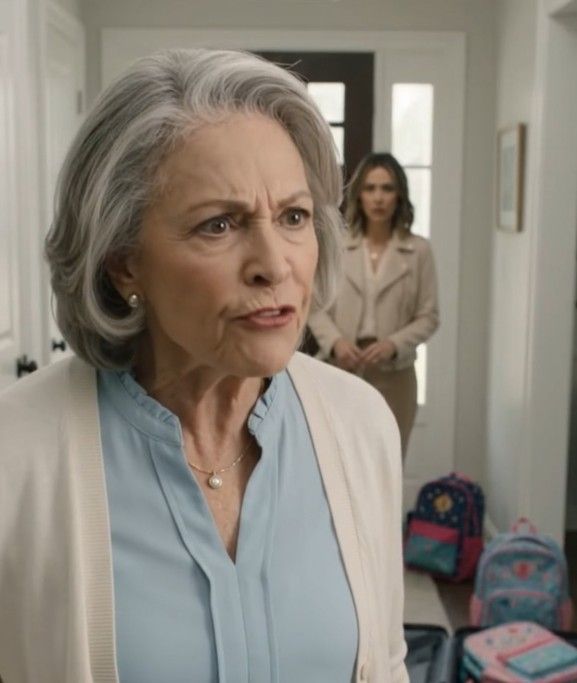
I asked whether the two older children even wanted to appear. Tori waved the question away. “Kids love being photographed.” Hannah had been listening from the doorway. She said quietly, “I said I didn’t want strangers taking pictures of us.” Tori turned. “You agreed to the clothes.” Hannah shook her head. “I said I liked the blue coat.” For a moment I saw Tori confronted not by a legal problem or a payment schedule, but by the simple fact that her daughter was a person whose words had been rearranged into consent.
Caleb sat on the bottom stair and cried. I had seen him cry as a boy over a lost pet and, much later, when he held his first newborn child. This was different. His tears were full of humiliation because he’d accepted Tori’s confidence as a substitute for knowledge. He kept saying, “I should have asked.” Hannah came and touched his shoulder. He caught himself and drew a breath. “No, sweetheart,” he said. “You do not need to comfort me. I need to take care of this.” I was proud of him for making that distinction, even as I was furious he had learned it so late.
My flight notification sounded from the suitcase where the boarding pass still lay. I had two hours before I needed to leave. The familiar urge returned: cancel the trip, feed the children, call everyone, find a way to make the mess disappear. I could already feel myself slipping back into the role their mother had written across the folder. I looked at Caleb. “Your first job is to confirm the children are not going anywhere under a false form,” I said. “Your second is to arrange care yourself. Your third is to tell the truth to anyone who has been misled.”
He nodded. “I’ll cancel Japan.” Tori said he couldn’t because the advance was spent on flights and marketing. Caleb looked at her for a long time. “Then we’ll deal with the debt,” he said. “We will not deal with it by making Mom and the children carry it.” He called the airline, the school, and the travel coordinator. He requested copies of the documents and asked how to report the questionable signatures. He did not hand the phone to me. That mattered as much as anything he’d said.
Tori tried one final argument. “What if you miss your flight?” she asked me. “Wouldn’t that be easier than all of this?” I looked at her expensive jacket, her packed carry-on, and the four children’s things piled at my feet. “Easier for whom?” I asked. She didn’t answer. For thirty years I had translated everyone else’s convenience into my obligations. The translation stopped in my hall. I told Caleb that I was leaving on schedule if he could confirm the children were safe with their parents and the travel arrangements had been blocked. If not, I would help contact the appropriate local authorities, not quietly assume a duty I had refused.
It took nearly an hour. Ms. Chen emailed confirmation that the disputed child travel requests were suspended. The campaign company acknowledged Caleb’s objection to the use of his and my purported signatures and placed the project under review. Caleb canceled the couple’s trip and obtained written confirmation that the four children remained in his care. He made a separate appointment with a family lawyer to address the documents. Tori stood by the window, no longer arguing, as if she were calculating the distance between the day she had imagined and the one that had actually arrived.
When I lifted my suitcase, Maya wrapped both arms around my knees. My first instinct was to kneel and promise I would come home immediately if she needed me. Instead I hugged her and told her when I expected to return. Oliver asked whether Portugal had dinosaurs. Eli asked whether people there spoke English. Hannah stood back with the rabbit, which belonged to Maya but had somehow become everyone’s comfort object. “Are you still going?” she asked. “Yes,” I said. “And your dad is staying with you.” She nodded slowly, as though hearing the adults’ plans line up with reality was its own kind of relief.
Caleb drove me to the airport after confirming that the children would remain with Tori’s mother, Diane, for the afternoon while he attended to the legal paperwork. This time Diane knew the truth and had freely agreed to a specific arrangement. Caleb repeated the address, pickup time, and allergy information to me without asking me to supervise any of it. At the curb he reached across the console. “You were right to say no,” he said. “I should have been the one protecting your answer.” I kissed his cheek. “Then protect the children’s answers too,” I said, and stepped into the terminal.
The plane rose through a gray bank of cloud. I stared at the seatback in front of me, exhausted and too tense to enjoy the departure I’d dreamed about for eight months. I had not stopped loving my family at the airport door. I had simply refused to let that love become a place where other people could deposit consequences. When the clouds cleared, the late sunlight turned the wing a soft gold. I unfastened my hands from the armrests. For the first time all day there was nothing I needed to arrange for someone else.
Lisbon met me with steep streets, the sound of tram bells, and a light that seemed to settle warmly on every pale stone wall. I walked slowly because I could. On my first morning I sat at a cafe above a narrow street, ordered coffee with a pastry, and watched a woman unlock a flower shop. I sent the children a photograph of the tiled doorway and a message telling them I loved them. I did not call to ask whether they had eaten breakfast. Caleb had sent a brief update: school pickup completed, dinner organized, children safe. I read it once and put my phone away.
I carried a small notebook containing the names and places my grandparents used to speak of. The coast they had loved was farther from the tourist streets, in a town where the sea met whitewashed houses and people still mended fishing nets in doorways. I traveled there by train and stood above the water with tears on my face. I could almost hear my grandmother telling stories in a mixture of languages I understood better in memory than in speech. All these years I’d thought I was postponing a vacation. On that headland I realized I had also been postponing a conversation with the people who had made me feel that my own life mattered.
Back home, the consequences unfolded without my management. The campaign company canceled the promotional arrangement after reviewing the consent discrepancies and demanded repayment of the unearned advance under its contract terms. The travel agency barred further processing of the disputed forms and cooperated with the investigation. Caleb’s lawyer advised him on documenting every communication, protecting the children’s identification records, and obtaining an appropriate parenting plan. Because false signatures and proposed international arrangements involving minors had been submitted, the matter was referred for formal review. No one treated the children as publicity assets or clerical details.
Tori’s professional reputation suffered when the inaccurate representations became known to the people responsible for the campaign. She lost the contract, had to account for the advance, and was required through the legal process to accept restrictions on arranging travel or commercial participation for the children without verified parental consent. There were hearings, repayment obligations, and oversight, rather than one theatrical punishment. Caleb pursued a separation. He remained responsible for his own earlier failure to question the plan. He did not tell the children their mother was a monster; he told them she had made serious choices adults must answer for.
Diane, Tori’s mother, called me once while I was away. She apologized for doubting me when Tori had said the children were traveling with their parents. I said that she had been lied to as well. She told me Hannah had been worrying about whether a child could be made to go abroad for work. Diane had listened and helped Caleb find a counselor experienced with family stress. “I want the children to know they can say something when a grown-up frightens them,” she said. Her voice broke. “I wish my own daughter had understood that.” We let the silence hold what neither of us could repair over the telephone.
On my tenth morning in Portugal, Hannah called with Caleb sitting nearby. She asked whether I was angry because she had kept the secret. I told her no. I explained that adults sometimes tell children to hide things they should never have been asked to carry. “You told me when it mattered,” I said. “That was brave.” She asked whether saying no to a parent was disrespectful. I thought of the red folder. “Saying no can be respectful,” I said. “It tells the truth about what you can and cannot agree to.” Hannah was quiet, then asked if she could see the sea through my camera.
I turned the phone toward the blue horizon. She laughed when a wave struck a rock and sent spray above the wall. Eli crowded beside her and asked how to say hello in Portuguese. I taught them the word I’d learned from my grandmother. Maya shouted it with enormous confidence and no concern for pronunciation. For several minutes there were only children being children, not evidence in an adult conflict. Caleb thanked me later for the call. I told him he could thank me by continuing to listen to them when I wasn’t there.
When I returned, the house smelled of lemon cleaner and the plant by the window had survived without my supervision. On the kitchen table sat a handmade welcome-home card. The four children had drawn trams, boats, pastries, and a gigantic purple dinosaur in Portugal because Oliver still believed every interesting place deserved one. Caleb came by to return the spare key I’d lent him for genuine emergencies. He asked before entering. He looked tired, but he seemed to occupy his own body differently now, as if the weight of fatherhood had finally settled where it belonged.
We had a difficult conversation after the children went to play. He told me he’d spent years allowing Tori to make plans because she was decisive and because disagreement seemed exhausting. I said that passivity could be a decision, especially when someone else paid the cost. He nodded. “I know,” he said. “I thought keeping peace meant not asking questions.” I looked at the family photos along my hall. “Peace that requires people to surrender their voices isn’t peace.” He wrote the sentence down on his phone. I smiled in spite of myself. The schoolteacher in me hadn’t retired entirely.
Tori asked to speak with me several weeks later. We met at a neutral cafe. She looked thinner and wore no expensive jacket. She said she had started counseling and was working out how to repay the advance. She asked whether I understood how frightening it had been to see her career failing. I said I did understand fear, but not her decision to involve the children without their informed agreement or to sign my name. She began to say she’d assumed I would help, then stopped. “I treated your time as if it had no owner,” she said. I told her that was the most accurate thing she’d said to me in years.
I did not promise to mend her marriage. I did not offer to pay the business debt. I told her I hoped she would learn to respect her children as people with boundaries and that any rebuilding of trust with me would happen slowly. When she said she wanted Hannah to know she was sorry, I encouraged her to discuss a safe, age-appropriate apology with the counselor instead of making Hannah responsible for accepting it. Tori nodded. It was not forgiveness. It was a small beginning of accountability, and I left it where it belonged—with her.
The next year brought ordinary adjustments. Caleb learned to pack lunches, take medical appointments without asking me to remember them, and manage a calendar that listed his children’s needs rather than his assumptions about my availability. Diane and I both visited on planned afternoons because we wanted to, not because one of us had been cornered. Hannah joined a drawing club. Eli started building model trains. Oliver remained interested in dinosaurs. Maya made a grand project of learning to tie her shoes. The house felt less like a place everyone rushed through and more like a home I could choose to share.
One afternoon Hannah asked whether I would show her the photographs from the coast. We spread them across the table. She recognized a fishing boat, a crooked staircase, and a blue tile patterned with swallows. Then she brought me a new red folder. I stiffened without meaning to. She noticed and placed it gently in front of me. Across the cover she’d crossed out GRANDMA’S RESPONSIBILITY in thick ink and written GRANDMA’S ADVENTURES. Inside were photos, a list of places she hoped I would visit someday, and four handmade coupons for storytelling evenings on dates we could agree together.
At the back was a note in Hannah’s handwriting: “When Mom said we had to surprise you, I thought surprises meant you couldn’t say no. Then you went on your trip and came back. I know now you can love us and still go.” Below it, in Eli’s untidy letters, were the words, “You always come home because you want to.” I stared at the page until the writing blurred. All the time I had feared that holding a boundary would teach the children they were unwanted. Instead it had taught them something I hadn’t been able to teach their parents quickly enough: affection does not require ownership.
We put the folder on the shelf beside my travel notebook. When Caleb arrived, Hannah showed it to him. He read her words and kissed the top of her head. “That’s right,” he said. “People get to choose, and we take care of each other anyway.” Maya asked if that meant Grandma could come to her birthday. “It means we can invite her,” Caleb replied, “and she gets to answer.” I said yes to that invitation. I also said no to driving across town the next morning. Nobody argued. The peace of it felt extraordinary.
That evening I unpacked the last small object from my suitcase: a smooth stone I’d picked up near the coast where my grandparents once walked. I set it on the windowsill beneath the children’s drawings. Outside, the streetlights came on one by one, and I heard a neighbor calling her dog home. My phone showed a message from Caleb with next week’s confirmed plans and a question, not a demand. I answered when I was ready. Then I opened a map to consider another place I’d always wanted to see. There was room for more adventures, and the people I loved would still be here when I returned.
