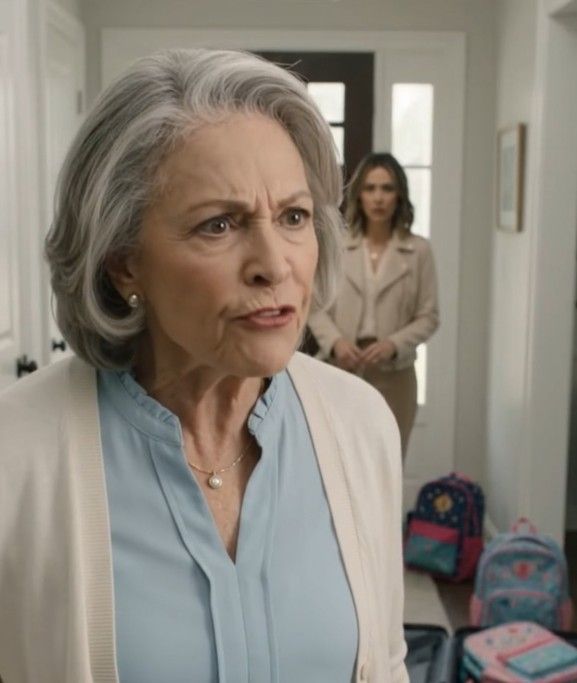
Caleb finally suggested postponing the Japan trip.
Tori’s face went white.
She said that wasn’t possible because their tickets were linked to an important business meeting.
I’d heard nothing about a meeting.
Until then, they’d described Japan as a romantic getaway and reward for working hard.
I asked what business they were conducting.
Tori told me it was none of my concern.
Perhaps it wasn’t, but who would care for four children certainly was.
I telephoned their other grandmother, thinking she might be able to help with some of the days.
She was shocked.
She said Tori had told her the children would be traveling with the parents.
Caleb stared at his wife.
“Why would you tell her that?”
Tori started rearranging the backpacks, her hands suddenly unsteady.
Hannah looked from one adult to another and clutched her stuffed rabbit.
Then my phone rang.
It was a woman from the travel agency, calling about a request to change the primary contact on a child travel authorization.
I explained I had submitted no such request.
She hesitated.
“Mrs. Ellis, your name is on a form authorizing international travel for two of these children.”
I looked at Tori.
She wasn’t looking at my passport or my suitcase.
She was staring at Hannah, who whispered, “Mom said we weren’t supposed to tell Grandma.”
Hannah’s fingers tightened around the rabbit until one of its stitched ears folded over. I put the phone on speaker and asked the travel agent to stay with me. Tori stepped forward so quickly that Caleb caught her arm. “What did you tell the children?” I asked. Hannah shook her head, tears gathering but not falling. “Mom said it was a surprise. She said you would be happy once everything was arranged.” I looked at the authorization form described by the woman on the phone and felt the old, familiar pull to solve everyone else’s emergency. For once, that instinct frightened me more than the argument.
The agent introduced herself as Ms. Chen and carefully explained what she could verify. Two of the children’s names, Hannah and her nine-year-old brother Eli, had been entered on a travel request connected to a supervised promotional visit to Japan later that week. The contact listed as their responsible adult in the United States was me. An electronic signature purporting to be mine appeared beside an acknowledgment that I had reviewed the itinerary. I had reviewed no itinerary. “Please place an immediate concern on that authorization,” I said. “It is not genuine. I do not consent to my name being used.”
Tori said the paperwork was preliminary, that nothing had actually happened. Ms. Chen answered that the documents had been forwarded to a partner coordinator, though the travel itself had not been finalized. She would suspend the arrangements, alert her supervisor, and send the disputed document to the appropriate compliance team. I asked her to confirm in writing that neither child could be collected or transported under my purported authorization. Caleb took the phone long enough to identify himself as the children’s father and request the same suspension. His voice cracked when he pronounced Eli’s full name.
“Promotional visit?” he said after the call ended. Tori stared at the red folder. “It’s part of the business meeting. They wanted family participation.” He asked why she had told him it was only a conference about branding. She answered that the opportunity had changed and that she planned to explain on the flight. “Which flight?” he asked. She opened her mouth, then shut it. The room was very quiet except for the kitchen clock. The smallest child, four-year-old Maya, picked up the crayons and began putting them back into the burst backpack.
I crouched beside her and helped. I couldn’t shield the children from everything they had heard, but I could lower the temperature in the hall. “No one is leaving you here without a plan,” I told them. “Your parents are here. You’re safe in this house right now.” Six-year-old Oliver asked if he was in trouble because he’d packed the wrong shoes. I told him shoes had nothing to do with it. Eli had gone pale and stood so close to Hannah that their sleeves touched. Hannah looked at me with an expression I recognized from schoolchildren who believed adult conflict was their responsibility.
Caleb asked the children to wait in the sitting room with a cartoon while the adults talked within earshot. He gave them water and assured them he was not going anywhere. Then he came back and opened the red folder. It contained genuine information about allergies and school hours, but mixed among those pages were model release forms, photocopied passports, and a payment schedule titled FAMILY CAMPAIGN ADVANCE. Tori tried to take the folder. Caleb moved it away. “You used our children as part of a contract,” he said. She replied that he enjoyed the money her work brought home and that he couldn’t suddenly pretend to be above it.
The contract was for a children’s clothing campaign to be filmed during an event in Kyoto. The company expected two older children to appear with a parent and a licensed local production team. There were conditions requiring accurate consent and age-appropriate working arrangements. Tori had accepted an advance while reporting that both parents had approved the participation. Caleb insisted he had not. She had copied a signature from an unrelated business form and used my details as an emergency adult because, she claimed, it would make the file “look complete.” Every excuse made the situation worse.
