“No.”
“Did you tell prospective investors she personally guaranteed oversight?”
He dropped his head. “I told them she believed in me.”
Belief had become a commodity in his hands. He had taken the trust I’d given him as a mother and divided it into shares to sell to strangers.
Dana put the presentation on the desk. “Some of these claims may be legally significant. We need accurate records, not another version designed to soften their meaning.”
Terrence began to cry. It was the exhausted crying of someone who had finally found the edge of a lie and could see the drop beyond it. I passed him a tissue. I did not tell him it would all be all right.
He explained that their startup sold scheduling software to small clinics. An early contract had failed; then a developer demanded payment after deadlines slipped. Lennox, who handled marketing and investor communications, convinced him they could attract bridge financing by emphasizing family connections and projecting revenue they hoped to earn. Each new round paid old invoices while generating another promise that couldn’t be kept.
“Where did the inheritance go?” I asked.
He showed us a ledger. Some had been invested in development. Some had gone toward an office lease far beyond their needs. Much had disappeared into consulting invoices from a separate company owned by Lennox, listed as brand strategy. His signature authorized payments, but he said he believed the work had been done.
“Did you ever ask for proof?”
He shook his head. “I didn’t want another fight.”
A week later the court granted a temporary order requiring preservation of financial and electronic records. The dispute did not end with that order. It only made concealment more difficult. A forensic accountant traced transfers from the startup to Lennox’s consulting business, then from that business to car payments, travel reservations, and personal purchases. Some invoices had no supporting deliverables. Others were dated before the company was incorporated.
Patricia and the other investor had sued over missing records and misleading representations, not simply because a risky business had failed. As we learned more, the distinction became painfully important. People could lose money in an honest venture. What they could not consent to was a fake board, a forged message, and a hidden path from company accounts to someone’s private spending.
Lennox began calling relatives. She told them I was trying to take Lily away and that Patricia had conspired to ruin Terrence out of jealousy. I received worried messages from cousins I hadn’t spoken to in years. Rather than retaliate, I sent one reply: I am not discussing a child’s private life. There is a legal dispute about financial representations. Please do not involve Lily.
At school pickup, Lily asked why her parents were staying in a small rental with furniture borrowed from a friend. I crouched beside her on the sidewalk.
“Sometimes grown-ups make choices that cost more than money,” I said. “They have to fix those choices. You are loved, and none of this is yours to fix.”
“Can I still come for pancakes?”
“Every Saturday you’re allowed to come.”
She wrapped her arms around me so tightly I almost lost my balance. I understood then that a locked door for an adult could coexist with an open place at the table for a child.
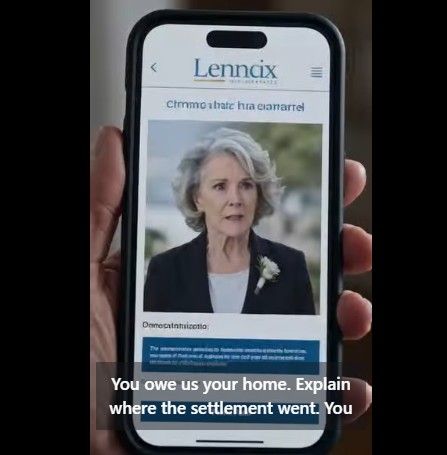
The worst revelation came during a settlement conference. Lennox arrived in a charcoal suit with a binder of documents and told the mediator she would settle only if I signed a statement accepting responsibility for investor communications. In exchange, she said, she would withdraw any claim that I’d misled their family about financial support and let Terrence negotiate a reduced amount.
There it was: a request for me to become the lie in order to save my son from it.
Terrence sat beside her. For one terrible moment he did not speak. I could see him measuring my house, my savings, and my devotion against the damage he had helped create. Then Lennox placed a second paper on the table: a purported personal guarantee bearing my full name and the last four digits of an old account.
I had never seen it. Dana asked where the original was stored. Lennox said the startup’s digital files had been lost during a server migration, but her printed copy should be enough. Dana calmly showed the mediator a record-preservation report. The file’s creation date postdated Patricia’s investment by eight months. Even more telling, its author field contained the name of Lennox’s consulting company.
“That metadata could be changed,” Lennox said.
“Then we should examine the original systems,” Dana replied. “And the payment records showing who benefited from this representation.”
A younger accountant from the neutral review team opened a transaction schedule. The largest payment to Lennox’s company had occurred the same day a promotional presentation told investors that family oversight had been formally approved. The invoice description read BOARD GOVERNANCE SUPPORT. No such board had ever met.
Patricia looked at me across the table. I felt her disappointment, not directed at me, but passing through the room like a cold draft. Terrence stared at the transaction date. It was his daughter’s birthday. He remembered the party Lennox had hosted at a rented venue that night, a party they had apparently paid for with investors’ money.
Lennox stood so abruptly her chair struck the wall. “Every successful company does this. You all want a villain because the market changed.”
“Sit down,” her attorney whispered.
She pointed at me. “She has more than she needs. She could make everyone whole and keep us out of this.”
