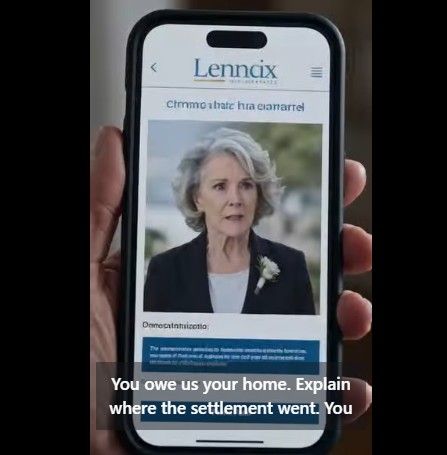
I had been silent for nearly a minute. Now I folded the proposed statement in half and returned it without signing.
“You used my name because people trusted it,” I said. “If I sign that paper, you will use my silence the same way. I won’t do it.”
Terrence reached for the microphone used by the court reporter. His hand shook, but his voice was clear. “Mom didn’t approve the board. I knew that. I should have stopped the presentation, and I didn’t. I signed the transfers. I’m responsible for that.”
Lennox stared at him with a look that contained neither surprise nor compassion. “If you say another word, we’re finished.”
He nodded. “Then we’re finished.”
The settlement conference ended without a universal agreement. But the evidence had changed the case. Terrence cooperated with a fuller accounting, the fabricated guarantee was formally repudiated, and I obtained written confirmation that I had not undertaken personal liability for the company. The investors pursued claims against the people and entities who actually made the representations.
Lennox later entered a court-approved restitution agreement after findings that she had falsified material records and diverted funds. Her consulting company dissolved. The new car was sold, and the proceeds went toward verified debts. She could no longer present herself as the steward of a flourishing enterprise; the public record established how that image had been built. Separate proceedings over knowingly false submissions led to additional penalties. There would be no clever rebranding that erased those judgments.
Terrence also bore consequences. He surrendered the remaining company assets, accepted a repayment schedule he could actually meet, and lost the professional confidence of people whose trust he had traded on. He found a job in customer support for a regional software firm. On his first day he took the bus because he no longer owned the car. He told me this without self-pity, and for that I was grateful.
Patricia recovered only part of her investment through settlements and distributions. I wished it could have been all. Instead of offering money to erase the hurt, I helped her photograph damage to her roof for a grant application and drove her sister to appointments when Patricia’s car needed repairs. Some kindnesses were not payments. They were simply what old friends still did.
Lily began meeting a counselor who helped her separate adult conflict from her own worth. She spent more weekends at my house under an agreed parenting arrangement while Terrence established stable housing. Lennox remained her mother; I never asked Lily to turn love into a verdict. When Lily brought drawings home from the counselor’s office, she showed me one of three houses connected by a long yellow path.
“That’s how I get to everybody,” she said.
I asked what the little circles along the path meant.
“Places to stop if I’m tired.”
I put the drawing on the refrigerator. It was the first sensible plan anyone in this family had made for months.
One Saturday Terrence came to collect her and found me mending the backing of the wedding photograph Lennox had knocked down. The glass had been replaced. The wooden frame still carried a pale scar near one corner. I was trying to keep the old paper from curling.
“Dad would have been ashamed of me,” he said.
“He would have been disappointed in what you did,” I replied. “He would also have wanted you to tell the truth before someone had to force it out of you.”
Terrence touched the corner of the frame. “What was he laughing about in that picture? I’ve always wondered.”
I studied the image. My husband was bent slightly forward, his mouth open in an unguarded laugh. For years I had thought the moment was lost beyond recovery. We had been busy and nervous that day, and the photographer had hurried us toward the church steps.
“I don’t remember,” I admitted.
Lily, who’d come into the room carrying her rabbit, peered over our shoulders. “Why’s his pocket so big?”
She was right. The jacket pocket bulged strangely. I remembered then that the photographer had given us a second print. I went to the hall closet and opened the wedding album. Between its covers lay a faded sheet of contact photographs, each no larger than a postage stamp.
In the frame just before the familiar picture, three-year-old Terrence was running down the steps, dragging a toy house by its chimney. In the next, he’d thrust it toward his father and shouted something that made us both laugh. In the final frame, my husband had picked him up, toy house and all.
I knew what Terrence had shouted then. “Our house has room for everybody!”
My husband had laughed because the toy had a roof no wider than his hand. Later that evening, he’d written a sentence inside our wedding album: A house isn’t proof of love. The way we treat people inside it is.
I read the words aloud. Terrence sat heavily in the chair across from me. He had come to my house believing a spare bedroom was evidence that I owed him unconditional shelter. His father had left us a gentler, harder measure.
“I thought if you said no, you didn’t love me,” he whispered.
“I said no because I do love you,” I answered. “I wouldn’t help you build another life on somebody else’s loss.”
He took the photograph to the table and carefully slid it back into the repaired frame. He did not ask me again to cover his debts or explain his choices away.
By the following summer, Terrence had paid six consecutive installments toward his obligations. He rented a small apartment with secondhand furniture and enough space for Lily’s books. Patricia’s roof was repaired. I watched him carry grocery bags into his own kitchen one afternoon, and I felt something I hadn’t expected: relief, not because he needed me again, but because he was learning how not to.
