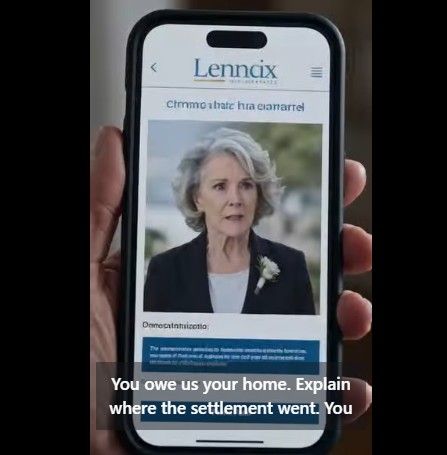
“No.”
Lennox moved forward. “It was a presentation, not a legal contract. Nobody actually reads those things.”
“Patricia did. She invested her savings.”
“She took a business risk.”
“With my name attached to a promise I never made.”
I set the phone on the table, careful not to shake it. Behind us, the process server’s car was disappearing down the street. The notice she’d delivered was the first visible piece of a much larger collapse, and I understood that my house could become the next place where someone paid for their decisions if I didn’t stop them at the threshold.
Terrence said he could explain everything if I’d let them stay for a few nights. I offered him the telephone numbers for two short-term apartments and the name of a housing counselor. He shook his head. Lennox said they shouldn’t have to beg strangers when I had two spare rooms.
“Those rooms aren’t an insurance policy against dishonesty,” I said. “I won’t discuss moving in while you are using my identity to raise money.”
Lennox gathered a suitcase, thrust it toward Terrence, and hissed, “Tell her what happens if the investors win.”
He went pale. “They might claim Mom promised to cover losses.”
The words made my stomach drop. I looked again at the authorization on Patricia’s message. An invented board title was bad enough. A personal guarantee could put my savings, and perhaps the home my husband and I had paid for over thirty years, into a dispute I had never chosen.
I called Patricia. She answered on the second ring. I told her about the process server and asked whether she could come over, not to confront my son, but to show me what she had been sent. She agreed, then said quietly, “I should have called you before I gave him a cent.”
“We both should have asked more questions,” I replied. “Come anyway.”
Terrence and Lennox left before she arrived. Their new car accelerated too quickly out of my driveway. Lily lifted her hand from the back window, and I waved until they turned the corner. I hated that she would think my refusal was directed at her. I also knew that letting her parents move in under false pretenses would teach her a worse lesson.
Patricia came carrying a shopping bag full of printed emails. We sat beneath the kitchen light where my husband used to repair his glasses with tiny screwdrivers. She showed me the investor deck, the subscription agreement, and a supposed statement from me guaranteeing that family members would supervise quarterly reviews. My name appeared repeatedly. My actual voice appeared nowhere.
Then she showed me the email that had persuaded her.
It began, Dear Patricia, it’s wonderful to see Terrence following his grandfather’s entrepreneurial spirit. I look forward to keeping a close eye on the company and protecting our friends’ investments. It was signed with my name and sent from an address I’d used for a school volunteer committee nearly a decade earlier.
I covered my mouth. The greeting sounded like something I might have written. But the promise was the opposite of anything I would make without reading a document.
“Did you ever speak to the person who sent this?” I asked.
“No. Terrence said you were recovering from a bad cold. I thought I was sparing you a nuisance.”
Her eyes were red. She told me how much she had invested. It was money she’d planned to use to replace a leaking roof and support her sister after surgery. She hadn’t expected a guaranteed return, she said, but she had expected the ordinary honesty of knowing who was responsible for the business.
For a moment I wanted to protect Terrence from the full weight of what she’d lost. Then I saw Patricia’s hands around her mug and remembered how many evenings she had sat with me after my husband’s death. Loyalty to one person could not require the abandonment of another.
“I didn’t write it,” I said. “But I will help you establish who did.”
The next morning I met an attorney, Dana Cho, recommended by Patricia’s counsel. Dana immediately told me not to ignore the claim or communicate promises to investors. She would respond on my behalf, deny the alleged authorization, and ask for original electronic records. She also suggested freezing access to the old account, preserving its logs where possible, and making a formal identity-misuse report. I spent the afternoon retrieving passwords, confirming bank beneficiaries, and informing my insurer about possible fraud-related claims.
I found it humiliating to describe my own son’s actions to strangers. But the bank officer didn’t ask whether Terrence had been a good child. She asked whether I had authorized specific transactions. The clarity of that question steadied me.
Terrence called at dusk. Lily had asked why Grandma was mad. I told him I would explain my boundaries to her gently, but not by blaming her mother or pretending nothing had happened. I asked to see him alone, in Dana’s office, with documents rather than apologies.
He arrived two days later without Lennox. The skin beneath his eyes was dark. He admitted he’d originally created the old email account for me during my volunteer years, then kept its recovery details when he helped me switch to a new address. He said he had given the password to Lennox to retrieve family photographs for a pitch presentation.
“Did you read the message to Patricia?” Dana asked.
“I knew something went out. I didn’t know the wording.”
“Did you tell your mother her name would be used on a board?”
