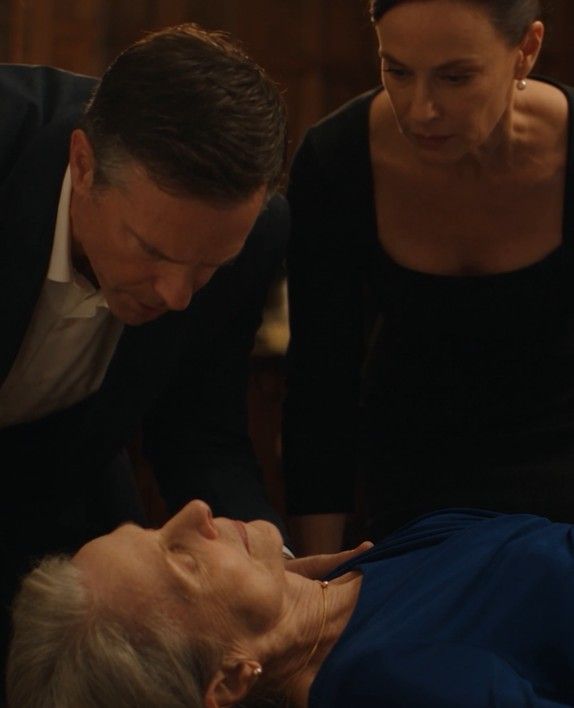
“Did you create the spill?”
“I thought if everyone was clearing plates, I could stand behind her.”
Her voice broke. “I did not want her to fall.”
I stared at her. She had planned a distraction and a swap. She had reached for the chain even after that distraction became an injury. Whether the fall was intended did not erase the choice I had watched her make.
“Write down what you have told me,” I said.
She pulled away. “So you can use it against me?”
“So you can stop changing it.”
She refused that night. I did not take her phone, lock a door, or force a confession. I put a few clothes into a bag and told her I would stay with Mom while we decided what came next.
In the morning, Evelyn sent a message admitting she had planned to borrow the original without permission. She still used borrow. I saved the message and answered that she must not contact Mom directly or come to her house.
Mom read it at her kitchen table with one arm supported by a pillow. “She thinks a softer word makes a softer act,” she said.
“Do you want to report it?”
She looked at me carefully. “What do you want me to do?”
“I want you to have a choice.”
It took effort to say that honestly. Part of me wanted to make a grand decision and call it protection. But Mom had lived eighty-one years. I would not replace Evelyn’s wish to control her with my own.
We spoke with a lawyer about the messages, the attempted taking, and the injury. The advice was careful. Evidence supported a plan to switch the necklaces; intent concerning the fall would be harder to establish.
Mom chose to make a police report so there was a record. An officer spoke with her, then with witnesses. I gave my account without claiming certainty about things I had not seen. The process moved slowly and did not turn our kitchen into a courtroom.
Ruth described the copy in Evelyn’s hand. Other relatives remembered the repeated comments about the necklace and the struggle for the clasp. Nobody could say exactly how the glass had tipped. We did not fill that gap with anger.
For weeks, no dramatic result came. Mom went to therapy for her shoulder. She could button her dress but could not carry a full kettle. I stayed in the guest room and learned how much work she had done while telling everyone she was fine.
She disliked being watched. “You can leave the room while I make toast,” she told me one morning.
I stepped back. “I know.”
“Then do it.”
We both laughed, and I felt the room loosen. Safety had to leave room for her will, or it would become another kind of cage.
Evelyn began debt counseling. She sent statements showing the balances and admitted that she had hidden them. I reviewed our joint accounts with my own adviser and arranged safeguards while we lived apart.
I did not assume every purchase was dishonest. There were ordinary groceries, repairs, and bills among the charges. The truth was ugly enough without adding false details. Her fear about money had been real. Her plan to solve it through Mom was real too.
She asked for couples counseling. I agreed to one meeting, with no promise that it would save the marriage. The therapist asked her to describe the dinner without explaining why she had no choice.
For the first ten minutes, she could not. Every sentence began with stress or shame. Then she said, “I thought Margaret would never notice. She is old. I thought if I smiled, David would explain it away.”
I felt those words land against every earlier excuse I had made. The therapist let the silence stay. At last Evelyn added, “She noticed. He noticed. I still tried.”
That was the first honest account I heard from her. It did not make me want to return home. It made me understand how little she had trusted the dignity of another person when her own plans were threatened.
I told her I wanted a separation with clear boundaries. She cried. I cried too. We had shared good years, and I would not pretend every tender moment had been false. I also could not build safety from the hope that tenderness would cancel a planned betrayal.
Her lawyer helped arrange the practical terms. Mine did the same. We divided immediate bills, discussed the house, and kept the process away from Mom. Evelyn’s debts did not become my mother’s burden because she had been the intended shortcut.
The investigation ended without a finding that Evelyn had deliberately caused the fall. Mom understood. She did not need a false certainty to support her boundary. The copy, messages, and admissions remained evidence of what Evelyn had tried to do.
Mom accepted a written apology through counsel and declined a private visit. Evelyn repaid the costs she agreed to cover for the injury and treatment through a documented arrangement. It took months. No check could purchase access to the house.
Some relatives urged Mom to move on. She asked what they meant. Most meant inviting Evelyn to the next gathering so they could stop feeling uncomfortable. Mom said she had moved forward already; she was simply choosing who came with her.
Ruth supported her. She brought soup, drove her to appointments when I could not, and began asking before lifting a bag or adjusting a cushion. Mom noticed. She said kindness felt different when it did not require surrender.
As her shoulder improved, she returned to the garden. I watched her pull one weed with the patient anger of someone reclaiming a small part of a day. She handed me the bucket and told me to stop looking tragic.
“I have had a bruise, David. I have not become the bruise.”
I carried the bucket to the compost. Her voice followed me, amused and firm. For the first time in weeks, I could hear my mother instead of the sound of her hitting the floor.
I began seeing a counselor alone as well. The first time she asked what I felt, I told her what had happened. She waited until I ran out of details, then asked again.
“Angry,” I said. “And foolish.”
“Those are different things.”
