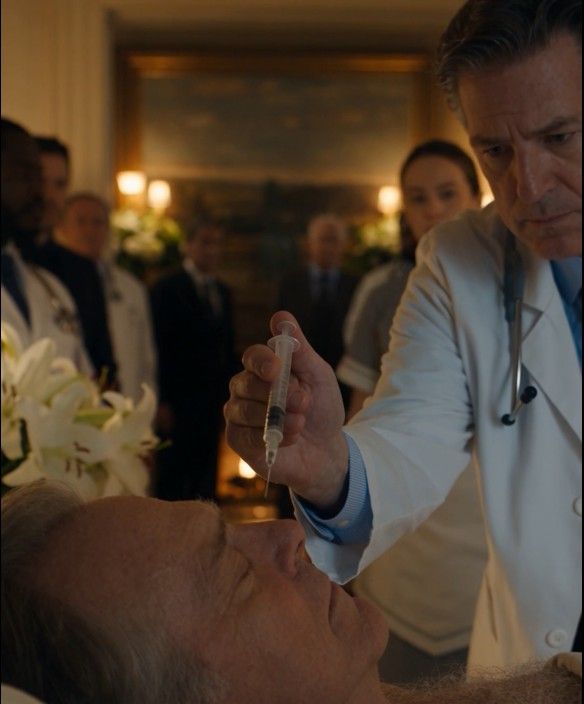
Lorenzo Hale lowered himself into a chair. His pallor had not improved. Dante noticed and asked him why Arthur Miller’s name frightened him. Lorenzo first claimed that he remembered only an old business dispute. Tess placed the laboratory page in front of him. His eyes went directly to a notation in the margin before he could stop himself.
That reaction changed the room. Dante asked how Lorenzo knew where to look. The adviser said nothing. Dominic’s fingers twitched against the sheet, a small rhythmic movement Tess had been counting from the beginning. She told Dr. Bloom that the trigger exposure had to be removed and that Dominic needed supportive treatment while they identified the activating agent. Dr. Bloom agreed to work from the documented symptoms rather than administer another unexplained injection.
The lilies were carried out in sealed bags. Within minutes Dominic’s pupil movement slowed. It was not a recovery, but it was the first measurable improvement anyone had seen. Reeves called it coincidence. Dr. Bloom did not. She asked security to preserve the flowers, the water in the vase, Dominic’s recent medications, and every item delivered to the estate that week.
Dante turned back to Tess. She told him the envelope contained one more page. It was a short note in Arthur’s handwriting addressed to her: If the Moretti symptoms appear, trust the son who questions the room, not the man who controls it. Dante read the line twice. Dominic had been the Moretti son who questioned everything. Lorenzo had controlled access to the estate, the schedule, the staff, and many of the family’s outside arrangements for decades.
Lorenzo stood abruptly. Security blocked the door before Dante had to ask. The old adviser’s composure fractured. He insisted he had protected the family through wars Dante knew nothing about. Tess answered that protection did not explain why sympathy flowers had been ordered before Dominic was dead.
The florist records supplied the first hard connection. The order had been placed through an account belonging to a holding company used by Lorenzo’s office. He denied authorizing it, but security found the confirmation message on a secondary phone in his coat. The timing matched Dominic’s collapse almost perfectly.
Reeves tried to leave next. Dr. Bloom stopped him long enough to ask why his proposed injection had not been entered into the medication chart. The syringe was sealed as evidence. Its contents were later found to be a sedative that would have dangerously suppressed Dominic’s already unstable breathing. Reeves claimed panic and poor judgment. The explanation did not survive the messages recovered from his phone.
Those messages showed Lorenzo pressuring Reeves to keep Dominic unconscious until a transfer could be arranged. They did not prove that Reeves understood the entire poisoning mechanism, but they proved he had abandoned his duty to the patient. Dante ordered him removed from the house and turned the evidence over to investigators rather than handling the betrayal privately.
Tess stayed beside Dominic through the night with Dr. Bloom and a toxicology team brought in from the city. Using Arthur’s notes, they identified the likely trigger in the lilies’ treatment solution and traced the dormant compound to supplements Dominic had begun taking months earlier on Lorenzo’s recommendation. No single dose had looked suspicious. The pattern only became visible when the records were placed side by side.
Near dawn, Dominic opened his eyes. He could not speak at first. Dante bent close enough to hear the rough breath that became his brother’s first word: “Tess.” She stepped forward, stunned. Dominic looked at her and then at Dante. With enormous effort, he whispered, “Arthur… alive.”
The words changed Tess more than the alarms had. She gripped the bedrail until her knuckles whitened. Dominic explained in fragments over the next several hours. He had discovered Arthur months earlier under another name in a protected medical residence. Arthur had refused to contact Tess until Dominic could prove that Lorenzo’s network no longer had access to her. Dominic’s investigation was the reason Lorenzo moved against him.
Dante’s anger became colder. He had assumed Dominic’s secret meetings were business maneuvering. In reality, his brother had been trying to dismantle a threat that had reached into their family and Tess’s life long before she entered the estate as an employee.
When investigators questioned Lorenzo, the adviser finally admitted that he had helped bury the old research scandal. He claimed he had done it to protect powerful clients and later to protect himself. Dominic’s attempt to bring Arthur forward would have exposed financial records, illegal testing, and years of obstruction. The plan had been to incapacitate Dominic, move him to a controlled clinic, and make his decline look natural enough that no one would ask the right questions.
Lorenzo had underestimated the maid because he had never learned who she was. That contempt became the flaw that ended his control. Tess noticed what the specialists missed because Arthur had taught her the symptom pattern when she was young. She recognized the lilies because he had once warned her that ordinary objects could become triggers when someone understood the chemistry behind them.
Weeks later, Lorenzo faced criminal charges tied to the poisoning attempt and the older cover-up. Reeves lost his medical privileges while the case against him proceeded. Dante refused every suggestion that the matter should be handled quietly for the sake of the family name. Dominic, still weak, agreed. Their name had protected too many people already.
Tess traveled with Dante to the medical residence where Arthur had been living under protection. She stopped outside his room, suddenly unable to touch the handle. For years she had rehearsed grief because grief was easier than uncertainty. Dante waited several steps behind her and gave her the privacy to choose the moment herself.
Arthur was older, thinner, and walking with assistance, but the instant he saw his daughter his face folded. Tess crossed the room without speaking. Their embrace was awkward around his cane and her shaking hands, then fierce enough to erase the distance everyone else had forced between them.
Arthur apologized for disappearing. Tess did not forgive the years in a single sentence. She told him that being protected without being told the truth had still hurt her. He accepted that. Their reconciliation began there, not as a perfect reunion, but as two people finally allowed to speak honestly without someone listening from the other side of a door.
Dominic recovered slowly. He needed therapy, rest, and months before his strength returned. Tess never became a miraculous doctor, and no one pretended she had been one. She had been observant, prepared, and brave enough to interrupt a room full of powerful people when the evidence in front of her did not make sense.
Dante offered her money. Tess refused it. Then he offered something different: funding for an independent foundation preserving Arthur’s research and supporting patients harmed by undisclosed experimental compounds. Tess agreed only after Arthur and Dominic insisted the foundation be governed outside Moretti control.
The weeks before Dominic reached the garden were less graceful than the photograph taken there would later suggest. His recovery moved in inches. Some mornings he could stand beside the bed without help; on others, the effort of crossing the room left him pale and furious with his own body. Tess never treated those setbacks as failure. She watched the monitors, kept notes on his reactions, and asked questions until the medical team stopped speaking around her and began speaking with her. Dr. Reeves, stripped of the certainty that had made him dismiss her, learned to answer without condescension. He did not become Tess’s friend. He became something more useful: a physician willing to admit when another person had seen what he had missed.
Dante changed in quieter ways. For years, money had allowed him to turn fear into orders. During Dominic’s illness, every command had sounded powerful while leaving him helpless. Tess had done the opposite. She had stood in a maid’s uniform, without status or permission, and risked humiliation because the detail in front of her mattered more than the people laughing behind her. Dante began asking before deciding. Staff members who had once lowered their eyes when he entered found him pausing in doorways, listening through complete answers, and occasionally saying the two words that had rarely survived in the Moretti house: I was wrong.
Arthur did not accept the family’s sudden attention easily. Tess’s father had lived too long with regret to trust a warm room simply because someone opened the door. His first visits with Tess were awkward, full of unfinished sentences and long stretches in which both of them studied their coffee. Tess refused to perform a reunion for anyone. She wanted facts before forgiveness. Arthur gave them to her one at a time: where he had gone, why he had stayed away, which choices had been cowardice, and which had been made under pressure he had once believed he could not resist. He did not ask her to erase the years. He asked for the chance to stop adding new ones to the distance between them.
The letters helped because they were specific. They did not claim Arthur had always been a good father. They proved he had remembered. One envelope mentioned the blue bicycle Tess wanted at nine. Another described the school recital he had watched from the back of the auditorium because he had been afraid his presence would cause trouble. A third contained no defense at all, only an apology for choosing absence when courage would have required staying. Tess read them slowly. Some made her angry. Some made her cry. None forced an answer from her. For the first time, the past was becoming a record she could examine instead of a blank space other people filled for her.
Dominic understood that kind of uncertainty better than anyone expected. Recovery had made him dependent on people he once barely noticed. He began learning names: the night nurse who adjusted his pillows without waking him, the housekeeper who knew which corridor stayed quietest during therapy, the kitchen assistant who prepared food he could tolerate after medication. He asked Dante to revise the household policies so medical concerns raised by staff could never again be dismissed because of job title. The change was practical, not ceremonial. Reports went directly to the care team. Employees could stop a procedure long enough to request review without risking dismissal. Tess insisted her name not be attached to the policy.
When Dante asked why, she looked toward Dominic’s room. Because the next person should not need to be me, she told him. The rule should work for someone nobody thinks is important. That answer stayed with Dante. He had spent most of his life believing influence belonged to the person whose name was on the building. Tess had shown him that responsibility could belong to the person willing to notice what everyone else had decided was beneath them.
The formal review of Dominic’s treatment was painful but necessary. Records showed where assumptions had hardened into a plan and where warning signs had been interpreted through the wrong diagnosis. No single dramatic villain explained every mistake. That made the findings harder to accept and more useful. Reeves faced professional consequences for ignoring a direct safety concern and for proceeding without adequately reconciling conflicting indicators. Other specialists revised their protocols. Dominic read the final report twice, then signed the recommendations without demanding anyone soften the language to protect the Moretti name.
Tess attended only the final meeting. She wore ordinary clothes and sat beside Arthur, not across from the doctors as an accuser. When asked what outcome she wanted, she said she wanted the record to be accurate. An apology mattered, but accuracy could protect someone she would never meet. The room went still. Dominic reached for the water beside him, his hand steadier than it had been a month earlier. Dante watched Tess and understood that she had never been fighting for a place at their table. She had been fighting against the habit of deciding whose voice counted before hearing what that voice was saying.
Arthur and Tess eventually created a routine that belonged only to them. Saturday mornings, no estate, no doctors, no Moretti business. They met at a small diner where the coffee was too strong and the booths were cracked at the edges. At first they talked about safe things. Weather. Books. The neighborhood where Tess had grown up. Later came the difficult subjects. Her mother. The birthdays Arthur missed. The anger Tess had carried so long it had begun to feel like part of her personality. Arthur never told her to let it go. He listened until she was finished, even when what she said hurt him.
That patience became the beginning of forgiveness, though Tess refused to name it too soon. Forgiveness, she discovered, was not a door swinging open. It was a series of small permissions. She answered his call. She let him walk her home. She showed him a photograph from a graduation he had missed. Eventually, she asked whether he wanted to see the box where she had kept the few things connected to him. Arthur cried before she opened it. Tess did not comfort him immediately. She let the grief be honest. Then she sat beside him.
Dominic’s first independent walk happened on an overcast morning with no guests present. He crossed from the bedroom to the library while Dante followed several steps behind, visibly resisting the urge to reach for him. Tess waited near the window. When Dominic reached the chair, he laughed from sheer exhaustion. It was not the controlled laugh of a businessman or the relieved laugh of a patient receiving good news. It was messy and surprised and alive. Tess laughed too. Dante looked away for a moment, pretending to inspect the books until he trusted his face again.
By then the estate no longer felt like the room where Tess had been mocked for speaking. It had become the place where several people were learning what listening cost and what it repaired. That did not make the original humiliation disappear. Tess remembered the laughter. She simply no longer measured herself by it. The people who had underestimated her had been forced to confront the consequences of doing so, while the people she chose to keep near her learned that respect was not gratitude offered after a rescue. It was the condition that should have existed before anyone needed saving.
The final surprise came when Arthur opened an old metal case he had carried from hiding. Inside were years of letters to Tess that he had never been able to send. On top lay a photograph of seven-year-old Tess in a garden holding a pot of white lilies. Arthur had written on the back that she had always noticed what other people overlooked.
Tess laughed through tears at the irony of the flowers. She had spent years believing her father had vanished without leaving her anything. In truth, he had preserved a record of every birthday, every regret, and every hope that they might one day sit together again.
Months later, the lilies at the Moretti estate were replaced with rosemary and small olive trees. Dominic walked into the garden on his own for the first time, Dante beside him and Tess a few steps ahead with Arthur. Nobody spoke about death that afternoon. The house that had once filled with alarms held only wind through the leaves, and Tess paused long enough to notice the sound before continuing toward her father.
Tess kept one habit from the crisis: she wrote down what she observed before deciding what it meant. That discipline followed her beyond Dominic’s recovery. It kept certainty from becoming arrogance, the very mistake that had nearly silenced her in the medical suite. Arthur recognized the change and told her she sounded like her mother when she insisted on facts first. For once, the comparison did not hurt.
