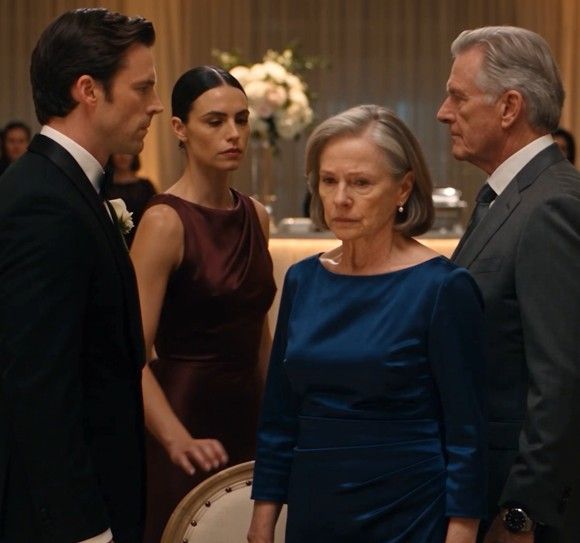
The document was a prenuptial agreement.
Not the one Andrew had signed. A different one. One Lydia had drafted herself, with her father’s attorneys, three weeks before the wedding. One she had never shown to Andrew.
At the bottom of the page was a name. A name that made Lydia’s face go white. A name that made her father sit back down and reach for his whiskey. A name that made Andrew’s hands begin to shake.
The name was Margaret Harper.
My name.
“What is this?” Andrew asked. His voice was quiet. Dangerous. The voice of a man who had just realized he had been lied to.
Charles Whitmore didn’t answer. He just handed the document to Andrew.
Andrew read it. His face went from confused to angry to something else. Something broken.
“This says my mother is not allowed to attend family functions,” he said. “This says she is not allowed to visit our home. This says she is not allowed to have any contact with our children.”
He looked up at Lydia. “You wrote this.”
Lydia shook her head. “It was just a draft. It was never supposed to be signed.”
“But you wrote it. You planned it. You planned to erase my mother from my life.”
Lydia’s lip trembled. “She’s not good for you, Andrew. She’s not good for us. She’s old. She’s poor. She doesn’t fit in our world. She would embarrass you.”
“She raised me. She sacrificed everything for me. She worked three jobs so I could go to school. She sold her wedding ring so I could buy my first drafting table. And you wanted to erase her.”
Lydia started to cry. “I was trying to protect you.”
“From what?”
“From being held back. From being dragged down. From becoming like her.”
Andrew stared at her. At his wife. At the woman he had married hours earlier. At the woman who had just pulled a chair out from under his mother.
“You’re a monster,” he said.
Lydia gasped. Her mother stood up. Her father stood up. They started toward Andrew, but Charles Whitmore stepped between them.
“I think you should leave,” Charles said. “All of you. The wedding is over.”
Lydia’s father puffed out his chest. “You can’t do that. This is my daughter’s wedding.”
“This is my hotel,” Charles said. “And I can do whatever I want.”
The ballroom erupted. Guests started talking. Some of them stood up. Some of them pulled out their phones. Some of them just watched.
Andrew walked toward me. He knelt down. He picked up my glasses. He picked up the coins. He picked up the photograph of himself as a seven-year-old boy.
“Mom,” he said. “I’m so sorry.”
I looked at him. At my son. At the boy who had drawn that picture. At the man who had just discovered the truth about his wife.
“It’s not your fault,” I said.
“It is my fault. I should have seen it. I should have known.”
“You didn’t know. She hid it from you.”
He helped me stand. He put his arm around me. He walked me to the door.
Behind us, Lydia was screaming. Her father was shouting. Her mother was crying. Charles Whitmore was calmly telling them to leave. The guests were watching. The cameras were rolling.
I didn’t look back.
The next few months were hard.
The marriage was annulled. Andrew filed for divorce the day after the wedding. Lydia tried to fight it. She claimed she loved him. She claimed the prenuptial agreement was a misunderstanding. She claimed I had manipulated him. The judge didn’t believe her. The annulment was granted. Lydia was ordered to return the wedding gifts. She was ordered to pay restitution for the reception. She was ordered to stay away from Andrew and from me.
Andrew moved back home. He was broken. He was embarrassed. He was ashamed. He spent weeks in his old bedroom, staring at the ceiling, replaying every moment of his relationship with Lydia. Every red flag. Every warning sign. Every time she had made a comment about me. Every time she had suggested he spend less time with me. Every time she had rolled her eyes when I called.
He started therapy. He started healing. He started to see.
The final twist came six months later.
I was cleaning out Andrew’s old room. He had moved into an apartment of his own. He was doing better. He was working on his proposal for Whitmore Holdings. Charles Whitmore had personally requested that he resubmit it. He had told Andrew that the family mattered. That the mother mattered. That the son who loved his mother was the kind of man he wanted to work with.
I found a box in the back of Andrew’s closet. It was labeled “Mom’s things.” I opened it.
Inside were drawings. Dozens of them. From when Andrew was a boy. Pictures of houses. Pictures of buildings. Pictures of me.
One of them was dated twenty-five years earlier. It showed a small house with a big window and a garden. In the window was a woman. She was smiling. At the bottom, in a child’s handwriting, was a caption: “My mom. The best architect in the world.”
I sat down on the floor. I cried.
Andrew came home that evening. He found me in his room, holding the drawing.
“I remember that,” he said. “I drew it after you helped me build the model of the Empire State Building. You stayed up all night with me because I couldn’t get the elevator shaft right.”
I looked at him. “You remember that?”
“I remember everything. You were always there. You were always helping. You were always sacrificing. And I forgot. I forgot what you did for me. I forgot who you were. I let Lydia make me forget.”
I stood up. I walked to him. I put my hands on his face.
“You never forgot,” I said. “You just got lost. But you found your way back.”
He hugged me. He held me tight. We stood there for a long time.
The final image: I sat on the porch of my house. The sun was setting. The sky was pink and gold. Andrew was inside, working on his proposal. The acceptance letter from Whitmore Holdings was framed on the wall. The photograph of Andrew as a seven-year-old boy was on the mantel. The drawing of the house with the big window was on the refrigerator. I looked at the garden. I looked at the roses. I looked at the sky. I was not the woman who had been pulled from her chair. I was not the mother who had been erased. I was not the victim who had been told to sit with the servants.
I was Margaret Harper. I was a mother. I was a survivor. I was home.
