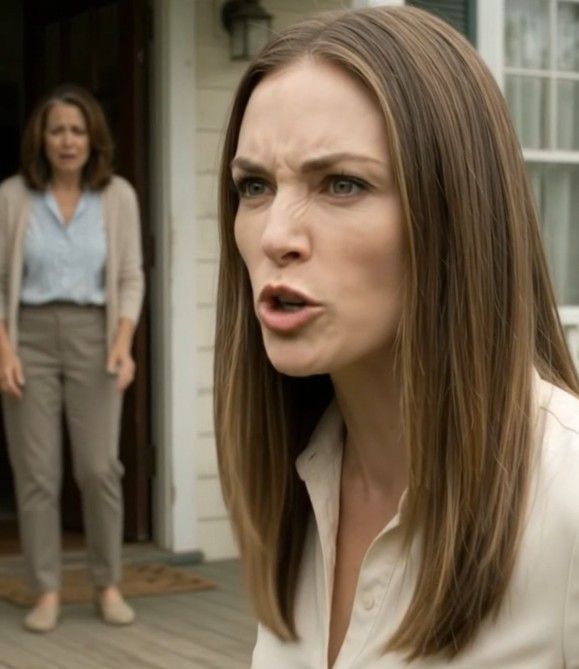
I offered Nina tea in the kitchen. We talked about the planned practice and the deposit she had paid. My attorney was arranging restitution claims, but I made clear that I could not guarantee what Sarah would repay immediately. Nina said she wasn’t asking me to cover her daughter’s dishonesty. She wanted assurance that other clients would learn the truth before moving their own practices or giving up leases elsewhere. Together we prepared a careful, factual notice for everyone on the list. Nina offered to connect any displaced professionals with a local association that could help them find legitimate space.
The worst revelation arrived in the form of an email from a man I had never met. He identified himself as an investor in Hearthstone Wellness Suites and claimed Sarah had promised him a percentage of rent for five years. Attached was a draft agreement stating that the cottage would transfer into a new management company after my mother’s estate was settled. The signature block carried my mother’s name, dated two months after her death. I stared at it until the letters stopped making sense. Sarah had not merely rented the rooms. She had described an inheritance that belonged to me as if it were an asset waiting for her to distribute.
I confronted her at my lawyer’s office, with the documents laid between us. She first insisted that the agreement was only a proposal. Then the investor’s proof of a payment arrived. She had received money in exchange for an interest she could not convey. “I was going to make it all real,” she said, tears gathering. “Once you saw the renovations, you would have agreed.” My lawyer asked whether she had ever considered what would happen if the wall had been torn down and I still said no. Sarah stared at the table. In that silence I heard the full shape of the betrayal. She had planned to make refusal impossible by changing the facts first.
I told her I would not endorse any of the agreements. There would be no transfer, no management company, and no demolition. I would cooperate with the investigation even if it led to charges. Sarah pushed back her chair. “You’re choosing bricks over your daughter.” I felt my face grow hot. “I’m choosing not to make your customers pay for your fear. I’m choosing not to bury Grandma’s wishes under false papers. And I’m choosing to love you without helping you keep doing this.” The words hurt us both. I did not take them back.
The months that followed were ugly in ordinary ways. Lawyers exchanged letters. Prospective tenants supplied receipts, and the investor pursued the return of his money. Investigators examined the signatures and communications. Sarah’s venture lost its proposed location, funding, and clients. The payments that remained were returned through the legal process, while Sarah became responsible for the shortfall and associated losses. Eventually she admitted to the false authorizations and deceptive contracts in court. The resulting judgment and restitution requirements ended her ability to present herself as an authorized property manager for the cottage. The business name disappeared from every advertisement. Its failure was irreversible because the trust on which it relied had been fabricated.
I attended the hearing because the cottage and my mother’s name were involved. Sarah looked straight ahead as the facts were read. I knew she was ashamed, but I also knew shame could become another hiding place if she used it to avoid action. When she spoke, she acknowledged using a deceased person’s name, taking deposits for property she could not lease, and trying to create pressure so I would surrender. She did not call it a misunderstanding. Afterwards, in the corridor, she asked whether I wished she’d never been born. The question stunned me. I told her I wished she’d asked for help before she chose to hurt people, and that those were entirely different wishes.
For several weeks I didn’t see her. I repaired the cottage fence, sorted my mother’s sewing basket, and had the damaged rocking chair taken to a woodworker who understood old furniture. He showed me how the split runner could be joined with a carefully fitted repair. “It won’t look new,” he said. “But it can hold weight again.” I found myself thinking about Sarah, then reminding myself that a chair was wood and a relationship required two people. I could repair one without anyone else’s consent. The other would depend on whether my daughter was willing to change.
Nina kept calling every few weeks, never to demand the office, always to ask how I was. One day she brought a box her father had stored in his attic. It contained old class photographs, recipe cards written by students, and a ledger my mother had lent him when he began volunteering. Near the back was a photograph of Sarah at eleven, standing beside Grandma and holding a handmade banner: WORDS OPEN DOORS. Sarah looked proud and unguarded. On the back, in my mother’s handwriting, was a note: “Sarah stayed after class to read with Mr. Alvarez. She is so patient when she forgets to be afraid.”
I read that sentence repeatedly. I had seen Sarah as the angry woman ordering people through my mother’s rooms. My mother had also seen her as a child capable of patience, and perhaps as someone frightened of not being enough. I didn’t confuse that insight with an excuse. The people who had lost deposits deserved repayment regardless of what Sarah felt. But the photograph kept me from allowing her worst act to erase every other truth about her. Healing, if it came, would begin with accurate memory rather than denial.
At the bottom of the cedar box I found another envelope, this one addressed to me in my mother’s handwriting. It had slipped inside a larger folder of household bills. She wrote that she knew I might find the cottage painful to keep, and she did not want me imprisoned by an inheritance. But if it was possible, she hoped I would preserve the small office because it had been the happiest room of her later years. Then came a line that made me stop: “I think Sarah could someday help there, if she learns to listen to people instead of trying to rescue them all at once.”
Enclosed was a proposed program, not a legal condition or a hidden transfer of ownership. My mother had imagined pairing adult literacy tutoring with practical workshops on job applications, housing forms, and access to community services. She had penciled Sarah’s name beside the words FUTURE COORDINATOR? and underlined the question mark. She knew her granddaughter had a gift for organizing. She also knew that being trusted with other people’s needs required humility. My mother had not rejected Sarah from the cottage’s future. She had left the door open for someone Sarah had not yet become.
I took the letter to my daughter at the small rented room where she was living while she repaid her debts. Sarah let me in awkwardly. The place smelled of fresh paint and instant coffee. She had found steady administrative work that did not involve handling client funds and was making scheduled restitution payments. She showed me the payment ledger without asking for praise. I gave her the letter. She read it slowly and covered her mouth with one hand. “She thought I could work here?” she asked. “She thought you might be able to earn that responsibility,” I said. Sarah nodded, tears wetting the page.
She confessed something I had not known. As a teenager she’d sometimes stayed after Grandma’s classes because she felt useful there in a way she hadn’t felt at school. After her marriage failed and she lost her client, the idea of returning had become tangled with the need to prove she was successful. “I wanted to walk in and show everyone I had built something,” she said. “I didn’t want to come back needing a chair and somebody to tell me I could start again.” I listened. Then I told her the truth: the real students had never needed her to be impressive. They needed her to show up honestly.
Sarah asked whether she could help restore the letters to the office wall. I said she could visit with me on a planned Saturday, but there would be no keys, contracts, or management role. She accepted the terms without arguing. We worked in quiet daylight, placing the old notes in protective sleeves and sorting photographs by date. When she found her own card in the pile, she sat on the floor and cried. I sat beside her, keeping enough space for her to breathe. “Grandma would have been furious,” she whispered. “Yes,” I said. “And she would have wanted you to learn from it.”
Over the following year, Nina helped me connect with an established literacy nonprofit. We agreed that qualified volunteers could use the office during limited hours under a written arrangement approved by my attorney and covered by appropriate insurance. The building’s safety needs were checked, and none of the load-bearing walls were removed. Nina occasionally offered free information sessions about anxiety and practical support, clearly separate from any counseling practice. Sarah attended volunteer training and assisted with setup only after the nonprofit’s coordinator approved it and safeguards were established. Her tasks were humble: arranging chairs, organizing supplies, and making tea. She did them well.
The people Sarah had harmed were not required to participate in her rehabilitation. Nina chose to be part of the program, but two other prospective tenants did not want further contact with her, and I respected that. Sarah continued making restitution payments, sometimes at the cost of comforts she’d once considered essential. The court judgment remained part of her history. She learned that accountability was not a ceremony after which everything returned to normal. It was a habit practiced when no one clapped, a set of obligations that continued even on the days she felt tired or misunderstood.
The woodworker returned the rocking chair just before winter. Its repaired runner bore a narrow line that caught the light, a visible reminder of the fall. Sarah helped me carry it onto the porch, then stepped away instead of choosing where it should go. I placed it facing the peonies. She looked at the chair for a moment and said, “I heard myself that day. I said your memories weren’t worth my future.” I told her I remembered. “I thought those were the only two choices,” she said. “I didn’t understand that your memories might be part of something I could help carry forward without owning it.”
At our first small open house, Nina arrived with a framed photograph of her father at my mother’s reading desk. In the image, he held up a completed job application and grinned at the camera. Behind him stood Sarah, much younger, pointing proudly at the line where he’d written his own name. Nina turned the frame over. Her father had written a sentence years later, after he had learned enough to express it in his own hand: “This room taught me I was not too late to begin.” I asked Nina if we could hang it beside the door. She smiled. “That’s why I brought it.”
Sarah was standing nearby. She read the sentence aloud, softly, then looked at me. I realized my mother had hidden no secret fortune or property promise in the cottage. Her gift was stranger and more generous: a place where people could begin again without pretending the past had never happened. The idea did not dissolve Sarah’s debt or the grief she’d caused, but it gave us a direction that didn’t require either of us to surrender the truth. I took her hand for a moment. She held it carefully, as though learning what permission felt like from the other side.
When the visitors left, I switched off the office lamp and walked onto the porch. The restored chair rocked gently in the evening breeze. Sarah locked only the supply cupboard she had been authorized to close, then handed me the key. She asked whether I wanted company for a cup of tea. I said yes. Inside, the old wall stood exactly where my mother had left it, now covered with new notes beside the old ones. I read the latest, written by a woman who’d completed her first letter to her granddaughter: “I had so much to say. Now I know how.” I set two cups on the table, and for the first time since my mother’s death the cottage felt less like a place I was trying to preserve and more like a place where life, patiently and honestly, was going on.
