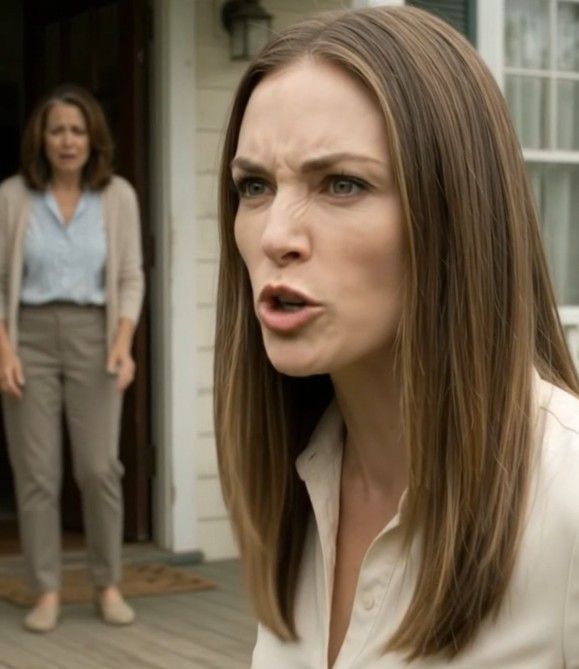
Sarah claimed the office was wasted space.
She said a larger bedroom would increase the home’s resale value.
But the contractor’s drawings included two office desks, not a bedroom.
I asked him who had requested the renovation.
He opened his email and showed me a message from Sarah stating that the cottage would soon host a small private counseling practice.
There were proposed appointment hours and a list of anticipated clients.
My daughter wasn’t a licensed counselor.
When I confronted her, she said she planned to rent rooms to professionals and manage bookings.
I asked whether she’d told those professionals the building belonged to her mother.
She looked away.
Then she said the office was already spoken for.
That evening I opened the cedar box of papers my mother had left me.
Among her letters was a note instructing that the cottage’s little office stay available for literacy tutoring as long as I could reasonably arrange it.
She had underlined the phrase twice.
As I read, a woman called asking for Sarah.
She said she’d paid a security deposit on the cottage’s professional suite.
Then she asked why the lease named my late mother as the landlord.
I held the phone tighter. Through the window, the cottage garden had darkened into blue shadow, and I could barely make out the peonies beside the path. The woman repeated her question. “The lease lists Mrs. Margaret Bell as the landlord. The property records show she died in April. I thought there might be a simple explanation.” Margaret Bell was my mother. My daughter had signed a contract in a dead woman’s name, promised a stranger space inside a home she did not own, and taken money for it. For a moment I heard nothing but the old refrigerator turning on behind me.
“There isn’t a simple explanation,” I said. “I’m her daughter and the legal owner of the cottage. I did not sign or authorize a lease. Please don’t send any more money, and would you forward the papers to me?” The woman introduced herself as Dr. Nina Alvarez, a licensed counselor looking for part-time space for her practice. She sounded shaken rather than angry. She had paid a deposit because the brochure described a quiet setting with private offices and easy parking. Sarah had assured her that the paperwork had been arranged with the family. “I believed her,” Nina said. I looked at the drawing spread across my kitchen table. So had the contractor.
I asked Nina to preserve her emails, receipts, and payment confirmation. I promised to work with an attorney to clarify the situation, but I didn’t offer use of the cottage as compensation. That distinction felt brutal at first. Somebody had lost money because of my daughter, and everything in me wanted to smooth the damage away. Yet the cottage was not a bank from which Sarah could withdraw forgiveness. Nina thanked me for taking the call seriously. Before she hung up, she said, “The strange part is that I’ve been in that office before. Your mother taught a class there. I’ll explain when we meet.”
At seven the next morning I called the contractor. He remembered the canceled job and said a separate demolition subcontractor had been scheduled for Monday. Sarah had told him the change of plans was a family disagreement that would resolve over the weekend. I informed him in writing that no work was authorized and sent proof of ownership. He canceled every crew associated with the project. He also forwarded the deposit invoice and the permit inquiry Sarah had submitted. On one form she had described herself as the property’s managing owner. On another the owner was listed as Margaret Bell. The names changed depending on which lie was useful.
I visited the cottage before sunrise. A thin mist hung among the trees, and the old boards creaked beneath my feet exactly as they had when I was a child. Upstairs, Sarah had stacked a few boxes of files beside the office door. They weren’t her personal possessions. They contained printed brochures for a new venture called Hearthstone Wellness Suites, complete with room rental rates, a management fee, and a photograph of my mother’s reading desk. Sarah had borrowed the warmth of the room and sold it back to strangers as a professional amenity.
I began photographing everything. Then I checked the locks, windows, and wall where my mother had pinned the students’ letters. Someone had taken down half the notes and put them in a bin marked RECYCLE. I knelt on the floor and spread the papers out. An older man had written that he could finally read letters from his son. A woman had thanked my mother for helping her complete the form for her first job. One card showed a child’s stick-figure drawing beside the words MY GRANDMA HELPS PEOPLE BE BRAVE. Sarah had made that card when she was nine. I pressed it flat with my palm.
Sarah arrived while I was still there. She carried a roll of blueprints and looked startled to see me on the office floor. “You can’t keep coming here to sabotage everything,” she said. I stood, holding her childhood card. “I own this house. You have taken deposits under Grandma’s name.” The color left her face. Then she accused Nina of betraying a confidence. “You told her a dead person was her landlord,” I answered. “The truth isn’t a betrayal just because it catches up with you.”
She said the deposit was temporary and that she had intended to reimburse everyone once her business was running. When I asked how many people were involved, she said two. I waited. She said three. Then, exhausted by her own changes of story, she sank into my mother’s chair and admitted there were six prospective tenants, including Nina. Three had paid deposits. Two had signed letters of intent. She had spent part of the money on renovation plans, advertising, and overdue rent. I could see panic beneath her anger, but panic did not make the contracts real.
“Why not ask me?” I said. Sarah looked at the desk instead of at me. “Because you would have said no.” There it was. Not a misunderstanding, or a plan she’d simply forgotten to mention. She knew I had a choice and decided to avoid it. I sat opposite her, the card between us. I told her that my refusal to surrender the cottage did not mean I had refused to help her survive. We could have discussed a job search, debt counseling, a temporary loan with terms, or one of the apartments I had offered to help her find. She had rejected those options because they came with the humiliating condition of being honest.
Her jaw tightened. “You don’t know what it’s like to lose everything at my age.” I reminded her that my marriage had gone through lean years, that I had buried my mother six months ago, and that I had not spent those months free from worry. Then I stopped. Comparing pain wouldn’t settle the papers on the desk. I asked Sarah to give me a complete list of clients and payments so everyone could be contacted without another lie. She said she needed time. I told her I would obtain the information from the records and involve professionals whether she cooperated or not.
That afternoon an attorney helped me send formal notices withdrawing any purported authority Sarah had claimed and requiring her to stop advertising, leasing, accessing, or modifying the cottage. We reported the suspected false signatures and collected receipts from prospective tenants. I contacted the local building office so no construction would begin based on an owner consent that hadn’t been given. The attorney explained the civil options for recovering money and protecting the title. I hated seeing my daughter’s name printed beside the word unauthorized. I hated even more that the description was accurate.
Nina came to meet me outside the cottage the following day. She was in her forties and wore sensible boots for the muddy path. She looked up at the office window with an expression of recognition so strong that I felt she had brought another version of the house with her. “Your mother helped my father learn to read after he lost his factory job,” she said. “He was fifty-three and ashamed to fill out an application.” She smiled sadly. “He used to practice at this desk while I waited on the porch.” Her father had found work, and the family had kept in touch with my mother for years.
Nina had become a counselor partly because she’d seen what shame could do to people who needed help. When Sarah advertised offices at the cottage, Nina thought the site was being reopened in the spirit of my mother’s tutoring work. “That’s why I wanted the space,” she explained. “Not because it would be prestigious. Because your mother made ordinary people feel safe enough to try again.” I felt both pride and grief rise so sharply that I couldn’t speak. Sarah had recognized the value of the cottage, but in trying to extract money from it she had misunderstood its purpose almost completely.
