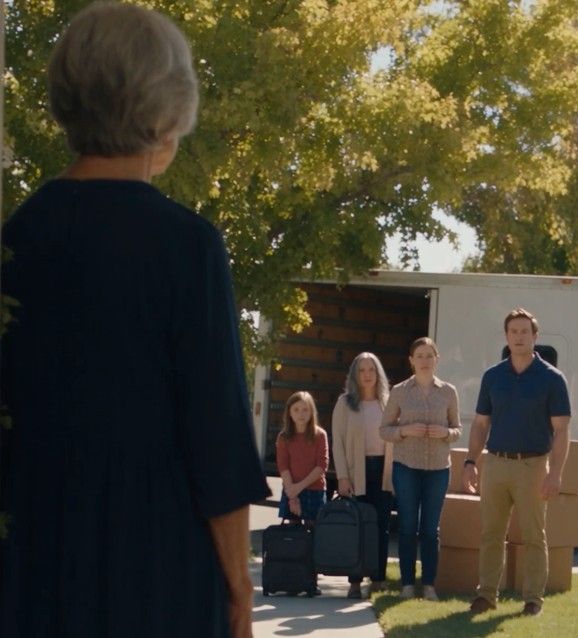
That fall, the children asked if they could spend Thanksgiving at my house. I told them I would think about it, and I asked what their parents wanted. Ethan called that evening, not to announce a plan but to ask whether I felt up to hosting a small meal. He offered to bring the turkey already cooked and to take every dish home afterward. Martha suggested that we meet at noon so I would not have to wake before dawn. I said yes, with one condition: if I got tired, we would stop and order dinner. They agreed without bargaining.
On the day itself, the kitchen filled with the kind of noise I had once believed I needed to manage. The children argued about the television remote. Ethan spilled gravy on a dish towel. Martha forgot the rolls in the oven until the edges browned too far. No one panicked. We ate what was ready, laughed about the rolls, and let the dishes wait while we played cards. I caught myself reaching for a sponge after dinner, then put it down. Kevin saw me and began washing without turning it into a performance or asking for praise.
Later, when the children were outside, Ethan asked whether I had been lonely since they moved. I told him that some evenings were quiet, but quiet did not mean I wanted to surrender my home. He listened. I asked if he felt lonely in the apartment. He said yes, sometimes, especially when the children asked why Grandma had not let them move in. We talked about how to answer them without blaming anyone. He agreed to tell them that adults had to make their own choices about where they lived and that they were always welcome to visit me.
That conversation did not erase what had happened on the lawn. It gave us a way to remember it without turning the children into messengers. From then on, when they asked, I said, “Grandma’s house is her home, and your home is yours. We can love each other in both places.” They seemed satisfied. Children often need the truth stated simply, not softened until it becomes confusing.
One Sunday, Sharon came over with an old photograph she had found in her attic. It showed me at forty, standing in front of the house on Maple Street with paint on my shirt and a key held up in one hand. Ethan was a toddler on my hip. Behind us, the porch railing was unfinished, and the front yard was only dirt.
I had forgotten the picture. I turned it over and found a note in my late husband’s handwriting: “Rose’s first house. Her name on the papers, her work in every wall. Someday, make sure she gets to enjoy it.”
I had thought he meant that we should finish fixing the place. Sharon looked at me and said, “He knew you would spend your whole life making it comfortable for everyone else.”
That note became the final piece I had not known was missing. The house had never been a prize waiting for Ethan. It had been a promise between my husband and me that I would have a place to rest. I had spent years treating that promise as less important than keeping my son happy.
I framed the photograph and hung it beside the kitchen doorway. Ethan noticed it when he came over the next week. He read the note twice. His face softened, and he touched the edge of the frame.
“Dad wanted you to have this,” he said.
“He wanted me to enjoy it.”
“I think I forgot that.”
“So did I, for a while.”
We stood together in the kitchen. The room was the same oak and tile, the same afternoon light across the counter. But now, when Ethan spoke about the future, he asked instead of assuming.
He never moved into my house. I never promised him that he would inherit it. We did not need those outcomes to define whether we were a family. He and Martha built a home of their own, slowly and within their means. I remained on Maple Street, with my sewing room, my garden, and a key that belonged to me.
The following Saturday, the children came over to bake. I let them roll dough on the old table, and flour dusted the floor. When they asked if they could have the cookies for their school bake sale, I agreed. Ethan arrived at pickup time, rang the bell, and waited on the porch while I opened the door.
“Can we come in?” he asked.
I looked around the home I had built with forty years of work, then at my son, who had finally learned to ask. “Yes,” I said. “Come in for a while.”
He smiled, and the children ran past him into the kitchen. The house was still mine. The welcome was mine to give. That was the decision he could never undo: I had learned that love could open the door without handing over the key.
