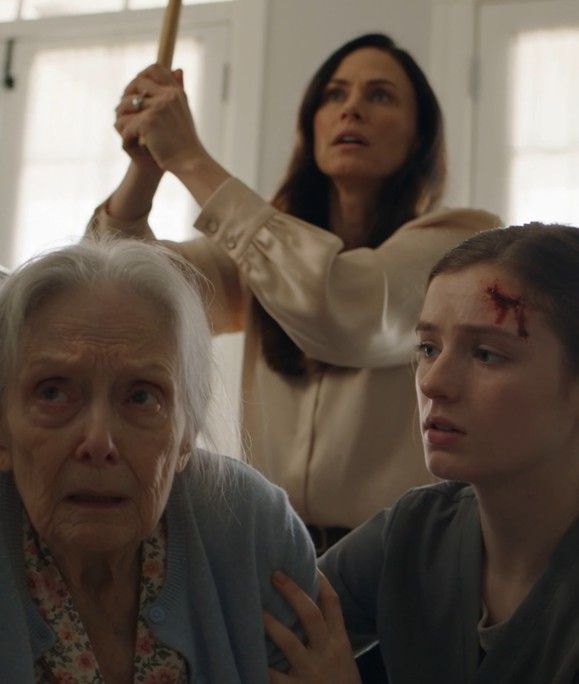
I came home early from Saudi Arabia and found my wife raising a wooden spoon over my seventy-eight-year-old mother while Elena, our twenty-six-year-old housekeeper, shielded her with her own body.
Blood ran from a cut above Mom’s eyebrow. Her wheelchair lay overturned beside her, and she was crumpled on the kitchen floor, begging Vanessa to stop. I dropped my suitcase and ran toward them.
“Stop!” I shouted.
Vanessa turned, lowered the spoon, and tried to smile. “Your mother was having another tantrum,” she said. “I was only teaching her a lesson.” Mom clutched Elena’s sleeve and whispered that Vanessa kept her locked in her room. Vanessa laughed and called her confused.
I called emergency services. While paramedics examined Mom and Elena, Vanessa followed me, claiming she had endured my mother’s behavior alone for eight months and that Elena had filled her head with lies. Elena looked at me from the ambulance door. “Please check the blue sewing box in your mother’s closet.”
The bedroom door had a new lock on the outside. Inside the sewing box, I found bank statements, credit card receipts, jewelry appraisals, a ledger in Mom’s shaky handwriting, and photographs of bruises at different stages of healing.
Before I left for Saudi Arabia to manage a refinery project, Mom had moved in after a minor stroke. Vanessa insisted she could handle everything, but I hired Elena to help. Vanessa called it an insult. I had installed a security system before my eight-month assignment, and for three weeks I had been checking the small cameras from overseas. I had seen Mom locked away, Vanessa screaming at Elena, and my mother begging for water. I had saved the footage and backed it up.
Vanessa thought I was still thousands of miles away when I returned. I showed her the recordings and told her I had locked every account and filed for divorce. Two officers arrived. They took her away as Elena stood beside Mom, exhausted but still holding her hand.
Mom cried that she had tried to tell me. I apologized for not being there. Elena had protected a woman she barely knew, and I could not forget it.
Six months later, Vanessa was sentenced to eighteen months in prison for elder abuse, theft, and fraud. Our divorce was finalized three weeks afterward. Four months ago, Elena and I married. We built our life slowly, knowing that gratitude alone could not be the foundation of a marriage. Mom moved into a safe, accessible room, and Elena left her job as our housekeeper before we began planning a future together.
I believed the hardest part was behind us. Then a letter arrived from Vanessa’s attorney, along with a bank document bearing my mother’s name. The account number was unfamiliar, and the signature at the bottom looked almost like Mom’s—almost.
Elena saw the paper and went very still. “Daniel,” she said, “there’s something Vanessa never told you.” The secret in that envelope would make me question what I thought I knew about the theft, the cameras, and the people I had trusted to protect my mother.
The corner of the bank paper curled where Elena’s fingers held it. She looked at me, then at the account number, as if each contained a different kind of danger.
“What do you know?” I asked. I heard how quickly the question came. It sounded less like a husband speaking to his wife than a man interrogating the only witness who had stayed beside his mother.
Elena set the document down. “I found the first notice in the sewing box. Vanessa told me it was your mother’s account, and that she was keeping the money safe for her. I didn’t tell you because I was afraid you would think I helped her.”
“Did you?”
Her face tightened. “No. But I should have told you what I saw.”
The answer opened a silence between us. In the front room, my mother was sitting by the window with a blanket across her knees. She had been listening to the radio when the envelope arrived. Now she looked toward us, alert, one hand resting on the cane beside her chair.
I placed the bank document on the table and took a slow breath. I had promised myself I would never let fear turn me into Vanessa. I could ask questions without making a verdict first.
“Tell me everything from the beginning,” I said.
Elena explained that, two weeks before my return, Vanessa had asked her to drive Mom to a bank branch. Vanessa said my mother needed to update an account after the stroke. Mom was tired and refused to go. Elena did not press her. A few days later, Vanessa carried a folder into the kitchen and told Elena she had handled it herself.
Then Vanessa showed her a form with my mother’s name and signature. She said it gave her authority to manage Mom’s finances. Elena had seen my mother sign cards and holiday notes. The signature on the form looked wrong to her: too smooth, with a loop that Mom no longer made since the stroke.
Elena asked Vanessa whether Mom had signed it in front of a bank employee. Vanessa told her not to meddle. She reminded Elena that her work permit depended on having a clean record and accused her of stealing a bracelet from the bedroom. Elena had not taken it. Vanessa said she could make sure the police believed otherwise.
“So you stayed quiet,” I said.
“I stayed because I thought your mother would be alone if I left. I kept copies of what I could find. I was scared, Daniel. I thought if I brought an accusation without proof, Vanessa would make it look like I was the one stealing.”
I wanted to defend her immediately. I also wanted to know why she had not told me once I came home, when I had watched the footage and called the police. Both instincts were true, and neither canceled the other.
“You could have told me after she was arrested.”
“I should have.” Her voice trembled, but she did not look away. “I was ashamed. And then the detective said they already had enough for the first case. I thought the bank would find the account if it was real. I did not want to become the person who made every part of your life about Vanessa.”
The paper carried a branch stamp and a request for verification of a disputed withdrawal. The account was in Mom’s name. The signature on the authorization resembled hers but missed the tiny break she made after the first letter of her surname. I had seen that same break on the ledger in the sewing box.
I turned the paper over. A handwritten note from the bank asked the account holder to confirm a transfer of sixty-one thousand four hundred dollars. The transfer had been made in several installments to an account under Vanessa’s maiden name. The bank had frozen the remaining balance after noticing a mismatch in the power-of-attorney record.
