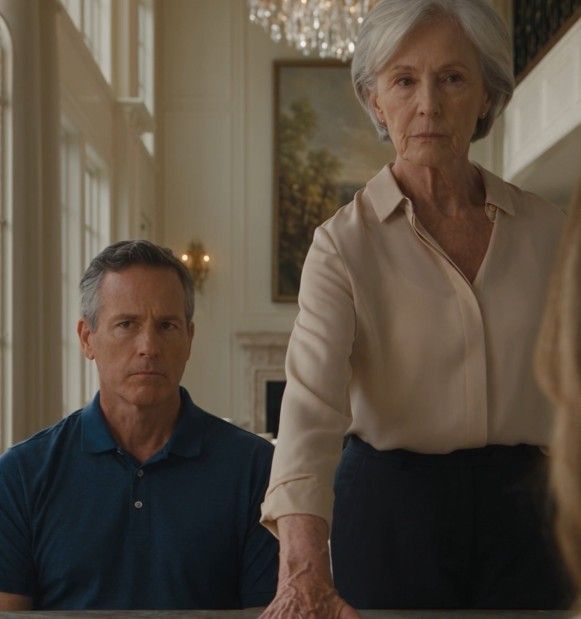
“I live in the east wing,” I said. “Two bedrooms. The other five house four women right now. Eleanor is in the room at the end of the hall. She hasn’t paid rent in two years. She cooks with me at five every morning.”
My son looked stricken, then something else broke across his face. Relief and shame tangled together.
“And this,” I said, sliding the final document toward them, “is what my son went pale about before I even opened the folder.”
It was a bank trust statement. Hayes Children’s Education Trust. Beneficiaries: Lily Hayes and Michael Hayes. Principal: $310,000. Funded over five years from quarterly dividends. Trustee: Margaret L. Hayes until age 25, then self-directed. Clause 9B: *No parent or guardian may withdraw, borrow against, or direct the use of principal or interest. Funds payable directly to educational institutions.*
My daughter-in-law’s hand froze mid-air.
My son made a sound he didn’t mean to make, a choked exhale that could have been a sob.
“You…” he said. He pressed his fingertips to his eyes. “You did this? All this time?”
“I got the first statement the month Lily started kindergarten,” I said. “I couldn’t be at her recitals. I couldn’t bring her soup when she was sick. But I could make sure that no matter what happened with the adults, she would never be left on a porch with two suitcases and no options.”
My daughter-in-law stared at the number. The calculation in her eyes had changed. It was no longer about bedrooms. It was about access. She could see the money and understand, with a sinking clarity, that she could not touch it.
“This is… very controlling,” she said, her voice thin and mean. “You set up secret accounts for our children behind our backs. You alienated—”
“I didn’t alienate anyone,” I said. “You intercepted their mail.”
She stood up.
The movement was abrupt, her handbag knocking against the coffee table, making the folder jump. The chandelier light caught the glass on the table and threw a sharp prism across her face.
“You ungrateful—” she started toward me, then caught herself, turning instead on my son. “Are you going to sit there and let her paint me as the villain? I kept this family together! I kept a roof over our heads while you drifted! You never had a backbone then and you don’t now!”
My son stood too, but slowly. He set the envelopes down with infinite care, as if they were made of ash.
“Stop,” he said.
It was the first time in twelve years I had heard him tell her to stop.
She stared at him, stunned.
“Don’t tell me to—”
“Stop,” he said again, louder, and his voice cracked. “Just stop talking for one minute.”
The silence that followed was brutal.
He turned to me. His face was red, his eyes wet.
“Mom,” he said. “Is it true? The letters? The money? You really did that alone?”
“I wasn’t alone,” I said. “Eleanor took me in. Then Mrs. Chen at the library let me use the computer after hours. Then Jamal, my first employee, lent me his truck. Then twenty-three people showed up because they believed a sixty-year-old widow with a soup pot knew what she was doing.”
He nodded, tears now spilling freely, not wiping them.
“I carried your box,” he whispered. “I carried it to the porch. I locked the door. I did that.”
“I know,” I said.
“I told myself you would be okay. That you were strong. That she was right about the kids needing boundaries. I told myself that click was just a lock. It wasn’t. It was me choosing.”
My daughter-in-law let out a short, harsh laugh. “Oh, wonderful. A confession. Is this what you wanted, Margaret? To humiliate us? To watch him crawl?”
I looked at her, and for the first time I felt not anger, but pity.
“No,” I said. “I wanted to see if you had changed.”
She blinked.
“If you had come and said, ‘We were wrong and we are sorry and we have no expectations,’ I would have made soup for you,” I said. “But you counted bedrooms.”
Her lip trembled with fury, not remorse.
“You’ll regret this,” she said. Her voice dropped, vicious and low. “When those kids realize you bribed them with college money to hate their mother—”
“They don’t hate you,” I said. “They don’t even know about the money yet. But they will. And they will also know their letters were returned.”
She grabbed her handbag.
“Come on,” she snapped at my son. “We’re leaving. She wants to play saint with her charity house, let her rot in it.”
My son didn’t move.
“David,” she said, sharper.
He stayed where he was, his hands at his sides, looking at the envelopes, at the trust papers, at me.
“No,” he said.
The word landed like that lock clicking in reverse.
“What did you say?”
“I said no,” he said, and this time he looked at her directly. “I am not leaving with you like that again. Not this time.”
Her face twisted. “You are choosing her? After everything I’ve done for you?”
“I am choosing not to carry another box for you,” he said.
For a second I thought she would scream. Instead, she did something smaller and more revealing. She looked around the beautiful living room one last time, at the chandelier, at the marble, at the life she had tried to step into, and realized it was never going to be hers.
“You’ll hear from my lawyer,” she whispered to me, but there was no power left in it.
“My lawyer is on the foundation board,” I said gently. “He helped me write that deed restriction specifically because I knew someone might say that.”
