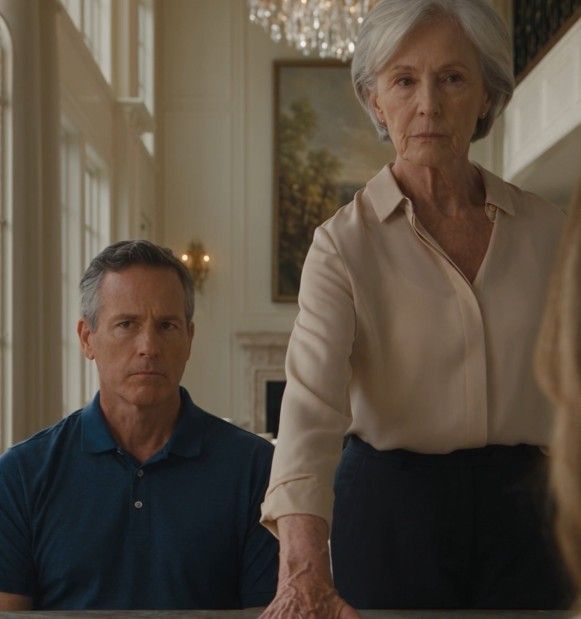
That made her pause.
My son finally swallowed. “Mom,” he said, his voice hoarse. “What’s in the folder?”
I lifted my hand.
I opened it.
The first page was not a legal threat. It was a photocopy of a bank receipt, faded, dated twelve years ago April 14th. Balance: $847.22. Under it, in my own handwriting from that morning, a list: rent room – 400, bus pass – 60, food – 100. At the bottom, underlined: Keep going.
My daughter-in-law leaned forward, frowned. “What is this? Some kind of… nostalgia trip?”
My son didn’t answer. He was staring at the receipt as if he had been struck.
“You left me with eight hundred and forty-seven dollars,” I said, not unkindly. Just clearly. “I kept the receipt because I needed to remember exactly where I started.”
I turned the page.
The second sheet was the letter she had typed and slid under my bedroom door the night before they locked me out. I had kept it folded in my purse for three years before I framed it in plastic.
Paragraph three was highlighted in yellow.
*Being their grandmother doesn’t mean you get to interfere. For the health of our marriage and the children, we need you to find other accommodations by Sunday.*
“You undermined us,” my daughter-in-law said quickly, defensively. “You were always—”
“Were you going to say interfering?” I asked.
She closed her mouth.
My son flinched as if the words themselves had hit him.
I turned the page again.
The next sheet was a business license. Margaret L. Hayes – Hayes Provisions LLC. Issue date: November 3rd, seven months after the porch. Registered address: Eleanor Finch’s spare room, 14B Maple Lane. Initial capital: $412.
“I started with soup,” I said. “Eleanor let me use her kitchen after midnight. I made forty quarts a week and sold them to nurses at the hospital where I used to clean floors. Your father always said small margins mattered when you understood volume. He was right.”
My daughter-in-law’s eyes narrowed. She was losing patience. “Margaret, this is very… inspiring. But we came because we want to be a family again. The kids—”
“The kids wrote to me,” I said.
The room went absolutely silent.
I slid the next pages across the coffee table, not toward her, toward my son.
They were envelopes. Six of them. Crayon-colored, lined school paper folded inside. Each one stamped RETURN TO SENDER – NO FORWARDING ADDRESS. Each one addressed in a child’s hand.
*To Grandma Hayes. I miss you. When are you coming for my birthday? – Lily, age 7.*
*Grandma, did we do something wrong? – Michael, age 9.*
*Dear Grandma, Mom said you moved far away and don’t want to see us. Is that true? Love, Lily.*
The dates ran across three years. The addresses were all to the house where I had raised my son, the house they had told me was no longer mine to receive mail at.
My son’s hand shook when he picked one up. He stared at the looping letters he would know anywhere.
“Lily,” he whispered. “This is Lily’s writing. From second grade.”
His wife went rigid.
“Where did you get these?” she snapped at me, her voice suddenly sharp and much less polished. “You had no right to—”
“I didn’t keep them,” I said. “Eleanor’s nephew works at the post office. When I finally had a stable address, I asked him to check if anything had been sent to the old house under my name. These were in a dead-letter bin. Unopened.”
My son looked up at his wife. Slowly. As if seeing her from a great distance for the first time.
“You told me she didn’t want to hear from us,” he said. His voice was barely audible. “You told me you mailed the cards and she never replied. You told me… you told me Mom chose to disappear.”
Her face flushed. “Don’t do this. Don’t you dare do this in front of her. I was protecting the children from instability. She was homeless! What was I supposed to tell them? That their grandmother was living in someone’s spare room making soup?”
“You told our children their grandmother didn’t love them,” he said.
He wasn’t yelling. That made it worse. His shoulders caved inward, and he held the little envelope like it might dissolve.
“I protected this family,” she hissed. “Someone had to make hard decisions while you stood around feeling guilty!”
I let the silence hang long enough that the hallway clock ticked five times.
Then I turned to the next section of the folder.
“This is what you really asked about,” I said.
It was a property valuation and a trust deed. Milbrook Heights Estate – Market Value $2.4M. Beneath it, the articles of incorporation for The Hayes Foundation, and a deed restriction.
My daughter-in-law lunged. Not physically, but her whole body tilted forward, her eyes locking onto the numbers. Her hand reached before her manners could stop it.
“This is… this is a charitable foundation?” she said, confused, then quickly recovering. “Well. If you’re planning to donate, you should have family counsel. I have a background in administration. I could help manage—”
“You could not,” I said. Still quietly.
I turned the page so she could see the restriction, the words I had paid a very good attorney to make ironclad.
*The Milbrook Heights property and all adjoining acreage shall be held in perpetuity as transitional housing and community kitchen for elderly women without family support. No part of the estate, its equity, or its operations may be transferred, sold, or encumbered for private family benefit. Board oversight required for all disbursements.*
Her mouth opened. Closed.
“You bought a mansion… to give it away?” she said, incredulous, almost laughing. “That’s… Margaret, that’s insane. You live here!”
