That summer, Daniel asked if he could visit with the children for a long weekend. He gave me two possible dates, told me which flight he planned to book, and waited for my answer. I chose the second weekend because the first was already full. He said, “Okay, we’ll come then,” without asking what I had scheduled or whether I could change it. The simple exchange felt almost unfamiliar.
Before they arrived, I made up the guest beds but did not stock the pantry with every cereal the grandchildren might like. I bought what I wanted for breakfast and asked them to bring anything special. When Daniel noticed, he started to apologize. I told him it was fine. Planning together meant neither of us had to guess.
The children helped me water the tomato plants. The youngest wanted to pour the whole can into one pot, and I showed him how to spread the water around the roots. Daniel watched us from the porch. Later, when the children were playing inside, he asked if I was still angry.
“I am still hurt,” I said. “Those aren’t the same thing.”
He nodded. He said the house project had become stressful and that he had seen my account as an easy bridge until his next paycheck. He admitted he had known he was not supposed to use my credentials. I told him that fear and stress could explain a choice without making it acceptable.
He asked what he could do now. I said he could start by following the repayment schedule and by never making a financial decision in my name again. I also asked him to call when he wanted to talk, not only when he needed money. He said he would try. I did not promise that trying would be enough, but I let him stay for the weekend.
On the last morning, he asked whether I wanted him to drive me to the nursery. I did, so I said yes. We bought more seedlings and loaded them into the car. The children chose two varieties, and Daniel carried the tray without turning the errand into a favor I owed him for. At the nursery entrance, he handed me the receipt and said, “You can pay me back if you want.”
I laughed. “I bought the plants.”
He looked embarrassed, then laughed too. The moment was small, but it showed how quickly our old habits could return: he still expected that every exchange had to be settled by money. I tucked the receipt into my purse and told him we would learn a different way to be family. The conversation did not fix us, but it gave us practice.
In June, I found a small wooden box in Thomas’s desk while sorting old tax papers. Inside were seed packets, a receipt from the nursery, and a folded note addressed to me. His handwriting had started to shake by then, but the words were clear: Marion, when the children have flown home, plant the tomatoes anyway. You never needed a full table to make a garden grow.
I read it in the quiet of the kitchen. The note was not proof that Thomas had predicted the birthday or the hurt. It was simply his way of reminding me that my life did not begin and end at the table I set for other people.
Ellen helped me clear a sunny patch beside the garage. My hands were unsteady the first morning I pushed the seedlings into the soil. I put in six plants, watered them, and marked the row with the old labels from the seed packets. One of the plants leaned badly. I tied it to a thin stake and watched it lift.
I turned seventy-one the following April. I did not set eleven places. I invited the children for the Saturday they could actually attend, and I asked them to confirm travel before I planned the meal. Daniel came with his wife and children. Marcus came with Sandra and her mother. Patrice arrived the night before. No one was asked to pay for anything, and I did not give anyone money.
We ate outdoors beneath the new leaves. The tomato plants had grown taller than the fence, and the first red fruit sat in a bowl beside the bread. Each child had brought something small: a pie, a jar of olives, a stack of paper napkins. The gifts were ordinary, but they had been offered without a request attached.
After dinner, Daniel handed me an envelope. “This is the first repayment,” he said. He had transferred the amount he owed from the unauthorized withdrawal into a savings account I controlled, and he had brought the bank confirmation. I thanked him. I did not make a speech about trust being restored. The repayment was a fact, and trust would be built by what happened afterward.
When the grandchildren began to clear the table, I asked them to leave the dishes. We went to the garden instead. The youngest held a tomato, warm from the sun, and asked whether it came from Grandpa’s seeds.
“Some of them did,” I said. “And some came from new plants.”
“Which one is better?”
I looked at my children standing together near the garage, each of them waiting to see what I would say. “The one we take care of,” I answered.
The sentence was about the garden, but all of us heard the rest inside it. Love could survive a missed birthday and a damaged trust, but it would need care from every person. It could not be funded by one woman quietly filling every empty place.
That evening, after the family left, I put Thomas’s unfinished library book beside my chair. I had finally checked it out under his name at the library. A bookmark still marked the page where he had stopped, twenty pages from the end. I read those pages slowly, then closed the cover and set it on the table.
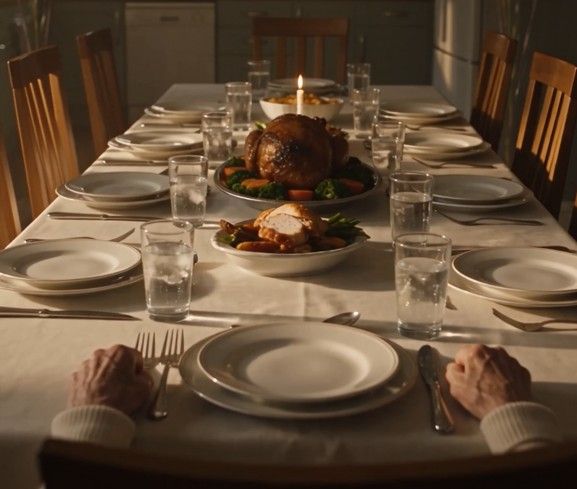
The next morning, I carried the book outside and read beneath the tomato vines. The sun warmed my hands. A ripe tomato rested on the windowsill, and the chair across from me was empty by choice, not abandonment. I thought of the eleven glasses, the melted ice, and the unanswered calls. Then I thought of the people who had come back and the boundaries that made their return honest.
I did not need a crowded table to prove I was loved. I needed to live as though my own presence counted, even when nobody else was watching. So I planted another row, made myself lunch, and saved the best tomato for later. This time, I did not wait for anyone to notice I was hungry.
